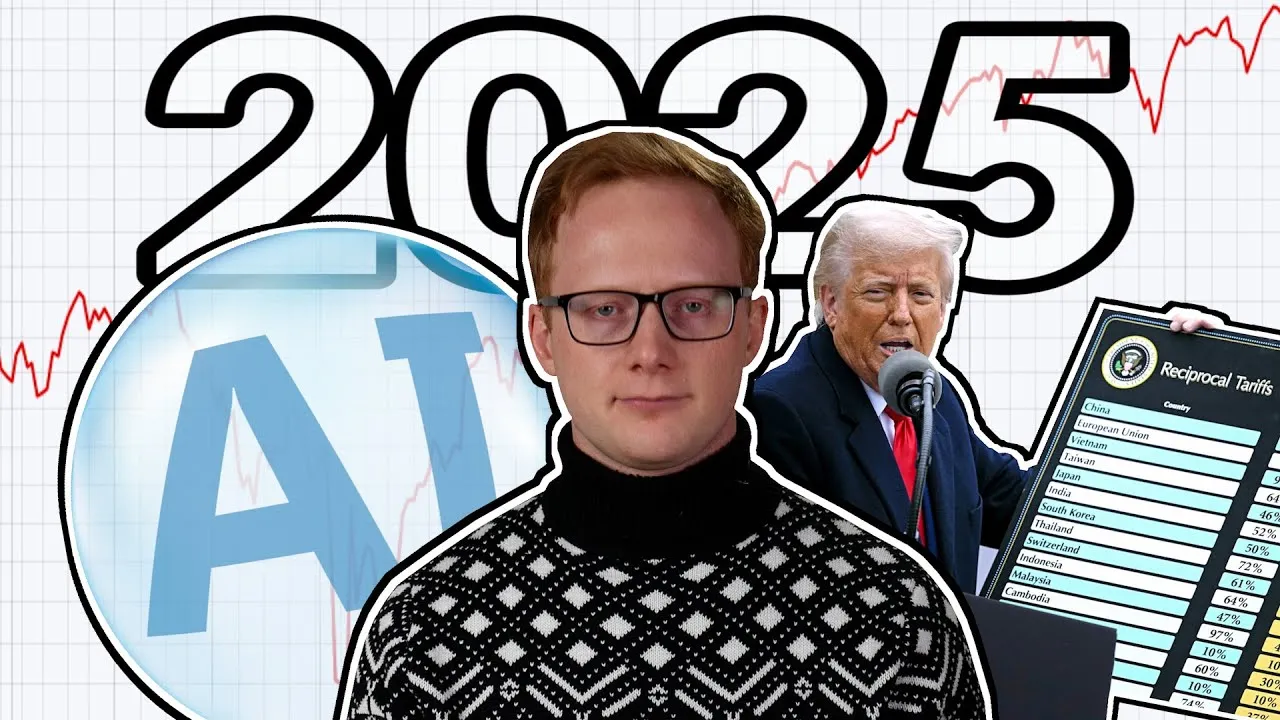
2025: A Tumultuous Year of Policy Shifts, Market Volatility, and Technological Leaps
As the calendar turned to 2025, the financial world braced for impact, and the year delivered a whirlwind of policy decisions, market fluctuations, and emerging technologies that will shape economic landscapes for years to come. From the controversial launch of a presidential memecoin to a dramatic escalation in trade wars and the unprecedented rise of artificial intelligence, 2025 proved to be a year where established norms were challenged and new frontiers were explored.
Presidential Policies and Market Shocks
The year kicked off with a bang on January 17th, as Donald Trump launched Trumpcoin, a Solana-based memecoin. The cryptocurrency experienced a meteoric rise, surging from just over $1 to nearly $75 in a few days before correcting. This event, occurring just days before Trump’s inauguration, was seen by some as a harbinger of crypto-friendly policies from the new administration, while others raised concerns about potential conflicts of interest. The president later addressed these concerns by offering an exclusive dinner to top holders.
January 18th saw a brief but significant disruption as TikTok was temporarily banned in the United States. The ban, enacted due to concerns over Chinese data surveillance, was a complex issue that saw multiple delays throughout the year, highlighting the delicate balance between national security and the economic reliance on social media platforms. A deal for ByteDance, TikTok’s parent company, to find a US owner was eventually reached in December with an investor group backed by Oracle and MGX.
Inaugurated on January 20th, President Trump immediately embarked on a prolific executive order agenda. Among the notable actions were attempts to end birthright citizenship, weaken regulatory bodies like the SEC and FTC, and dismantle DEI programs across government and corporations. The administration also focused on immigration enforcement and reduced the scope of agencies like USAID and the Department of Education. A more unusual initiative was the establishment of the Department of Government Efficiency (DOGE), headed by Elon Musk, aimed at cutting government spending. However, reports suggested that this initiative, relying on inexperienced staff, led to exaggerated savings figures and a slight increase in overall government spending, ultimately leading to the group’s disbandment in November.
The Trade War Escalates and Recedes
February 1st marked the beginning of a tumultuous year for international trade as President Trump imposed a 10% tariff on Chinese goods and a 25% tariff on Canadian and Mexican goods. These tariffs, initially delayed for North American partners, went into effect in March, citing issues like fentanyl and illegal immigration. The levies were soon followed by sector-specific tariffs on auto parts, steel, aluminum, copper, lumber, and furniture, prompting retaliatory measures from Canada and China.
April 2nd, dubbed “Liberation Day,” saw the introduction of a 10% baseline tariff on all imports, with higher country-specific tariffs calculated based on trade balances. This move caused markets to drop 12% in a single week. While these punitive tariffs were temporarily postponed to allow for negotiations, leading to agreements with the UK, Japan, and the EU, higher tariffs remained for most other nations.
The situation rapidly escalated. On April 4th, China responded with a 34% tariff on US goods and export restrictions on rare earth metals. The ensuing trade war saw tit-for-tat tariff hikes, with the US reaching 145% and China 125% at one point. However, by May 12th, both countries agreed to a 10% baseline tariff, and by November 4th, they announced a further easing of trade restrictions. This period underscored the volatile nature of global trade policy under the new administration.
Leadership Changes and Regulatory Shifts
April 28th brought a significant political development in Canada with the election of Mark Carney as Prime Minister. The former central banker adopted a centrist approach, focusing on nation-building projects while cutting the consumer carbon tax and tightening immigration. Despite trade tensions with the US, Canada found itself in an advantageous position due to a free trade agreement exemption that kept 85% of its goods tariff-free. However, the upcoming review of this agreement in 2026 presents ongoing challenges.
A legendary figure in the investment world, Warren Buffett, announced his retirement as CEO of Berkshire Hathaway on May 3rd, after over 60 years at the helm. Buffett transformed the company from a failing textile manufacturer into a global conglomerate worth over $1 trillion. Greg Abel was named his successor, though Berkshire Hathaway’s stock experienced a dip on the news amid concerns about replicating Buffett’s unparalleled leadership.
July 4th saw the signing of the “One Big Beautiful Bill,” which enacted trillions in tax breaks and spending cuts, notably impacting social aid programs like SNAP and Medicaid. While projected to save $1.1 trillion and boost GDP by 2 percentage points, the bill was also expected to increase the government deficit by $3 to $4 trillion over the next decade due to lower revenue and increased spending on areas like ICE operations and missile defense. A proposed “revenge tax” on foreign investors was ultimately removed.
July 18th, during “Crypto Week,” the United States passed the “Genius Act,” the first major national legislation for cryptocurrencies. This law established a regulatory framework for stablecoins, defining them as neither securities nor commodities and shifting oversight away from the SEC and CFTC. Other proposed crypto legislation, the Clarity Act and Anti-CBDC Act, did not pass.
The AI Revolution and Market Valuations
August 22nd, Federal Reserve Chair Jerome Powell, facing criticism and even an attempted firing from the President, announced a return to flexible inflation targeting and a balanced approach to the dual mandate at the Jackson Hole Symposium. Following this speech, the Fed cut rates three times and ended its quantitative tightening program by December 1st, signaling a shift towards loosening policy amid a weakening labor market.
A monumental investment in the burgeoning field of artificial intelligence occurred on September 22nd, when Nvidia announced a $100 billion investment in OpenAI. This deal, seen by some as circular, involved OpenAI utilizing Nvidia chips for its data centers in exchange for filling them. The move intensified concerns about an “AI bubble,” characterized by massive infrastructure buildouts, high valuations for unprofitable companies, and enormous partnerships. OpenAI, despite significant revenue shortfalls compared to its planned spending, continued to advance its technologies like Sora and ChatGPT.
The AI fervor propelled Nvidia to become the first company to reach a $5 trillion valuation in October. The government also participated, investing in Intel. This period highlighted the concentrated power within the tech sector, with just ten companies now making up roughly 40% of the S&P 500 index.
Economic Headwinds and Asset Mania
October 1st marked the beginning of the longest government shutdown in US history, lasting 43 days, due to a stalemate in the Senate over appropriations legislation. This disruption delayed key economic data releases, including CPI and labor figures for October. The shutdown ended on November 12th, but the expiration of Affordable Care Act subsidies remained a contentious issue.
The cryptocurrency market saw significant volatility. On October 6th, Bitcoin reached an all-time high of over $126,000, a 30% increase for the year. However, it corrected downwards to end the year in the mid-single-digit percentage range. Despite political endorsements, the establishment of a US Bitcoin Strategic Reserve, and the rise of Bitcoin Treasury companies, the cryptocurrency’s performance reflected lower market liquidity and a shift in investor perception, behaving more like a volatile tech stock than a safe haven asset.
In a sign of increasing integration between traditional finance and digital assets, ICE Inc., owner of the New York Stock Exchange, invested $2 billion in Poly Market, a crypto-based betting platform. This move, alongside similar integrations by Robinhood and Coinbase, signals the growing prominence of prediction markets within the financial ecosystem, blurring the lines between investment and speculation.
October 28th saw the launch of pre-orders for Neo, a consumer-ready humanoid robot from startup 1X, aiming to automate menial tasks. This development presented a challenge to established players like Elon Musk, who was already engaged in a public dispute with Sam Altman over AI ethics and whose Optimus robot was potentially being outpaced.
December 19th, the Bank of Japan surprised markets by raising its target rate to 75%, the highest since 1995. This move occurred amidst record high yields for Japanese government bonds and aimed to combat rising inflation and stimulate lagging GDP growth. The hike raised concerns about a potential unwinding of the Japanese carry trade, which had previously led to significant asset sell-offs.
The year concluded with a remarkable surge in precious metals. On December 21st, gold reached a new record price of over $4,500 per troy ounce, up over 70% year-to-date, driven by central bank accumulation and retail investor demand. Silver also hit an all-time high, rising over 100%. While some attributed this rally to concerns about the US dollar’s debasement, others pointed to investor FOMO, a departure from gold’s traditional role as a safe haven asset.
Looking Ahead to 2026
As 2025 drew to a close, the economic outlook for 2026 appeared bifurcated. Optimism stemmed from continued US economic growth, a strong stock market performance driven by big tech, and the rapid advancements in AI, which promised to revolutionize various aspects of life and work. However, significant uncertainties loomed. Concerns persisted about the sustainability of the AI-driven economic boom, potential inflationary pressures, and the impact of a new, Trump-appointed Federal Reserve chair. Geopolitical tensions, trade disputes, and the ongoing adjustments to US tariff policies added further layers of complexity. The trajectory of prediction markets and the continued evolution of the AI bubble are expected to be major investment themes, though the unpredictable nature of the current political climate suggests that market dynamics could shift rapidly.
This article is based on the “What A Year…” transcript from The Plane Bagel.
Source: What A Year… (YouTube)