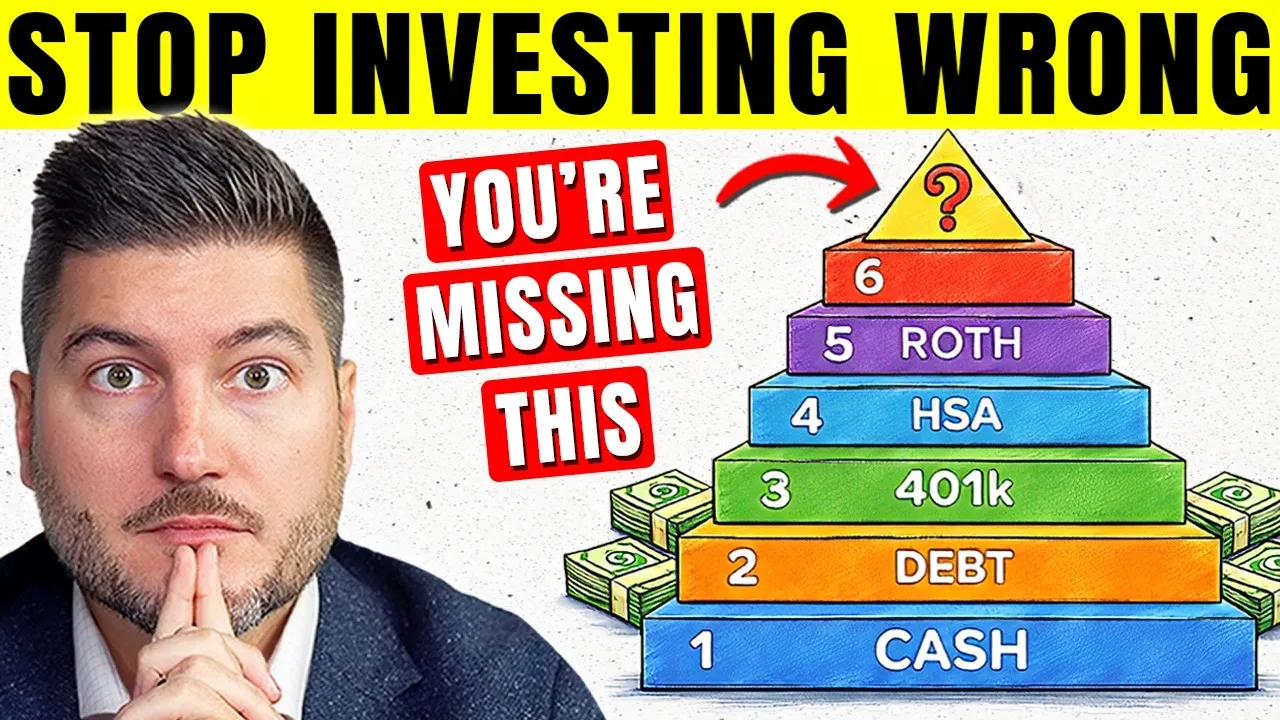
Most Americans Botch Their Savings Strategy
Many people think investing is all about picking the hottest stocks or timing the market. But experts say the order in which you save and invest your money is far more important. Getting this sequence right can mean tens of thousands of dollars more over your lifetime, without ever needing a lucky stock pick. Most people skip the crucial first steps, focusing on complex strategies before building a solid foundation.
Step 1: Build Your Safety Net First
Before thinking about Bitcoin or index funds, you need an emergency fund. One in three Americans has no emergency savings at all. For those who do, the average amount is only $500, down from $600 last year. This tiny cushion isn’t enough for real emergencies.
An emergency fund is more than just cash for a broken car or furnace. It’s a psychological safety net. Without it, a sudden expense can force you to sell investments at a loss, often when the market is already down. This can lead to a chain reaction of bad financial decisions.
A study by Vanguard showed that people with just $2,000 in emergency savings had 21% higher financial well-being scores. This boost was bigger than having a high income or a large investment portfolio. It highlights the immense psychological power of having a safety cushion.
Here’s how to build it:
- Start with a small, achievable goal: Get to $1,000 as quickly as possible. This covers minor issues and boosts your confidence.
- Next, aim for one month of living expenses.
- Finally, build up to three to six months of essential living expenses. Keep this money in a high-yield savings account or similar place where it’s safe and earns a little interest, but is easily accessible.
This money isn’t for investing; it’s for protection. While inflation erodes cash value, this fund is your shield against costly mistakes.
Step 2: Eliminate High-Interest Debt
The average credit card interest rate is over 22%. Warren Buffett’s long-term average return from Berkshire Hathaway is about 20%. If you’re paying high interest on debt while investing, you’re likely losing money. Paying off this debt is one of the few guaranteed returns available to investors.
For example, $5,000 in credit card debt at 22% interest can cost nearly $2,800 in interest over five years if you only make minimum payments. Every dollar paid toward this debt is like earning a guaranteed 22% return, tax-free. No index fund can consistently promise that.
The Rule: Any debt with an annual interest rate above roughly 8% should be paid off before you invest heavily. The most efficient method is the ‘debt avalanche’: list all debts, pay minimums on all but the one with the highest interest rate, and throw all extra money at that one until it’s gone. The ‘debt snowball’ (paying off smallest balances first) can also work if it keeps you motivated.
The Exception: The Employer Match
There’s one crucial exception to paying off debt first. If your employer offers matching contributions to your retirement account (like a 401k), you must capture that ‘free money’ before doing almost anything else. A typical match might be 50 cents for every dollar you contribute, up to 6% of your salary. If you make $50,000 and contribute $3,000 (6%), your employer adds $1,500. That’s an immediate 50% return on your money.
This guaranteed 50% (or sometimes even 100%) return beats any credit card interest rate. Not taking the match is a costly mistake. Before accepting it, check your company’s ‘vesting schedule,’ which determines when the employer’s money is truly yours. Even with vesting, the match is usually worth it. Contribute enough to get the full match, then redirect extra funds to high-interest debt. Once debt-free, increase your retirement contributions.
Step 3: Prioritize Tax-Advantaged Accounts
Once you’ve secured the employer match and are making progress on debt, turn to your Individual Retirement Account (IRA). This comes before maximizing your 401k contributions.
IRAs Offer Control: Unlike many 401k plans with limited, high-fee fund options (1-2% annual fees can cost tens of thousands over time), IRAs give you complete control. You can choose low-cost index funds. For 2025, the contribution limit is $7,000 for those under 50 and $8,000 for those 50 and older.
Traditional vs. Roth IRA:
- Traditional IRA: You get a tax deduction now; you pay taxes on withdrawals in retirement.
- Roth IRA: You pay taxes now; withdrawals in retirement are tax-free.
If you’re early in your career and in a lower tax bracket, a Roth IRA is often better, as you pay taxes at a lower rate now. If you’re in your peak earning years, a traditional IRA’s upfront deduction might be more valuable. You can also split contributions between both for tax flexibility.
The HSA Advantage
The Health Savings Account (HSA) is arguably the most powerful investment account available, yet many overlook it. HSAs offer a triple tax advantage: contributions are tax-deductible, money grows tax-free, and withdrawals for qualified medical expenses are tax-free.
For 2025, you can contribute up to $4,300 for individual coverage or $8,550 for families. The catch is you must be enrolled in a high-deductible health plan (HDHP). If you’re relatively young and healthy, this account is a ‘monster’.
Smart HSA Strategy: Pay current medical bills out-of-pocket and let your HSA money grow invested in the market. You can keep receipts indefinitely and reimburse yourself tax-free years later. After age 65, HSA funds can be withdrawn for any reason, taxed as ordinary income (like a traditional IRA). Given that healthcare costs in retirement can exceed $300,000, having a tax-free stash for medical needs is a significant advantage.
Maxing out an HSA for 30 years at a 7% annual return could yield over $400,000 in tax-free money.
Maxing Out Retirement and Taxable Accounts
After securing the employer match, maxing your IRA, and funding your HSA, return to your 401k. For 2025, the contribution limit is $23,500 for those under 50 and $31,000 for those 50+. Combined, these accounts can shelter nearly $35,000 annually from taxes.
Only after filling these tax-advantaged buckets should you consider a taxable brokerage account. These accounts offer flexibility, no contribution limits, and no withdrawal restrictions. They are ideal for goals like a down payment or bridging the gap for early retirement.
However, taxable accounts come with a ‘tax drag.’ Investing $10,000 annually for 30 years at 7% in a tax-advantaged account could result in about $944,000. The same investment in a taxable account might yield closer to $700,000 after taxes on dividends and capital gains, a difference of $244,000.
The Wealth-Building Sequence
The optimal order for building wealth is:
- Emergency Fund (start with $1,000, build to 3-6 months of expenses).
- Pay off high-interest debt (above 8% interest).
- Contribute enough to get your full employer 401k match.
- Max out your IRA (Traditional or Roth).
- Max out your HSA (if eligible).
- Max out your 401k.
- Invest in taxable brokerage accounts.
Following this sequence diligently, especially in your 20s and 30s when compounding works hardest, puts you ahead of most people. True financial freedom comes not from finding secret investments, but from consistent, disciplined execution of the fundamentals.
Source: The Exact Order To Invest Your Money (Most People Get This Wrong) (YouTube)