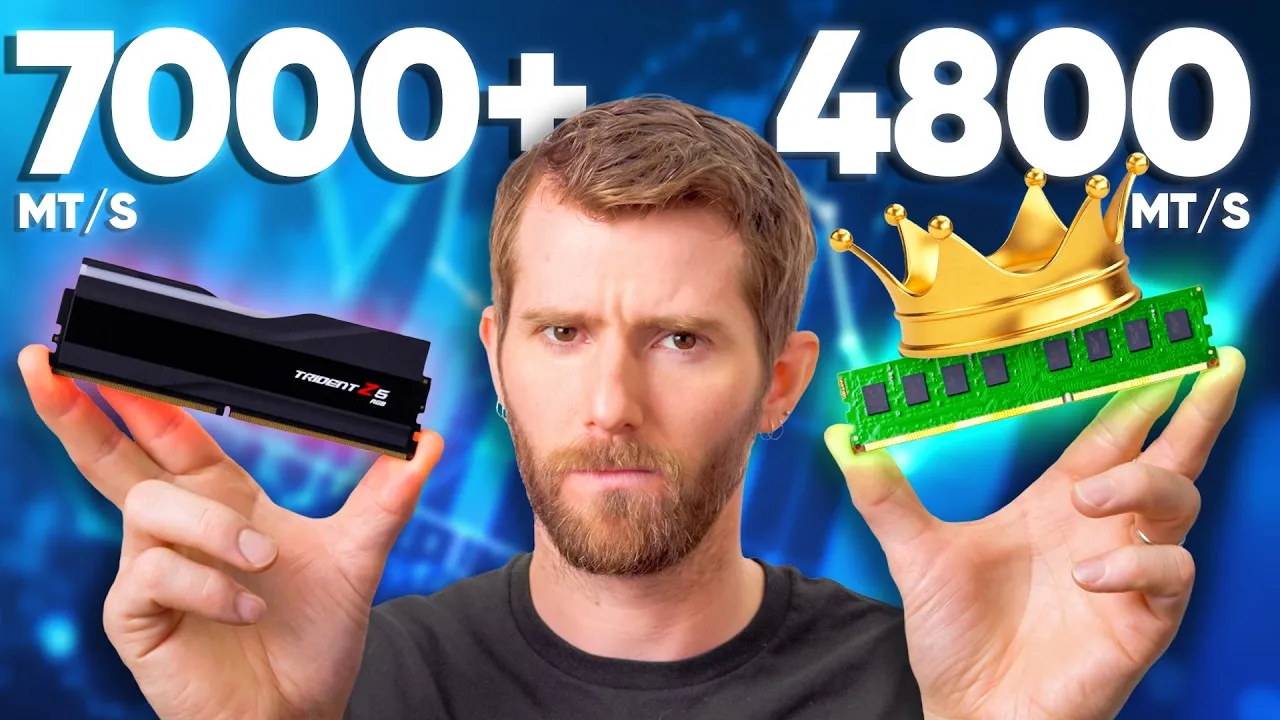
High-Speed RAM Scrutinized: Are Gamers Overspending on Memory?
The current RAM market is a minefield for consumers, with prices soaring to dizzying heights. For gamers and professionals alike, the question of whether to splurge on the fastest DDR5 kits or opt for more budget-friendly options has become critically important. New extensive testing suggests that for a significant segment of users, particularly those with AMD’s popular X3D gaming processors, the need for bleeding-edge RAM speeds might be overstated, potentially saving wallets from further pain.
Testing the Limits: DDR5 Performance Under the Microscope
In a comprehensive series of tests, four different CPUs were benchmarked across eight distinct DDR5 speeds, ranging from a modest 4,800 MT/s up to high-speed, overclocked kits. The findings reveal a nuanced picture: while some CPUs genuinely benefit from faster memory, the performance gains for many gaming scenarios, especially at higher resolutions, are surprisingly marginal.
Intel’s Raptor Lake and Meteor Lake: A Mixed Bag
For Intel’s platform, the story is less clear-cut. The 14900K, a last-generation representative, showed a noticeable preference for faster DDR5, with kits like 8,400 MT/s CL40 offering tangible benefits in specific titles such as Ashes of the Benchmark, Cyberpunk 2077, and Red Dead Redemption 2 at 1080p. However, even here, the performance drop-off when using slower kits wasn’t catastrophic, provided users avoided the absolute slowest options.
Intel’s newer Core Ultra 285K, on the other hand, struggled with the fastest RAM kits, and for most users on current-gen Intel chips, anything faster than JEDEC speeds appears to be largely unnecessary. Crucially, when examining 1% low frame rates, the difference across all tested games and resolutions was minimal, often within a handful of FPS – a difference imperceptible to the naked eye, especially at higher resolutions and detail settings.
The context of these findings is crucial. Previously, a small price difference for a few percent performance gain was an easy recommendation. However, with the current market, the price disparity for high-speed kits can run into hundreds of dollars, drastically altering the cost-benefit analysis.
Productivity on Intel: Where Speed Matters More
While gaming performance showed diminishing returns with extreme RAM speeds on Intel, productivity tasks presented a different narrative. The GDAU compile test, for instance, demonstrated a significant improvement with faster memory on the 14900K. This suggests that for users whose machines are primary workhorses for tasks like code compilation or other demanding professional applications, investing in higher-speed, lower-latency DDR5 kits might still be a justifiable expense, even with current inflated prices.
AMD’s X3D CPUs: The True Beneficiaries of Value?
AMD’s popular X3D processors, particularly the Ryzen 9 7900X3D, lived up to their reputation for being less sensitive to RAM speed. While the slowest 4,800 MT/s kit did lag slightly, the sweet spot of 6,000 MT/s CL30 still offered the best overall performance. However, even with faster kits, the performance gap narrowed considerably, especially when ray tracing was enabled or resolutions were increased.
In many gaming scenarios, the difference between RAM kits was less impactful than factors like module capacity (16GB vs. 24GB). The 3D V-Cache technology appears to be a significant factor in mitigating the need for ultra-fast memory.
Productivity on AMD: Similar Trends
Similar to Intel, AMD’s non-X3D CPUs showed that while the slowest JEDEC kit was a bottleneck, performance gains beyond a certain point (often around 6,000 MT/s with tuned EXPO profiles) became less pronounced. While specific use cases might still benefit from faster memory, for the average user, the incremental gains may not justify the premium price tag.
Who Should Care and Why?
Budget Gamers: If you’re building a new gaming PC, especially with an AMD X3D CPU, you can likely save a considerable amount of money by opting for a good quality 6,000 MT/s CL30 DDR5 kit. The performance difference compared to much more expensive options will likely be negligible in most gaming scenarios.
Performance Enthusiasts (Intel): If you’re running a high-end Intel CPU and prioritize every single frame, particularly at lower resolutions (1080p), faster RAM might offer a small but measurable boost. However, weigh this against the significant price increase.
Content Creators & Professionals: For those using their PC for demanding productivity tasks, especially if they involve large datasets, compilation, or rendering, faster and higher-capacity RAM can still provide substantial benefits. Researching specific application benchmarks is recommended.
Availability and Pricing Concerns
The broad issue remains the inflated price of RAM across the board. While slower kits are now more palatable for gamers, they are still impacted by price hikes.
For professionals who genuinely need faster or more RAM, the current market presents a difficult upgrade path. The hope is for market stabilization, allowing consumers to make more informed and cost-effective decisions.
Specs & Key Features
- RAM Types Tested: DDR5
- Speeds Tested: Ranging from 4,800 MT/s to 8,400 MT/s CL40
- CPUs Tested: Intel 14900K, Intel Core Ultra 285K, AMD Ryzen 9 7900X3D, AMD Ryzen 9 9950X
- Key Benefit for AMD X3D: Reduced sensitivity to RAM speed, especially at higher resolutions.
- Key Benefit for Intel: Faster RAM shows more pronounced gains, particularly on older generations and in specific productivity tasks.
- Productivity Scenarios: GDAU compile tests showed notable improvements with faster RAM on Intel.
- Gaming Scenarios: Differences become minimal at higher resolutions (1440p, 4K) and with maxed-out settings, especially on AMD X3D.
The Verdict: Smart Spending in a Tough Market
For the vast majority of gamers, particularly those opting for AMD’s X3D processors, the financial outlay for ultra-high-speed DDR5 RAM is likely unnecessary. A well-balanced 6,000 MT/s CL30 kit often hits the sweet spot, offering excellent performance without breaking the bank.
Professionals with specific, RAM-intensive workloads may still find value in faster kits, but should carefully evaluate application-specific benchmarks. Until RAM prices normalize, consumers are advised to prioritize core components and opt for sensible memory configurations rather than chasing the highest speeds for diminishing returns.
Source: Stop WASTING Money on Fancy RAM (YouTube)