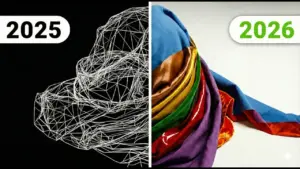
AI Revolutionizes Creative Workflows
Artificial intelligence is rapidly transforming the landscape of creative industries, moving beyond theoretical discussions to offer tangible tools that augment human creativity and streamline production processes. Recent advancements in AI models are empowering artists, writers, and developers with unprecedented capabilities, promising to democratize content creation and unlock new forms of expression.
The Rise of Generative AI
At the forefront of this revolution are generative AI models. These sophisticated systems, trained on vast datasets of text, images, and code, can now produce novel content that is often indistinguishable from human-created work.
Unlike previous AI iterations that focused on analysis or prediction, generative AI actively creates. This is made possible by complex architectures like transformers, which allow models to understand context and relationships within data, enabling them to generate coherent and contextually relevant outputs.
Consider the concept of parameters in AI. Larger models, with billions or even trillions of parameters, can capture more nuanced patterns and generate more sophisticated results.
For instance, models like OpenAI’s GPT series or Google’s LaMDA have demonstrated remarkable abilities in natural language processing, capable of writing essays, poems, and even code. Similarly, image generation models such as DALL-E 2 and Midjourney can create stunning visuals from simple text prompts, opening up new avenues for graphic design, illustration, and concept art.
Democratizing Content Creation
The accessibility of these AI tools is a significant factor in their widespread adoption. Many platforms are offering user-friendly interfaces and tiered pricing models, making advanced AI capabilities available to individuals and small businesses that previously lacked the resources for large-scale creative production. This democratization means that a budding indie game developer can now generate concept art or write dialogue, and a small marketing agency can produce a variety of visual assets without needing a large team of specialized artists or writers.
Augmenting Human Creativity
Rather than replacing human creators, these AI tools are largely being positioned as collaborators. They excel at tasks that are repetitive, time-consuming, or require exploring a vast number of possibilities. For writers, AI can assist with brainstorming plot points, generating character backstories, or overcoming writer’s block.
For artists, AI can generate variations of a design, create textures, or even provide a starting point for a complex illustration. This partnership allows human creators to focus on higher-level conceptualization, refinement, and the unique emotional and artistic nuances that only humans can provide.
Benchmarking Progress
The progress in AI capabilities is often measured through benchmarks, which are standardized tests designed to evaluate performance on specific tasks. While early AI benchmarks focused on tasks like image recognition or simple language translation, current benchmarks are increasingly evaluating generative capabilities, coherence, creativity, and factual accuracy. Comparing a new model’s performance on these benchmarks against established leaders provides a quantifiable measure of its advancement and potential.
Why This Matters
The implications of these AI advancements are far-reaching. For businesses, it means faster product development cycles, more personalized marketing content, and increased efficiency in content creation. For individuals, it offers new tools for self-expression, learning, and entrepreneurship.
The ability to generate high-quality content quickly and affordably can lower the barrier to entry for many creative pursuits, fostering innovation and diversity in the digital landscape. AI is poised to assist in fields beyond traditional media, such as scientific research, where it can help analyze complex data and generate hypotheses.
The Future of AI in Creativity
The trajectory of AI in creative fields is one of continuous evolution. As models become more sophisticated, we can expect to see even more seamless integration into existing workflows and the emergence of entirely new creative disciplines. The ethical considerations surrounding AI-generated content, such as copyright and authenticity, will also become increasingly important as these tools become more powerful and pervasive.
Companies like OpenAI, Google, and Stability AI are at the forefront, continually pushing the boundaries of what AI can achieve, with new models and features being announced regularly. Pricing structures vary, with many offering free tiers for basic usage and subscription models for advanced features and higher usage limits.
Source: The Dark Web isn't what you think (YouTube)