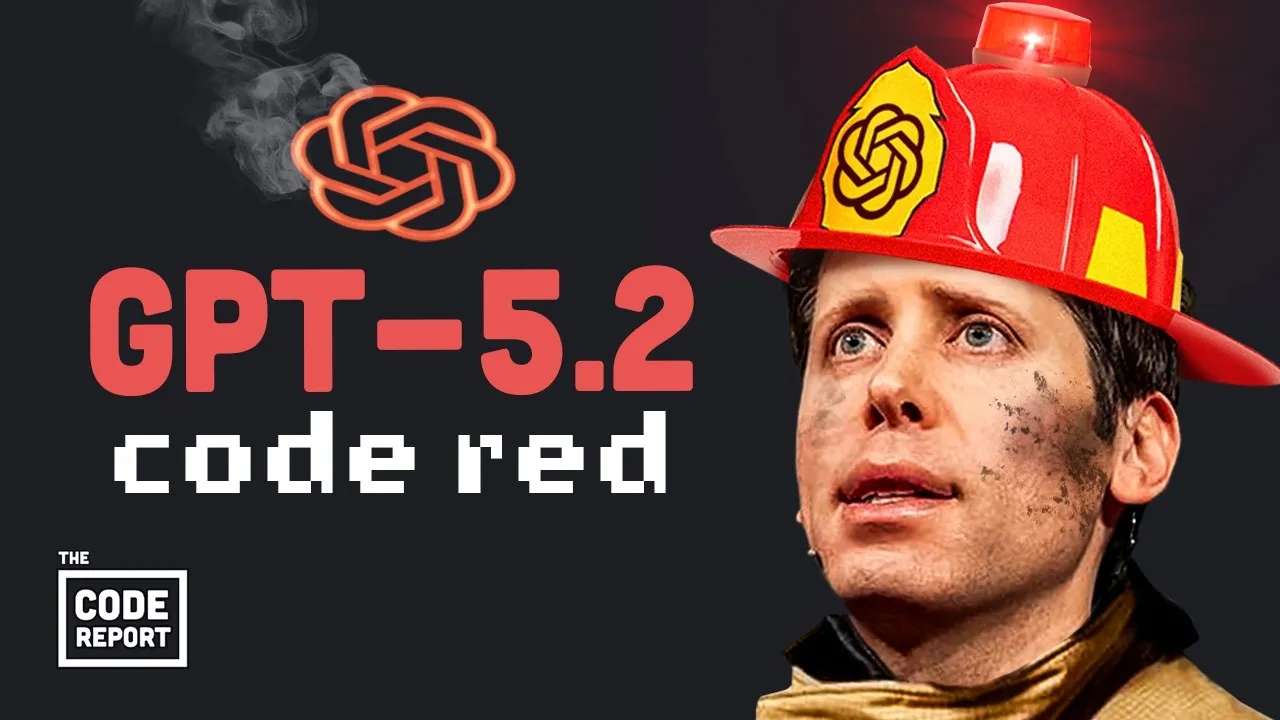
GPT-5.2 Reclaims AI Crown for OpenAI
In a dramatic turn of events that has sent ripples through the artificial intelligence community, OpenAI has seemingly regained its footing in the competitive AI landscape with the surprise release of GPT-5.2. This development comes on the heels of significant pressure from rivals, particularly Google’s Gemini, which had recently been perceived as outperforming OpenAI’s offerings.
OpenAI’s Strategic Response
Just days after OpenAI CEO Sam Altman reportedly declared a ‘code red’ threat level due to Google’s Gemini 3 dominance, the company unveiled GPT-5.2. This new model is already making waves, reportedly excelling in various benchmarks and even surpassing competitors like Claude Opus 4.5 in specific areas such as software engineering and reasoning.
ARC AGI Benchmark Breakthrough
A key indicator of GPT-5.2’s advancement is its performance on the Abstraction and Reasoning Corpus (ARC) benchmark. OpenAI claims a remarkable 390x efficiency improvement from its 03 model to the new 5.2 version within a year.
The ARC benchmark is designed to test an AI’s ability to solve novel, unique problems that require pure reasoning rather than memorization. Unlike many AI models that struggle with these intentionally abstract and low-data puzzles, a strong performance on ARC suggests a model’s capacity for generalization, a crucial step towards artificial general intelligence (AGI).
Understanding the ARC Benchmark
The Abstraction and Reasoning Corpus (ARC) is a critical evaluation tool in AI research. It presents AI models with a series of puzzles that are designed to be solvable by humans with minimal examples. The core challenge lies in the fact that these problems are not amenable to brute-force pattern matching or simple memorization.
Instead, they demand abstract thinking and reasoning capabilities. Many existing large language models (LLMs) have historically faltered when faced with ARC challenges, highlighting the difficulty in developing AI that can truly generalize its understanding beyond its training data.
Concerns and Commercial Deals
While the technical advancements of GPT-5.2 are a significant talking point, the broader implications of AI technology continue to spark debate. A recent example cited is a McDonald’s commercial that was reportedly pulled due to negative public reception, attributed to its AI-generated nature. OpenAI has reportedly entered into a $1 billion deal with Disney.
This partnership will allow Disney’s iconic characters to be integrated into AI-generated photos and videos, potentially enabling users to create custom content featuring beloved franchises like Star Wars or Toy Story, all powered by OpenAI’s technology. This development raises questions about intellectual property, creative control, and the future of media production.
Prediction Markets and Insider Trading
The accuracy of prediction markets, such as Polymarket and Kelsi, in forecasting GPT-5.2’s release date has also drawn attention. The transcript suggests a potential for insider trading within these markets, where individuals with foreknowledge might exploit this information for financial gain. The existence of such practices, even in a gray area, raises concerns about fairness and transparency in the AI industry.
User Experience and Developer Tools
For the average user, discerning the practical improvements in new LLM releases can be challenging. While GPT-5.2 is touted as being significantly better at coding and exhibiting fewer hallucinations, the subtle differences might be difficult to perceive in day-to-day use. For developers, however, the focus often shifts to reliable deployment and infrastructure management.
Platforms like Railway, a cloud service, offer solutions for instantly hosting production-ready deployments and managing infrastructure stacks. Railway aims to simplify the deployment process with one-click environment spin-ups, automatic scaling, and a pay-for-use model that can lead to significant cost savings compared to provisioned resources. They also boast faster build times and a wide array of templates for quick application and database deployment.
Why This Matters
The release of GPT-5.2, particularly its performance on the ARC benchmark, represents a potential leap forward in AI’s ability to reason and generalize. If these advancements translate into real-world applications, we could see more sophisticated AI assistants, more capable coding tools, and a greater capacity for AI to tackle complex, unseen problems.
The partnership with Disney also signals a new era of AI integration into mainstream entertainment, with both opportunities for creative expression and potential challenges regarding authenticity and intellectual property. The ongoing competition between major AI labs like OpenAI and Google fuels rapid innovation, pushing the boundaries of what AI can achieve, while also necessitating careful consideration of ethical implications and market dynamics.
Source: OpenAI was dead… Then GPT-5.2 dropped (YouTube)