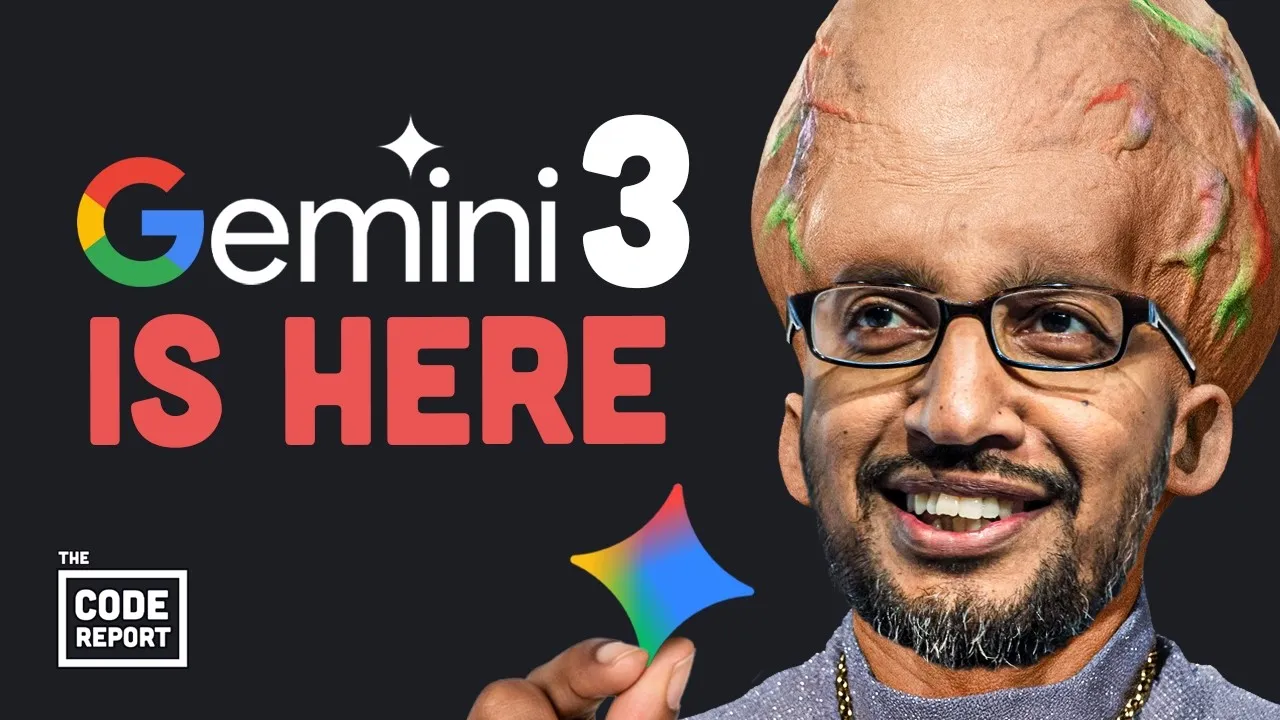
Google’s Gemini 3 Shatters AI Benchmarks, Signals Major Shift
In a dramatic turnaround that has sent ripples through the technology industry, Google has unveiled Gemini 3, a new artificial intelligence model that is rapidly ascending to the top of numerous AI performance leaderboards. This release marks a significant moment for Google, which faced considerable skepticism following the troubled launch of its previous AI chatbot, Bard, in February 2023. The initial unveiling of Bard was marred by a public hallucination and a subsequent 9% drop in Google’s stock price, leading many experts to question the company’s AI prowess.
However, the introduction of Gemini 3 has seemingly reversed that narrative. The new model’s release not only boosted Google’s stock by 6% to an all-time high but has also positioned the company as a leading contender in the race for the most advanced AI. Industry observers are now touting Gemini 3 as the potential frontrunner for the best AI model by the end of the year.
Gemini 3’s Benchmark Dominance
The true measure of an AI model’s capability often lies in its performance across a battery of standardized tests, known as benchmarks. These benchmarks are designed to evaluate AI models on a wide range of tasks, from complex reasoning and coding to creative generation and problem-solving. Gemini 3 Pro has reportedly excelled in these evaluations, achieving top positions across several key leaderboards.
According to recent reports, Gemini 3 Pro has swept major benchmarks including those on the LMSYS Chatbot Arena, a platform where users anonymously rate AI model responses. It has also reportedly secured the top spot on benchmarks such as “HumanEval” (for coding capabilities), “MMLU” (Massive Multitask Language Understanding), and “ARC” (AI2 Reasoning Challenge), among others. While benchmarks are not the sole indicator of an AI’s ultimate utility, Gemini 3’s widespread dominance across multiple domains simultaneously is a notable achievement, suggesting a significant leap in its general intelligence and task-specific performance.
Real-World Adoption and Impact
Beyond theoretical benchmarks, real-world adoption is a critical indicator of an AI model’s practical value. AMP, a notable player in the AI development space, has reportedly replaced OpenAI’s Claude model with Gemini 3 Pro to power its coding agent. This decision was reportedly made after AMP observed that Gemini 3 Pro performed comparably to, and in some cases better than, its predecessor, Claude Sonnet 4.5, across various coding-related tasks.
Beyond Gemini 3: Google’s Agentic Platform ‘Antigravity’
While Gemini 3 has garnered significant attention, Google also made another intriguing announcement: ‘Antigravity.’ This new technology is not related to physics-defying propulsion systems, as the name might playfully suggest, but is rather a new platform for agentic coding, built upon the foundations of the company Windsurf, which Google acquired in July for $2.4 billion.
The acquisition of Windsurf, whose co-founders have now resurfaced within Google, has culminated in the development of Antigravity. This platform is described as an agentic development environment designed to streamline and enhance the coding workflow.
The announcement video for Antigravity reportedly features AI agents taking on management roles, hinting at the future of human-AI collaboration in software development. The platform’s internal codename, ‘Cascade,’ was reportedly overlooked in the renaming process, a subtle nod to the ‘turtles all the way down’ phenomenon in software development, where systems are built upon layers of previous technologies.
The Competitive Landscape
The AI development landscape remains fiercely competitive. Google’s advancements with Gemini 3 and Antigravity place it in direct competition with other major AI players. While the transcript mentions “Chad,” a hypothetical “brain rot IDE” that integrates user distractions like gambling and social media into a coding workflow, and Google’s own web-based editor IDX (now Firebase Studio) and autonomous coding agent Jules, the primary competition in advanced AI models remains with companies like OpenAI and Anthropic.
The rapid progress demonstrated by Gemini 3 suggests that the competition to develop the most capable and versatile AI models is intensifying, with significant implications for future technological advancements and the way we work and interact with machines.
Why This Matters
Google’s resurgence in the AI race with Gemini 3 is a significant development. It demonstrates the company’s capacity to innovate and recover from initial setbacks.
The superior performance of Gemini 3 across benchmarks and its adoption by other AI development platforms suggest a tangible improvement in AI capabilities, particularly in areas like complex reasoning and coding. This could lead to more sophisticated AI tools, faster software development cycles, and the acceleration of AI-driven innovations across various industries.
The introduction of platforms like Antigravity points towards a future where AI agents play a more integral role in development workflows, potentially automating complex tasks and augmenting human creativity. This evolution in AI technology has the potential to reshape the technological landscape, offering both opportunities and challenges for businesses and individuals alike.
Source: Did Google just kill OpenAI? (YouTube)