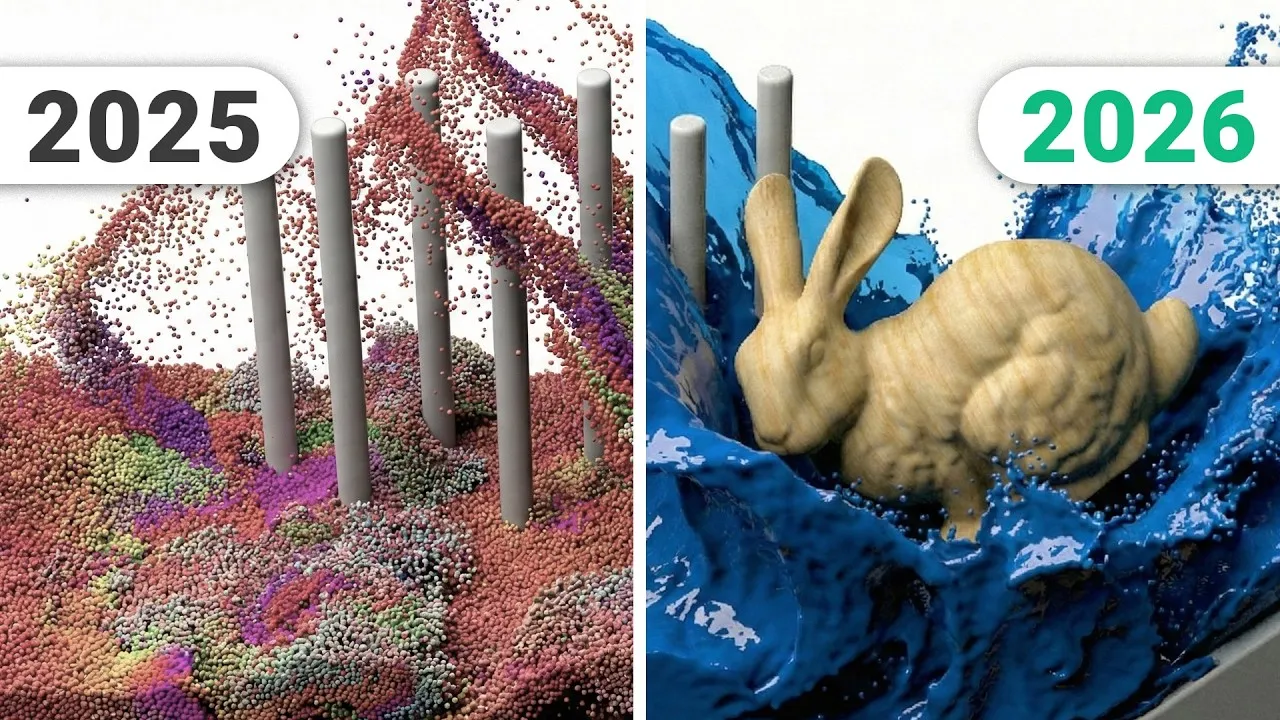
Breakthrough Fluid Solver Eliminates Volume Loss, Enhances Realism
For decades, a subtle yet persistent bug has plagued computer graphics, causing digital liquids to mysteriously lose volume over time. This issue, stemming from minute calculation errors in traditional fluid simulators, has led to unrealistic simulations where water seemingly vanishes, impacting everything from visual effects in movies to scientific modeling. Now, groundbreaking research has introduced a novel fluid solver that not only eradicates this long-standing problem but also introduces significant improvements in realism, efficiency, and handling complex scenarios.
The Problem: The Disappearing Liquid
The core issue lies in how traditional fluid simulators calculate the movement and interaction of countless tiny particles representing liquid. Each calculation, no matter how small, introduces a tiny margin of error.
Over millions of calculations, these errors accumulate, leading to a net loss of simulated liquid volume. This effect, while often imperceptible in short simulations, becomes glaringly obvious in longer sequences, making digital water appear to evaporate or leak away unnaturally.
Previous attempts to combat this “theft” of volume involved implementing mathematical filters that averaged out particle velocities. While this approach could stabilize the simulation and prevent volume loss, it came at a significant cost: it drastically slowed down the simulation, leading to sluggish animations and a loss of dynamic detail.
Imagine trying to prevent financial theft by freezing all assets – the money is safe, but the economy grinds to a halt. This is analogous to how these filters crippled the visual dynamism of fluid simulations, resulting in less crisp splashes and muted swirls.
The Innovation: A Theft-Proof System
The new research, authored by Dr. Ryoichi Ando, Professor Nils Thürey, and advised by Professor Chris Wojtan, presents a fundamentally different approach. Instead of trying to patch up errors or artificially slow down the simulation, this method redesigns the underlying mathematical framework to be inherently volume-preserving. It’s not about hiring more guards for each dollar; it’s about building a perfectly sealed vault where the money can move freely within but cannot escape.
Key Improvements of the New Solver:
- Volume Conservation: The mathematical construction ensures that liquid volume is conserved by design, eliminating the gradual disappearance seen in older simulators. This means digital water behaves as it does in the real world, without unexplained losses.
- Dynamic Realism: Unlike methods that sacrificed visual fidelity for stability, this new solver maintains crisp splashes, beautiful swirls, and overall dynamic realism without the performance penalty.
- Adaptive Efficiency: Traditional simulators often waste computational resources by tracking particles in areas where nothing significant is happening, such as the deep ocean floor. This new system is adaptive, focusing its computational budget on areas with the most activity, typically the surface details, making it more efficient.
- Handling Bottlenecks: A particularly challenging aspect of fluid simulation is accurately depicting scenarios like pouring liquid from a bottle, where water rushes out through a narrow opening while air rushes in. This creates extreme velocity conflicts within simulation cells. The new solver handles these “bottlenecks” seamlessly, allowing for natural glugging effects without simulation instability.
- Practical Application of Advanced Theory: For decades, scientists have theorized about mathematical approaches that would offer superior fluid simulation but lacked a practical method for implementing them, particularly in 3D. This research provides the missing piece, enabling the successful application of these complex, yet more accurate, theories.
Understanding the Visuals: Vector Potential Explained
The visual representations often seen in demonstrations, with colorful particles, serve to illustrate the complex mathematics at play. These colors represent the Vector Potential, an invisible mathematical construct that guides the fluid’s motion.
By assigning Red, Green, and Blue to different force directions, researchers visualize the “puppet strings” controlling the fluid’s dance. This allows viewers to see the underlying mechanics that drive the realistic fluid behavior, offering a backstage view of the simulation’s computational choreography.
The Technical Edge: Divergence-Free Velocity Fields
For those familiar with fluid dynamics, the technical elegance of this solution lies in its mathematical formulation. Instead of directly solving for velocity, the solver computes the Vector Potential.
Since velocity is derived as the Curl of this potential, the resulting velocity field is inherently Divergence-Free. This mathematical property is the key to ensuring volume conservation – it guarantees that what goes into a system must come out, preventing any net loss or gain of fluid volume within the simulation domain.
Limitations and Future Directions
While this research represents a significant leap forward, it is not without its limitations. The current mathematical framework appears to assume a simple domain.
For complex geometries, such as a torus (donut shape), the solver might theoretically struggle with flows circulating around the ring due to a missing “Harmonic Field” component. This means while it excels at realistic splashes and pours, simulating liquids in highly complex, looping environments might require further development.
Why This Matters
The implications of this advanced fluid solver are far-reaching. For the entertainment industry, it promises more realistic and visually stunning special effects in films and video games, without the computational compromises of older methods. Scientific research stands to benefit immensely, with more accurate simulations for fields like weather forecasting, oceanography, and biomedical engineering.
The ability to simulate fluid dynamics with greater fidelity and efficiency opens new avenues for discovery and innovation across numerous disciplines. It’s proof of human ingenuity that a problem recognized and theorized about for decades has finally found a practical, elegant solution, hidden away in a paper published ten years ago and only now gaining attention.
Source: The Bug That Ruined Game Physics For Decades (YouTube)