New Physics Engine Slashes Animation Time by 45x
Creating realistic digital environments for movies and video games often involves painstaking animation of complex elements like hair, cloth, or dynamic structures. A common bottleneck is the physics engine, which simulates how these objects behave.
When these engines are unstable or slow, artists face weeks of manual correction, significantly increasing costs and production time. However, a groundbreaking new research paper introduces a method that promises to revolutionize this process, offering unprecedented speed and stability.
Revolutionizing Real-Time Simulation
This new technique, developed by researchers and detailed in a recent paper, tackles the long-standing challenge of simulating complex physical interactions in real-time. Unlike previous methods that often required compromises in detail or speed, this approach allows for highly detailed simulations of elements like hair, trees, cloth down to individual strands, and even structural elements like bridges, with remarkable stability.
Unprecedented Speed and Detail
The results showcased are nothing short of astonishing. In one demonstration, a simulation involving nearly 1.5 million vertices representing hair was rendered in just 7 milliseconds per frame, easily surpassing real-time performance.
This is a significant leap from traditional methods, which often rely on simulating only a few “guide” strands and interpolating the rest. This new technique, in contrast, computes the physics for the entire mass of hair simultaneously.
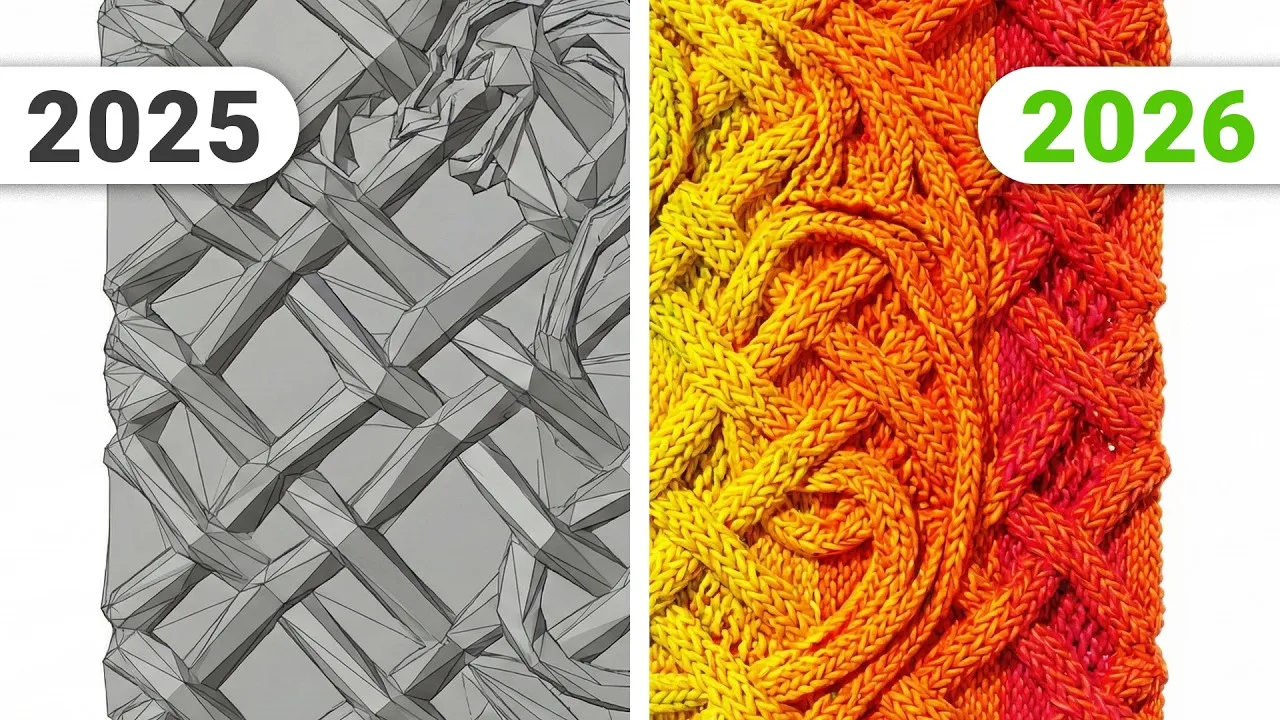
Similarly, a simulation of knitted fabric, composed of 65,000 individual strands, moved with natural fluidity. While not strictly real-time for interactive manipulation, it allowed for immediate visual feedback as elements were manipulated, a capability that historically required supercomputing resources but is now achievable on a single GPU.
Comparing to Previous Techniques
The paper highlights a dramatic improvement in performance when compared to established techniques. In a specific test involving a slinky, the new method achieved a speedup of approximately 45 times compared to a Discrete Elastic Rods technique from eight years prior.
While acknowledging that the older technique might have offered slightly higher accuracy in this particular scenario, the new method remained remarkably close while delivering a massive performance boost. This efficiency gain is crucial for complex simulations where even small inaccuracies are acceptable in exchange for drastically reduced computation times.
Handling Extreme Scenarios
The robustness of the new technique is further demonstrated by its ability to handle extreme conditions and material disparities. A simulation involving a slingshot, where the rubber band was over a thousand times more elastic than the handle, was executed without issue. Many previous methods would have failed under such extreme differences in material stiffness, but this new approach handled the deformation smoothly.
The Science Behind the Speed: Cosserat Rods and Split Optimization
The underlying innovation, explained by researchers, is not AI-driven but a result of human ingenuity in refining physics simulation algorithms. The core of the technique involves a novel approach to simulating objects like branches or rods, referred to as Cosserat Rods. Previous methods struggled to solve position and rotation simultaneously, often leading to instability and requiring very small simulation time steps, which drastically slowed down the process.
A Novel Approach to Stability
The new technique introduces a split position and rotation optimization scheme. This allows for tracking every point along a simulated object and understanding its stretch, bend, and twist.
The researchers liken the improvement to a more efficient construction process. Instead of laying one brick, adding mortar, and waiting for it to dry before the next step (a slow, sequential process), this new method effectively lays all the “bricks” at once and uses an “instant-drying foam” to stabilize the structure, enabling much larger time steps without sacrificing stability.
This is summarized in technical terms as a “split position and rotation optimization scheme with a closed-form Gauss-Seidel quasi-static orientation update to achieve robust numerical stability under large time steps.”
Trade-offs and Applications
While the “instant foam” analogy highlights the speed, it comes with a minor caveat. In extremely specific and complex scenarios, such as a knot tightening rapidly or a rod being crushed from multiple directions, the assumption that position and rotation don’t need to interact during the simulation step can lead to slight inaccuracies. In these rare cases, older, slower methods might offer marginally better precision.
However, for the vast majority of applications, including animation for games and films, these minor differences are imperceptible. The researchers suggest that the older methods should be reserved for high-precision scientific engineering or surgical simulations, while this new technique is ideal for everything else.
Accessibility and Impact
Crucially, the researchers have made this powerful technique and its source code freely available to the public. This move is intended to benefit humanity by democratizing access to advanced simulation capabilities. The availability of such a tool is expected to accelerate innovation in various fields, from entertainment to scientific research.
Why This Matters
The implications of this development are far-reaching. For the entertainment industry, it means faster production cycles, more complex and realistic visual effects, and potentially lower costs for animated features and games.
For researchers and engineers, it opens up new possibilities for simulating complex physical phenomena with greater speed and detail, aiding in design, analysis, and discovery. The ability to achieve such high-fidelity simulations on standard hardware democratizes access to powerful tools, fostering innovation across a wider range of users and organizations.
Source: This New Physics Engine Is 45x Faster! (YouTube)