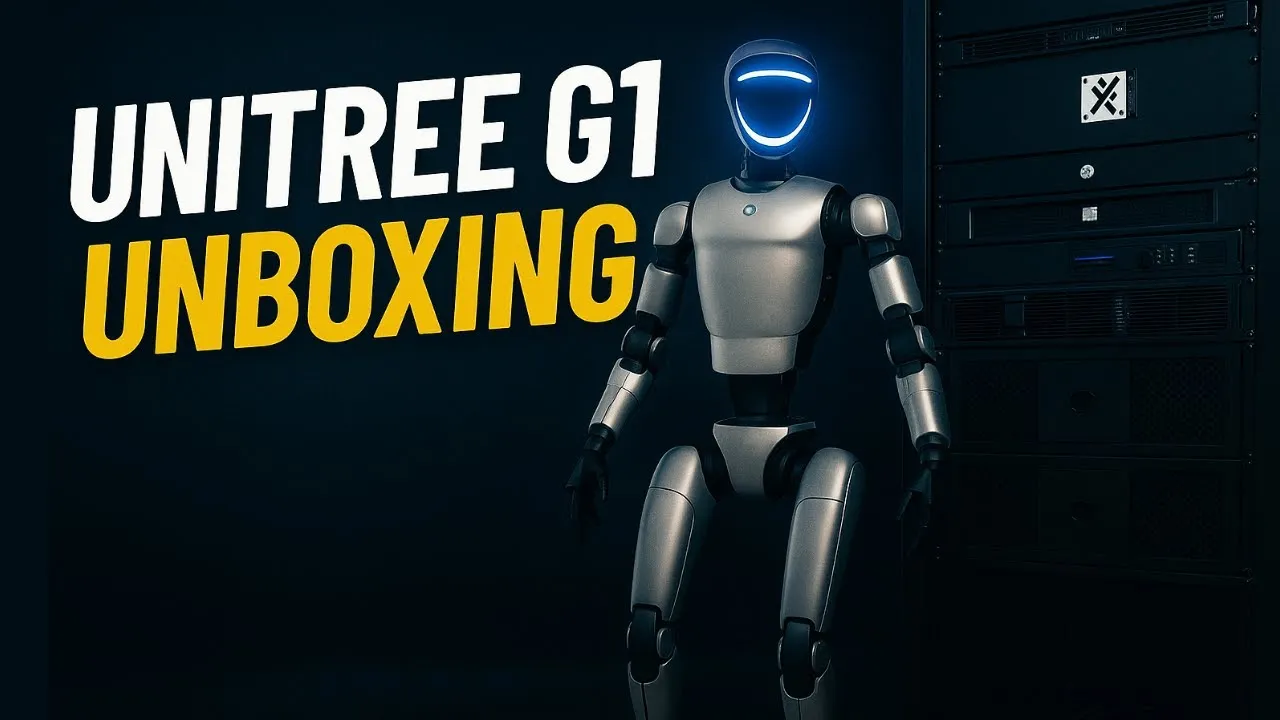
Unitree Ships G1 Humanoid, Igniting Robotics Development
The landscape of humanoid robotics is rapidly evolving, and Unitree, a company known for its advanced quadruped robots, has begun shipping its G1 series of humanoid robots. This move marks a significant step towards making sophisticated humanoid platforms accessible to researchers and developers, albeit at a considerable price point.
Unboxing the Unitree G1 Edu Ultimate B
The G1 Edu Ultimate B, a specific variant of the G1, was recently unboxed and demonstrated. While the reviewer has an advisory role with Lucky Robots, a company focused on simulated robotics training, they emphasize no direct affiliation with Unitree.
The unit was purchased through Robo Store in the US, with a delivery time of approximately 1.5 months. The gantry system, crucial for safe R&D, and the remote controller were still pending delivery at the time of the unboxing.
Pricing and Variants: Understanding the G1 Ecosystem
Unitree offers several G1 variants, each with distinct features and price points:
- Base Model: Starting at $16,000 (before taxes and tariffs), this model features non-functional, glove-like hands and lacks an SDK for secondary development. The estimated cost to the door in the US can reach $24,000.
- Base EDU Variant: This version includes an SDK for programming but still has the non-functional hands.
- Ultimate EDU Variants: These models come with functional hands, such as the Dex 3-in-1 hands (with or without tactile sensors) or the Inspire hands. The reviewer’s G1 Edu Ultimate B is equipped with Dex 3-in-1 hands featuring tactile sensors.
The G1 Edu Ultimate B is priced at $56,900 from Unitree (as if paying cash in China). However, with US taxes and tariffs, the final cost can escalate to the mid-$60,000s or potentially higher. The gantry system, sold separately, is approximately $1,500.
Physical Attributes and Range of Motion
The G1 stands 4.5 feet tall (approximately 135 cm) and weighs about 85 lbs (38 kg). Despite its relatively compact size, it is surprisingly dense and heavy, making manual handling and positioning challenging without assistance. The reviewer found seating the robot in a chair, as suggested by the manual, to be a difficult task.
The robot boasts impressive articulation:
- Feet: Capable of side-to-side and up-and-down motion, mimicking human ankles.
- Legs: Features knee joints and thighs with approximately 320° of rotational capability.
- Hips: Offer a remarkable 180° of lateral motion and significant forward/backward flexibility.
- Torso: Possesses over 300° of rotation.
- Arms: Shoulders have around 300° of rotation, with additional articulation below the shoulder. Elbows offer a human-like range of motion.
- Wrists: Equipped with motors for side-to-side and front-to-back movement, along with roughly 300° of rotation.
- Hands: The Dex 3-in-1 hands have rotating thumbs and three fingers, each with two pivot points.
- Head: Includes RGB and depth cameras, a LiDAR sensor, and can move up and down slightly, though this is not explicitly listed as a degree of freedom.
This extensive range of motion allows the G1 to achieve nearly any human-like pose, and potentially more.
Development and Software Interface
The G1 EDU models are equipped with an Nvidia Jetson Orin NX secondary computer, which serves as the primary interface for the Unitree SDK. The robot’s core system operates on a tight 2-millisecond compute cycle, typically handled by C++ for deterministic, low-level control like balancing. Python is considered more suitable for higher-level commands, such as positioning the torso or hands, which can orchestrate movements across multiple joints.
Documentation for the G1 is available online and in a physical manual. While Unitree’s documentation is rated highly compared to other robotics platforms, the reviewer notes that it still requires significant R&D effort, particularly for those not deeply proficient in C++. The reviewer successfully used OpenAI’s open-source agent framework, CodeX, to assist in building a Python API for the robot, significantly accelerating the development process and uncovering details about the robot’s operation.
The SDK provides both high-level and low-level examples. High-level commands, like controlling torso height or hand position, are easier to implement in Python.
Low-level control, essential for tasks like dynamic balancing, is best managed in C++. The reviewer plans to build a Python layer to interact with the robot’s C++ core, simplifying development.
Connectivity and Safety Considerations
The G1 features multiple communication ports on the back of its neck, including four USB-C and two LAN ports, accessible after removing a rubber cover. The reviewer opted to connect via Ethernet to a dedicated network for security reasons, advising others to do the same to avoid exposing their main network.
Safety is paramount when working with such a powerful machine. The reviewer emphasizes the need for a safe development loop, utilizing a repurposed game hanger to suspend the robot.
This setup prevents the robot from falling and potentially damaging itself or its surroundings, especially when it becomes a heavy, limp structure upon powering down. A gantry hoist or a medical Hoyer lift is recommended for safely maneuvering the robot, offering a more cost-effective alternative to Unitree’s gantry system.
The Reality of Shipping Humanoids
A critical point highlighted is that Unitree is currently one of the few companies actively shipping fully functional humanoid robots. While many companies showcase impressive demos, Unitree’s ability to deliver a tangible product to customers sets them apart in the burgeoning field of humanoid robotics.
Why This Matters
The availability of the Unitree G1, even with its substantial cost, represents a crucial step in advancing robotics research and development. It provides a powerful, albeit expensive, platform for engineers and scientists to explore complex locomotion, manipulation, and interaction tasks.
The challenges in programming and safety highlight the ongoing need for better development tools, more accessible documentation, and robust safety protocols. As AI models become more capable, the integration of such advanced hardware with sophisticated AI will pave the way for more capable and autonomous robots in various sectors, from industrial automation to research and exploration.
Source: Unboxing the Unitree G1 Edu Humanoid (YouTube)