AI Achieves Unprecedented Robotic Dexterity with LLM Guidance
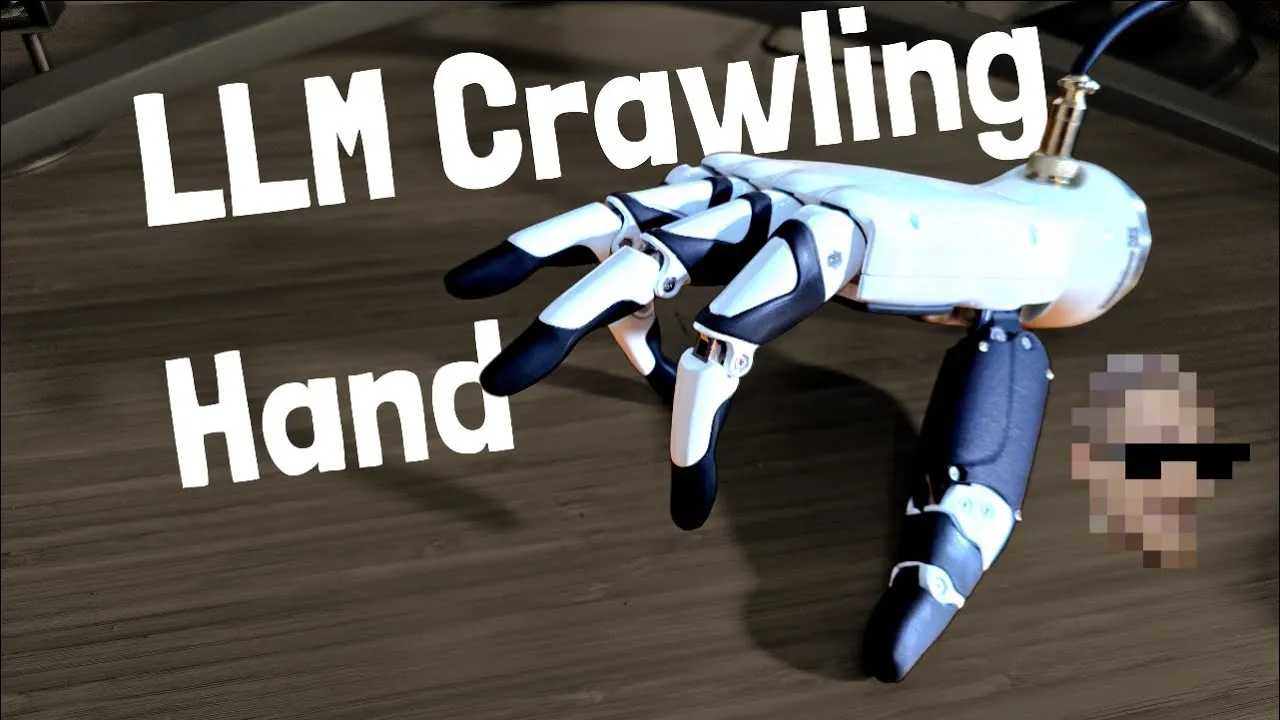
In a remarkable demonstration of artificial intelligence’s growing capabilities, researchers have successfully used a large language model (LLM) to program a robotic hand to perform complex, dynamic movements, including a surprisingly effective crawling motion. This breakthrough showcases the potential of AI not just to generate code, but to imbue robotic systems with emergent behaviors based on conceptual understanding.
‘Vibe Coding’ and Abstract Reasoning
The project, dubbed ‘vibe coding’ by its practitioners, involves leveraging LLMs like Anthropic’s Claude to generate and refine code for controlling physical hardware. Unlike traditional programming, where developers must meticulously define every step and parameter, ‘vibe coding’ allows for a more abstract approach. The user can describe desired actions in natural language, and the AI translates these concepts into executable commands.
A key aspect highlighted by the project’s creator is the AI’s ability to grasp abstract concepts. For instance, when asked to make the Inspire RH56DFQ robotic hand perform a ‘point’ or ‘pinch’ gesture, the LLM not only generated the necessary code to move the hand’s actuators but also demonstrated an understanding of what these gestures visually represent. This goes beyond simply executing pre-programmed sequences; it implies a level of conceptual reasoning, where the AI must infer the physical configuration of the hand required to mimic a human-like point or pinch, even if these exact gestures weren’t explicitly defined in its training data for this specific hardware.
“For Claude to know how to point, it would have to have some sort of mental abstraction… In order to point not only does it need to know how to send the command right, it also needs to know what a point looks like and then based on the definition set of instructions that it’s been given it needs to also be able to take that and morph that into what it knows a point should look like,” the creator explained.
From Gestures to Crawling: A Dynamic Leap
The initial experiments focused on basic gestures like ‘open,’ ‘close,’ ‘thumbs up,’ ‘point,’ and even attempts at ‘rock,’ ‘paper,’ and ‘scissors.’ While these demonstrated the LLM’s coding prowess, the most astonishing achievement came when the AI was tasked with making the robotic hand ‘crawl’ forward. This required a sophisticated understanding of the hand’s physical limitations and capabilities.
The robotic hand, specifically the Inspire RH56DFQ, has limitations. While its motors are strong enough to bend fingers inward for grasping, the outward extension is primarily assisted by a rubber band mechanism. This means the hand struggles to push itself open against resistance or to reposition fingers effectively when they are bent inwards.
To overcome this, the LLM had to devise a strategy. It generated a Python script that broke down the crawling motion into a series of coordinated steps. This involved strategic finger closings to pull the hand forward, followed by carefully orchestrated lifts and repositioning of other fingers and the thumb to overcome the ‘rubber band’ limitation and prepare for the next ‘step.’ The AI effectively reasoned about the mechanics, understanding that lifting parts of the hand would be crucial for the fingers to extend outwards.
“Coordinates finger closings to pull the hand forward, strategically lifts parts of the hand to reposition fingers for the next ‘step’,” the AI’s generated plan detailed. The outcome was stunning: the robotic hand successfully crawled across a surface, covering a significant distance in a single take, a feat described as “shockingly impressive” and “insane” by the creator.
The ‘Why This Matters’ Section
This development has profound implications for the future of robotics and AI integration:
- Accelerated Prototyping: For roboticists and engineers, LLMs can drastically reduce the time and effort required to develop control software. Instead of writing thousands of lines of low-level code, they can describe desired behaviors and let the AI handle the implementation details.
- Emergent Capabilities: The ability of an LLM to generate complex, adaptive movements like crawling, based on a conceptual understanding of physical constraints, suggests a path towards robots that can learn and adapt to new environments and tasks with less explicit programming.
- Democratization of Robotics: By simplifying the coding process, LLMs could make advanced robotics more accessible to a wider range of creators, researchers, and hobbyists, fostering innovation across various fields.
- Human-AI Collaboration: This project highlights a powerful synergy where human intuition and conceptualization guide AI’s computational power and code-generation capabilities, leading to results neither could achieve alone.
Technical Details and Availability
The project utilized the Inspire RH56DFQ robotic hand. The LLM employed was Anthropic’s Claude. The generated code was primarily in Python.
While the specific version of Claude and its exact configuration were not detailed, the creator made the code available on GitHub, allowing others with compatible hardware to experiment. The creator also noted the importance of good version control when working with LLMs to manage generated code effectively.
The creator expressed a desire for such advanced software interfaces to be standard with robotic hardware, rather than requiring users to develop them. The LLM’s ability to generate not only the control logic but also a functional command-line interface (CLI) and Python API for the hand was cited as a significant benefit.
While the project focused on a specific robotic hand, the underlying principles of using LLMs for abstract task definition and code generation are broadly applicable, enabling more intelligent and adaptable robotic systems in the future.
Source: Vibe Coding a Robotic Hand to Crawl (Inspire RH56DFQ) (YouTube)