AI Agents Are Redefining Software Development
The landscape of software development is undergoing a seismic shift, driven by the rapid advancement and integration of Large Language Models (LLMs) and AI agents. While skepticism lingers about their true capabilities, the reality is that these tools are becoming indispensable for programmers, dramatically amplifying output and accelerating complex tasks. This article explores how AI agents are transforming coding workflows, using practical examples and highlighting the underlying principles that make them so powerful.
Understanding AI Agents in Coding
The term “agent” in the context of AI might sound futuristic, but fundamentally, it often represents an enhanced workflow built upon LLMs. These agents typically combine sophisticated prompting techniques with fundamental programming constructs like loops and conditional statements to automate and assist in development tasks. While tools like Cursor offer integrated agent experiences, often at a subscription cost (around $20/month), platforms like Open Hands provide a flexible, often free, alternative. Open Hands allows users to leverage various LLMs, including open-source models or popular services like Anthropic’s Claude or OpenAI’s ChatGPT, enabling a wide range of functionalities without mandatory fees.
Getting Started with Open Hands
Setting up Open Hands is straightforward, typically requiring just a couple of commands to install and run. Once launched, it presents a browser-based interface where users can integrate their chosen LLM via an API key.
While the interface is intuitive, users might need to configure API keys for services like Anthropic. For those seeking a completely free solution, it’s possible to set up a local API using tools like `ll.cpp` and connect Open Hands to it, avoiding any per-use costs.
The Power of Quick R&D and Iteration
One of the most significant benefits of using AI agents in development is their ability to accelerate Research and Development (R&D). Imagine needing to explore a novel approach to language modeling, perhaps moving beyond the ubiquitous Transformer architecture. An agent can quickly process large datasets, like the complete works of Shakespeare, and assist in setting up experiments.
For instance, an agent can be tasked with preparing training data, encoding text into a bit-style representation, and structuring it for input/output pairs (e.g., 15 characters in, 3 characters out). This process, which would traditionally be manual and time-consuming, can be initiated with natural language prompts.
Breaking Down Complex Problems
A key principle when working with current AI agents is to avoid overwhelming them with monolithic requests. Instead, complex problems should be broken down into smaller, manageable sub-problems. This mirrors how human programmers approach large projects.
For example, instead of asking an agent to build an entire evolutionary algorithm from scratch, one would first prompt it to create a Python script for data preprocessing, then perhaps ask it to develop the core algorithm, and subsequently refine its parameters. This iterative approach ensures that the agent can effectively tackle each stage of development.
Managing Context and Workflow
As development progresses, the conversation history with an AI agent can become extensive, potentially impacting the model’s performance. A practical strategy to manage this is the creation and maintenance of a `readme.md` file. This file is a living summary of the project’s goals, current status, codebase overview, and a to-do list.
Before resetting the agent’s context (which might be necessary after around 200 steps to maintain focus), the `readme.md` should be updated and reviewed. This ensures that if the context needs to be re-established or the project restarted, the essential information is readily available.
Exploring Advanced AI Techniques
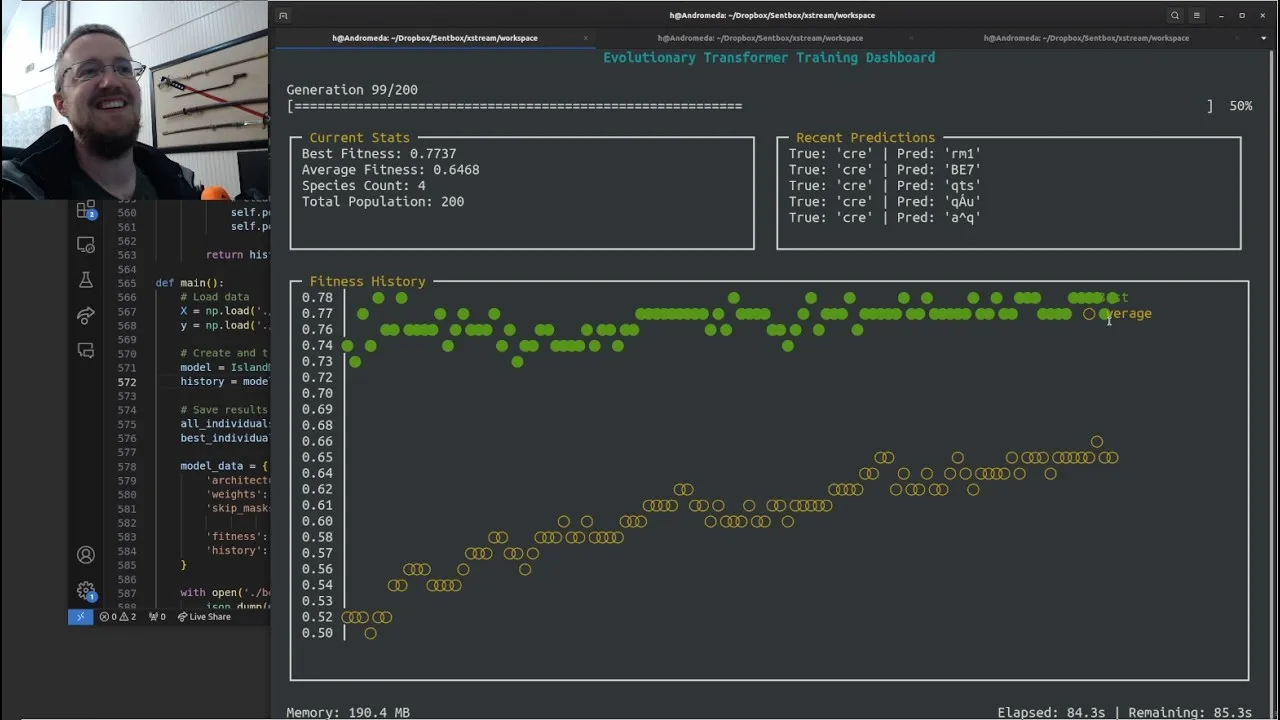
AI agents can facilitate experimentation with advanced techniques. For instance, the speaker explores using an evolutionary algorithm to train a model on the Shakespeare text. This involves tasks such as defining the network architecture (e.g., number of hidden layers, nodes per layer), specifying genetic operations (mutation, crossover), and setting fitness criteria.
The agent can generate code for these components, allowing the developer to focus on high-level design and experimentation rather than low-level implementation. The iterative refinement of the evolutionary model, including adjustments to mutation rates, population size, and activation functions, showcases the agent’s role as a collaborative partner in complex AI research.
The Future of Programming with Agents
The ability to program using natural language, combined with the agent’s capacity to generate, debug, and refine code, suggests a future where traditional programming skills may become less of a barrier to entry. While an engineer’s mindset – breaking down problems, testing, and debugging – remains crucial, AI agents significantly lower the technical hurdle.
The speaker estimates that even a single agent can provide a tenfold increase in productivity, with the potential for much greater gains when multiple agents are employed concurrently to work on different tasks in parallel. This multi-agent approach could lead to a 50x or even greater increase in leverage, making complex software development accessible to a broader range of individuals.
Why This Matters
The integration of AI agents into the software development lifecycle represents a paradigm shift. It democratizes coding by lowering the barrier to entry, allowing individuals with strong problem-solving skills but less traditional coding experience to contribute to software creation. For experienced developers, agents act as powerful force multipliers, drastically reducing the time spent on repetitive tasks, boilerplate code generation, and initial R&D.
This acceleration can lead to faster innovation cycles, quicker deployment of new applications, and the exploration of more ambitious and complex software projects. The ability to prototype and iterate rapidly with AI assistance means that the pace of technological advancement is likely to accelerate even further.
Pricing and Availability
Tools like Open Hands are generally free to use, though they require integration with LLM APIs, which may have associated costs depending on usage (e.g., Anthropic Claude, OpenAI ChatGPT). Paid alternatives like Cursor offer integrated agent features with subscription plans, typically around $20 per month. The choice of LLM and platform depends on individual needs, budget, and desired level of customization.
Source: Programming with LLM Agents in 2025 (YouTube)