AI Breakthrough Dramatically Speeds Up Realistic Clothing Simulation
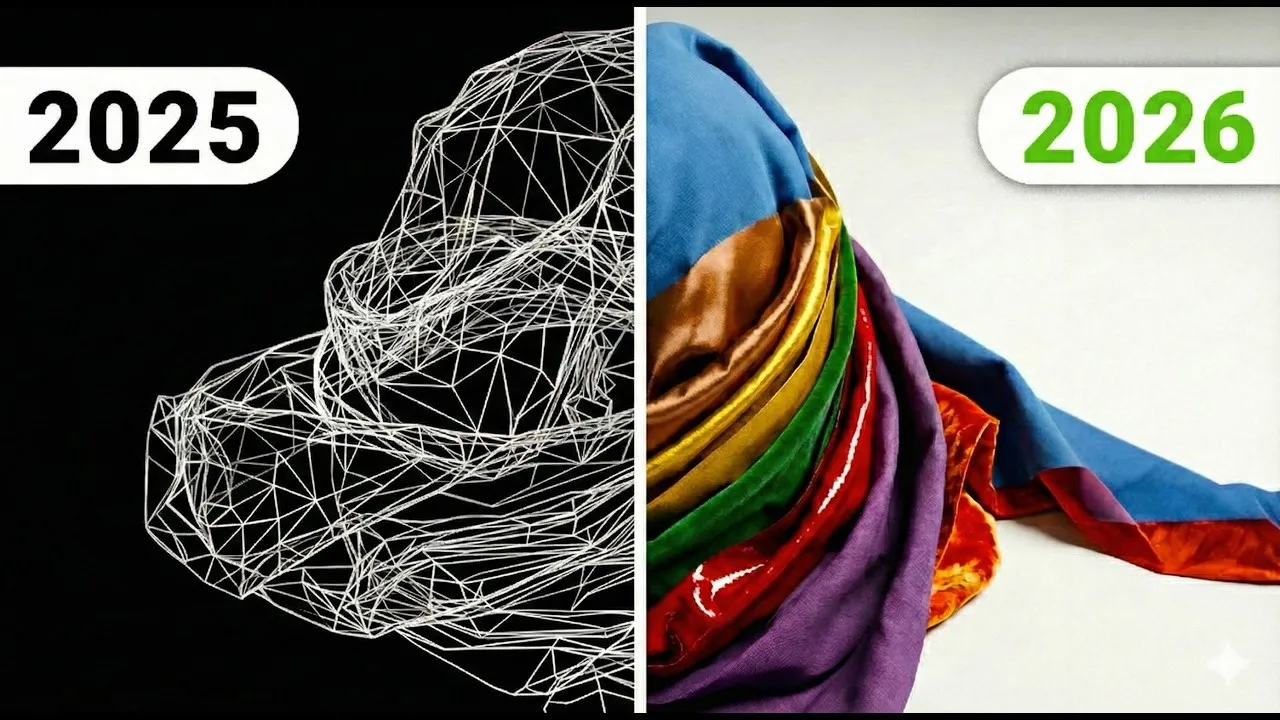
Creating hyper-realistic digital clothing for movies and video games has long been a balancing act between visual fidelity and computational cost. Traditional methods force designers into a difficult choice: either use low-resolution geometry that looks like stiff cardboard, or employ high-resolution meshes with millions of triangles that demand immense processing power, leading to lengthy simulation times. Now, a novel physics-inspired technique promises to shatter this compromise, delivering stunningly realistic fabric dynamics at a fraction of the usual cost.
The Challenge of Digital Tailoring
The process of simulating cloth in 3D environments involves complex calculations to determine how fabric stretches, folds, and wrinkles. “Digital fashion designers who create clothing for a blockbuster animated movie or a video game…
Have two terrible choices,” explains Dr. Károly Zsolnai-Fehér in a recent Two Minute Papers video. The first option, using “low-quality coarse geometry,” results in clothing that “will look like it is made of stiff cardboard.” The second, employing a “high-resolution mesh with millions of tiny triangles,” achieves realistic visuals but requires “your computer catches fire and it takes three weeks to simulate one second of footage.” This stark dichotomy has historically limited the quality or speed of digital cloth rendering.
A Smarter Approach to Detail
The new technique, developed by Huamin Wang’s group, offers a revolutionary solution by intelligently allocating detail only where it’s needed. Instead of applying uniform detail across the entire mesh, it starts with a coarse input geometry and then generates an “optimized mesh that puts detail exactly where it is needed, and nowhere else.” This approach is likened to a “smart budget manager” that “spends the big bucks only on the lead actor’s close-up, and saves money on the background extras.” The result is “incredibly high quality results at the fraction of the cost of a full simulation,” with movements like that of a “ridiculous puffy jacket” rendered as “mesmerizing.”
The Secret Equation: Wrinkle Wavelength and Stiffness
The core innovation lies in a “crazy equation that relates the stiffness of a material to the wavelength of its wrinkles.” This equation acts like a “master tailor,” enabling the system to “know in advance what kind of wrinkles are expected from it” and how materials will stretch and fold. Based on this predictive capability, the technique creates triangle meshes that are “a bit elongated into one direction,” specifically aligning with the “direction of the wrinkles.” This contrasts sharply with older methods that might use a uniform mesh, requiring “detail everywhere, all the time,” leading to expensive computations.
Adaptive Meshing: The Paving Analogy
The adaptive nature of the mesh generation is further illustrated with a paving analogy. “If the road is straight, you can use long slabs of concrete. No problem.
However, when you know that it takes a big turn, you’ll need a lot of smaller tiles to follow the curvature of the turn. But only then.” This focused application of detail is the “secret sauce that makes the new technique so efficient.” The system dynamically adjusts the mesh density during simulation based on how much the cloth is currently stretching or compressing, a proactive approach that avoids the last-minute “frantic” attempts of older, reactive methods.
Beyond Simple Fabrics: Multi-Layered Garments and Solver Agnosticism
While initially seeming applicable only to simpler items like flags or capes, the technique has demonstrated its power on “complex, multi-layered garments with collisions.” It adeptly handles “the interaction between different layers of cloth,” a notoriously difficult challenge in digital simulation. Crucially, the method is “solver-agnostic,” meaning it can be integrated into existing production pipelines without requiring modifications to the core simulation models or collision detection systems. This “difference between a research demo and something you can actually ship” is a significant advantage for studios looking to adopt new technologies.
Physics-Inspired, Not AI-Trained
In an era dominated by machine learning and neural networks, this breakthrough stands out as being “purely physics-inspired.” It solves the problem “analytically, using fundamental mechanics, not by training a black box on a million images.” This reliance on “physics and human ingenuity” is highlighted as proof of “human brilliance at its best.” While the technique is highly effective, it’s noted that its reliance on predicting wrinkles based on static properties might falter in extremely chaotic scenarios, such as a cloth becoming tangled in an “unpredictable knot,” akin to a weather forecast missing a sudden, freaky thunderstorm.
Why This Matters
This advancement has profound implications for the entertainment industry and beyond. For game developers and filmmakers, it means the potential to create more visually stunning and believable characters and environments without prohibitive rendering times or costs.
This could lead to higher quality graphics in real-time applications like video games, and more intricate, dynamic clothing in animated films and visual effects. Beyond entertainment, such efficient simulation techniques can be applied to virtual prototyping in fashion design, biomechanical simulations, and the creation of digital twins for various industries, making complex simulations more accessible and practical.
Availability and Future Outlook
The research, originating from Huamin Wang’s group, represents a significant leap forward. While specific pricing or commercial product availability details were not provided in the original transcript, the fact that the method is “solver-agnostic” suggests it can be integrated into existing industry-standard software, making its adoption potentially smoother. The ongoing work by researchers like Wang continues to push the boundaries of realism and efficiency in computer graphics, promising a future where digital worlds are not only more lifelike but also more accessible to create.
Source: The Secret Equation Behind Hyper-Realistic Clothing (YouTube)