AI Crafts Scalable SVGs From Text Prompts
A new tool, Quiver, is making waves in the AI image generation space by focusing on a format often overlooked: Scalable Vector Graphics (SVG). Unlike traditional raster images (like JPEGs or PNGs) which are made of pixels and can become blurry when enlarged, SVGs are code-based.
This means they can be scaled infinitely without any loss of quality, making them ideal for web design, logos, and illustrations. Quiver allows users to generate these versatile graphics simply by typing text prompts.
The platform, accessible at app.quiver.ai, offers a free tier that provides users with 20 credits. Each generation request utilizes these credits and typically results in four distinct SVG image options.
How Quiver Works
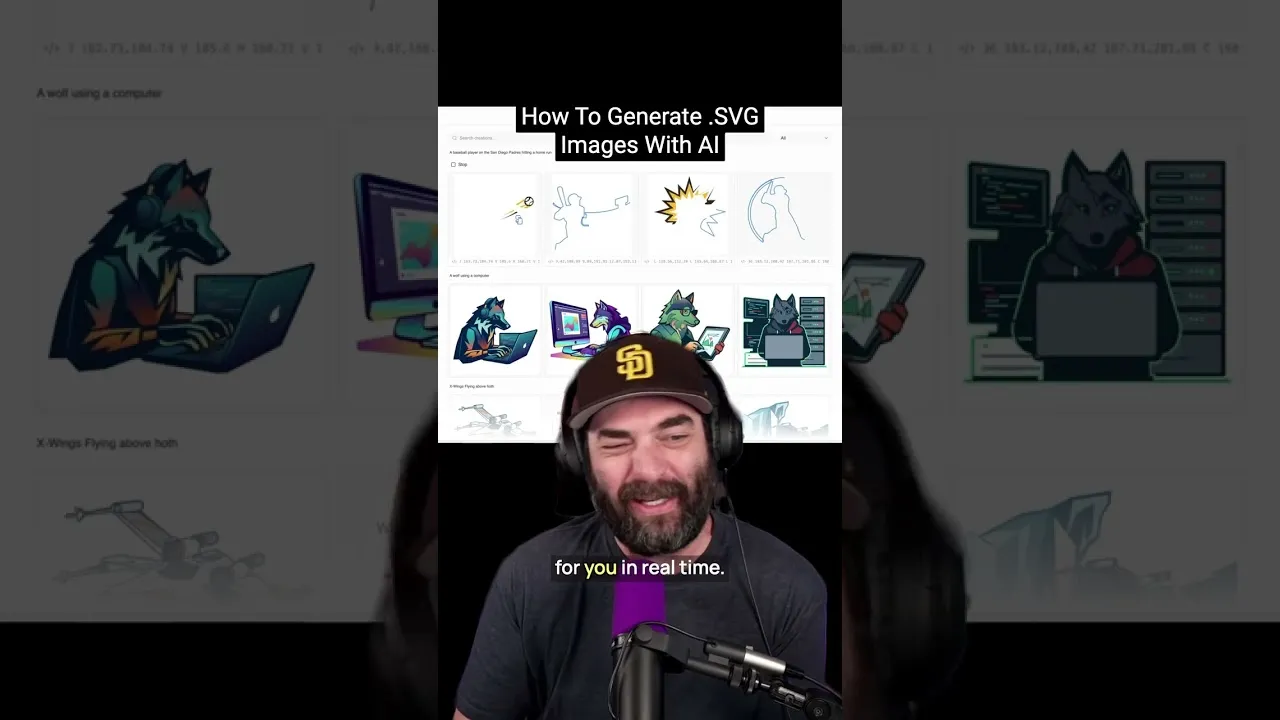
The process is straightforward. Users input a descriptive prompt, much like with other AI image generators. For instance, a prompt like “a baseball player on the San Diego Padres hitting a home run” can be submitted.
As the AI processes the request, users can observe the underlying code being generated in real-time. This stream of code visually represents the creation of the SVG, akin to a digital sketch being drawn line by line.
Once the generation is complete, users are presented with the resulting SVG images. The quality and interpretation can vary. In the example provided, the AI successfully captured the distinct brand colors of the San Diego Padres.
However, as with many AI generation tools, there can be occasional quirks. One generated image depicted the baseball appearing to hit the player rather than being hit by him, a common challenge for AI in understanding complex actions and physics.
Despite such occasional anomalies, the output can be remarkably impressive. Another generated image was described as “pretty solid,” showcasing the potential of AI to create usable and aesthetically pleasing vector graphics from simple text descriptions.
Why This Matters
The ability to generate SVGs directly from text prompts has significant implications for various creative and technical fields:
- Web Development: SVGs are crucial for modern web design due to their scalability and small file sizes. Quiver could streamline the process of creating icons, logos, and illustrations for websites, making them responsive across all devices.
- Graphic Design: Designers can leverage Quiver for rapid prototyping of logos, icons, and other vector-based assets. This could significantly speed up the initial design phases.
- Accessibility: As code-based graphics, SVGs can be more easily manipulated for accessibility purposes, such as adjusting contrast or reading text elements within the graphic.
- Democratization of Design: Tools like Quiver lower the barrier to entry for creating professional-quality vector graphics, empowering individuals without extensive design software skills.
Comparison to Existing Tools
While numerous AI tools excel at generating raster images (like Midjourney, DALL-E 2, or Stable Diffusion), the focus on SVGs is a distinct niche. Traditional methods for creating SVGs involve using vector graphics software like Adobe Illustrator or Inkscape, which require specialized skills and significant time investment.
AI tools are beginning to bridge this gap, but Quiver’s dedicated approach to SVG output sets it apart. The real-time code generation aspect also offers a unique transparency into the creation process compared to black-box raster generators.
Availability and Pricing
Quiver is currently available for testing via its web application at app.quiver.ai. The platform offers a free trial with 20 credits. Details on potential future pricing tiers or subscription models were not provided in the initial announcement, but the credit-based system suggests a usage-based model is likely.
The emergence of Quiver highlights a growing trend in AI development: specialization. Instead of aiming to be a general-purpose image generator, Quiver focuses on a specific, high-demand format, offering a targeted solution for a particular set of user needs. As AI continues to evolve, we can expect more specialized tools that leverage artificial intelligence to simplify complex creative and technical tasks.
Source: How To Generate .SVG Images With AI (YouTube)