AI Builders Can Now Create and Monetize Sophisticated Agentic Systems with New Tools
The artificial intelligence landscape is experiencing unprecedented pressure, not on end-users, but on businesses and professionals who are aware of AI’s potential but lack the time or expertise to implement it. Plumbers, dentists, lawyers, and countless other industries are feeling the imperative to adopt AI, creating a significant market opportunity for skilled builders. Leveraging powerful new tools like Claude Code and Lerty, developers can now rapidly construct and sell sophisticated AI-powered systems, generating substantial monthly revenue.
Understanding Agentic Systems
Fundamentally, an agentic system is an AI that can perform tasks with a degree of autonomy. These systems are built upon several key components:
- The User: The individual or business utilizing the system.
- Databases: The foundation for storing and organizing information. This can include structured data, files, images, and more, acting as a central repository for the AI to reference. Platforms like Lerty offer relational databases that function similarly to tools like Airtable or Notion but are integrated directly into AI workflows.
- Agents: These are the AI components that interact with the data. Agents can be connected to various AI models (like those from Anthropic, OpenAI, or via OpenRouter) and are given specific instructions (system prompts) to perform tasks, retrieve information, or make decisions. They can also integrate with external tools via webhooks (e.g., Zapier, Make).
- Dashboards: Visual interfaces that present the data in an accessible and actionable format. Dashboards can display key metrics, provide buttons for quick actions, and offer customized views of the underlying data, making the system user-friendly and attractive to clients.
The Power Duo: Claude Code and Lerty
The process of building these agentic systems is significantly streamlined by combining Claude Code and Lerty. Claude Code, accessible through a paid Claude account (starting around $20/month), acts as a development environment that allows users to interact with AI models via their terminal. It can write code, generate system prompts, and, crucially, interact with platforms like Lerty.
Lerty serves as the infrastructure for these AI systems. It provides the necessary components: organizations (which can represent individual clients), agents, databases, and dashboards. Lerty’s agency plan, which is necessary for selling to clients, offers up to 50 organizations, meaning a single client paying $500-$1000 per month can cover the tool’s cost and generate profit.
Building a Coaching Accountability System: A Case Study
To illustrate the process, consider building a coaching client accountability system. This system aims to help business coaches manage client data, track sessions, and monitor action items.
The workflow involves:
- Setting up the Environment: Users need a paid Claude account and a Lerty account. They also need to install Claude Code locally.
- Configuring Lerty: A new organization is created in Lerty for the client (e.g., “Elite Coaching”). An API key is generated within Lerty for Claude Code to use.
- Prompting Claude Code: A detailed system prompt is fed into Claude Code. This prompt instructs Claude on how to interact with Lerty, build the necessary database tables (Clients, Sessions, Action Items), and populate them with realistic, lived-in data. This can include client progress, session history, and action items. The prompt provided in the free resource contains pre-built structures for 50 sellable agentic systems, including this coaching example.
- Database Creation: Claude Code, guided by the prompt and using the Lerty API, automatically generates the database structure within Lerty. This process, including seeding the database with sample data, can take under 10 minutes.
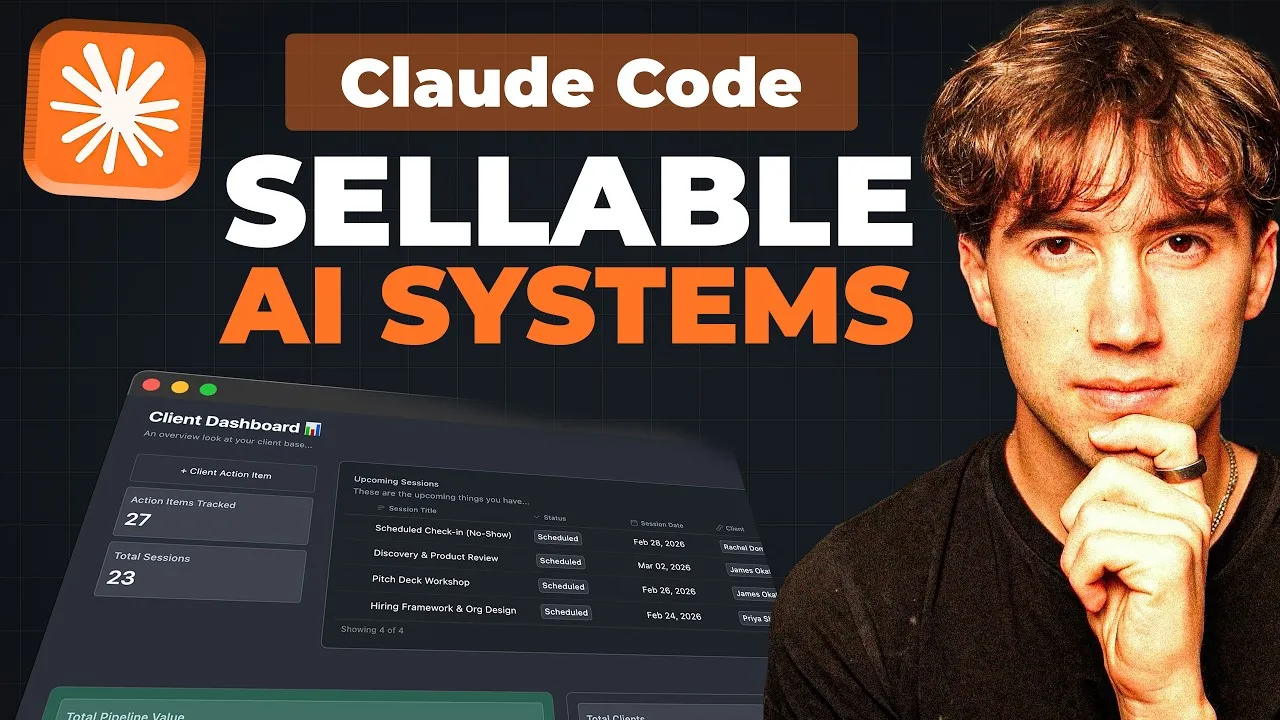
- Dashboard Development: A dashboard is created in Lerty to visualize the data. This could include sections for upcoming sessions, client status, and quick action buttons. Views can be configured to filter data, such as showing only scheduled sessions or upcoming action items. This layer makes the system intuitive for the end-user.
- Agent Creation: A custom AI agent is built within Lerty. This agent is connected to a language model (e.g., via OpenRouter) and configured with system instructions. The instructions define the agent’s role, such as acting as an executive assistant that can access client data through natural language queries. For instance, a coach could ask the agent for a briefing on a specific client or a summary of upcoming tasks. The agent can then query the Lerty database to provide this information.
- Adding Starter Prompts: To further enhance usability, starter prompts can be added to the agent. These pre-defined prompts allow users to quickly get insights, such as a “daily brief” that synthesizes key information from the database about client progress and priorities.
Why This Matters: Monetizing AI Expertise
The combination of Claude Code and Lerty democratizes the creation and sale of custom AI solutions. Businesses that cannot afford to hire in-house AI teams can now purchase these sophisticated, tailored systems. For AI builders, this presents a lucrative opportunity:
- High Value Proposition: Systems that save businesses time, increase revenue, or improve client satisfaction command significant prices, often ranging from $500 to $1000+ per month.
- Rapid Development: Tools like Claude Code drastically reduce development time, allowing builders to create complex systems in hours, not weeks or months.
- Scalability: Lerty’s agency plan allows for managing up to 50 clients, creating a clear path to scaling a business. The model emphasizes that securing just one client can cover tool costs and lead to profitability, with subsequent clients driving substantial income.
- Accessibility: The availability of free resources, including system prompts and a list of 50 sellable agentic system ideas, lowers the barrier to entry for aspiring AI entrepreneurs.
The core principle is that clients are less concerned with the underlying technology and more with the tangible benefits—making money, saving time, or improving outcomes. By demonstrating a powerful, well-functioning system built with tools like Claude Code and Lerty, builders can effectively address these client needs and capture a significant share of the growing AI solutions market.
Source: Here's how to build & sell AI systems using Claude Code (YouTube)