AI Automates Blog Creation with Human-in-the-Loop Control
A new workflow demonstrated using n8n, Lerty, and Open Router promises to automate blog content generation at scale, blending AI’s efficiency with crucial human oversight. This system allows users to input project details and have AI draft entire blog posts, complete with SEO optimization and tailored brand voice, while offering opportunities for brainstorming and content refinement.
The Automated Blogging Workflow
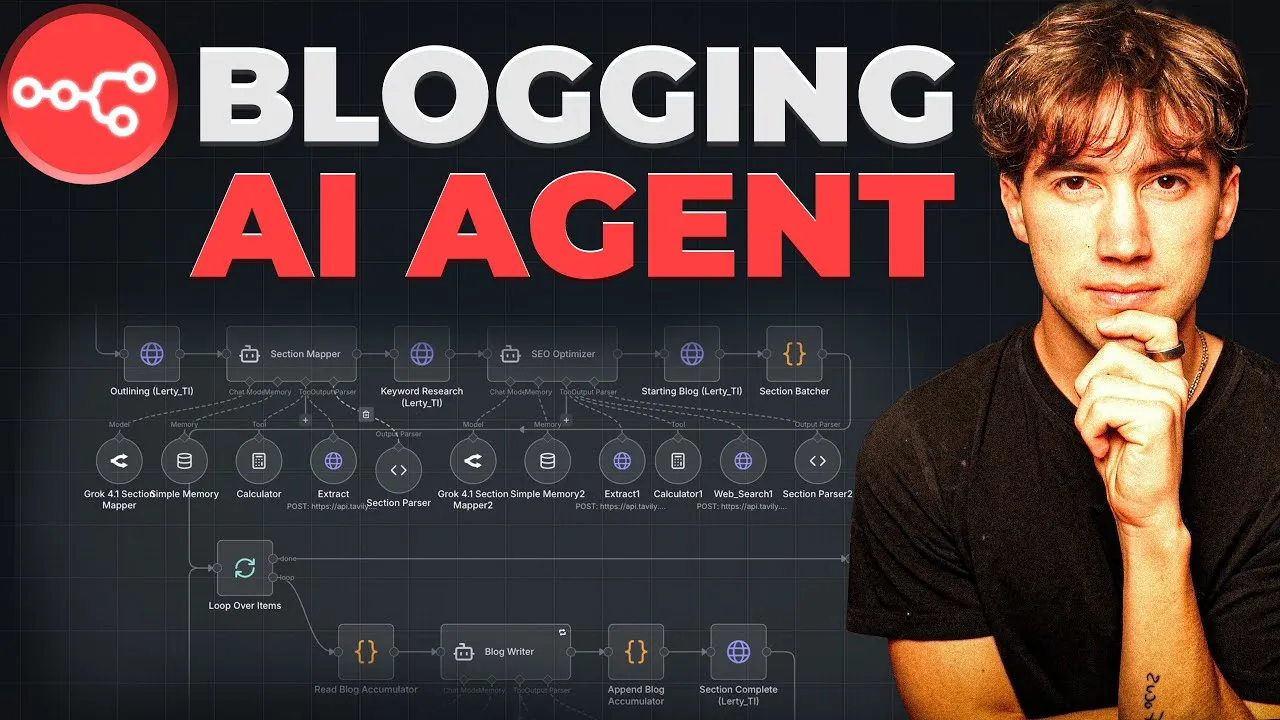
The core of this system lies in its ability to take user inputs and orchestrate a series of AI-driven tasks. The workflow is designed with two main branches: an assistant for initial brainstorming and a detailed content generation pipeline.
Users can interact with an AI assistant to explore blog post ideas, leveraging its knowledge of a specific company, its industry, and its brand voice. This initial phase helps ensure that the subsequent content is relevant and aligned with the client’s or user’s objectives.
Once ideas are generated, the workflow moves to a more structured content creation phase. A key component is the ‘human in the loop’ node, which pauses the automation to allow for user input.
Here, users can specify the blog topic, target audience, the primary goal of the post, an optional call-to-action (CTA), and a desired word count. This step is crucial for maintaining control over the content’s direction and purpose, preventing purely automated, potentially off-target output.
AI-Powered Content Generation Stages
Following user input, the workflow engages several AI agents to build the blog post:
- Researching: The AI gathers information relevant to the specified topic and audience.
- Outlining (Section Mapper): A sophisticated ‘section mapper’ agent breaks down the blog post into distinct sections. This agent considers the company context, user inputs (like word count), and aims to create sections optimized for reader engagement and retention, with specific word count targets for each section (e.g., 250-750 words).
- Keyword Research: Before writing, a keyword researcher identifies high-targeted keywords to improve the blog post’s search engine visibility.
- Blog Writer: This agent generates the actual content for each section, drawing from the research and outline. The workflow tracks progress through this stage, often indicating which section is currently being written.
- Formatting and Finalization: Once all sections are drafted, the AI formats the entire post and prepares it for output.
The system is capable of producing substantial content, with the example demonstrating a near-perfect adherence to a 2,000-word target, a feat not easily achieved by standard chatbot interactions.
Tools and Technologies
This automated blogging system relies on a combination of specialized tools:
- n8n: An open-source workflow automation tool that serves as the backbone for orchestrating the entire process. It allows for the creation of complex, multi-step workflows with conditional logic and integrations.
- Lerty: A platform developed by the creators of the workflow, designed for connecting, communicating, and sharing AI agents. Lerty acts as a user interface, enabling interaction with the AI assistant, providing status updates (like typing indicators), and offering options for human approval or action. It also facilitates sharing these AI agents with clients, potentially for a fee.
- Open Router: This service acts as a unified API gateway for various AI models. It allows users to select from a wide range of large language models (LLMs) by inputting a single API key, enabling experimentation and selection of the best-performing model for specific tasks within the workflow.
Human Oversight and Scalability
A significant aspect of this workflow is its emphasis on ‘automated control,’ a concept that balances full automation with user intervention. After the initial blog draft is generated, another ‘human in the loop’ node can present users with options.
These options might include sending the post directly to a content management system (like WordPress, Squarespace, or Wix), archiving it, or initiating a revision process. This allows for quality control and ensures that the final output meets all requirements before publication.
The flexibility of n8n allows for numerous such decision points. Users can implement switch nodes to route the content down different paths based on their selections, making the workflow highly scalable and adaptable to various use cases. The creators emphasize that while full automation is possible, incorporating human decision points can significantly reduce failure rates and enhance the overall reliability of the system.
Why This Matters
This advanced AI blogging system represents a significant step towards efficient content creation for businesses, marketers, and individual creators. By automating the research, drafting, and optimization phases, it frees up valuable time that can be redirected towards strategic growth and higher-level tasks.
The integration of human oversight ensures that AI-generated content remains aligned with brand identity, strategic goals, and quality standards. The ability to customize and scale such workflows means that companies can tailor AI solutions to their specific operational needs, potentially leading to increased productivity and cost savings in content marketing efforts.
Availability and Resources
The creators offer a free resource that breaks down this entire workflow, allowing users to copy and paste it into their n8n instance. A free Lerty account is also available for users to sign up and follow along with the process. The system is designed for easy implementation and customization, with instructions on editing system prompts to tailor the AI’s behavior.
Source: 100% AUTOMATED Blogging with AI Agents in n8n! (YouTube)