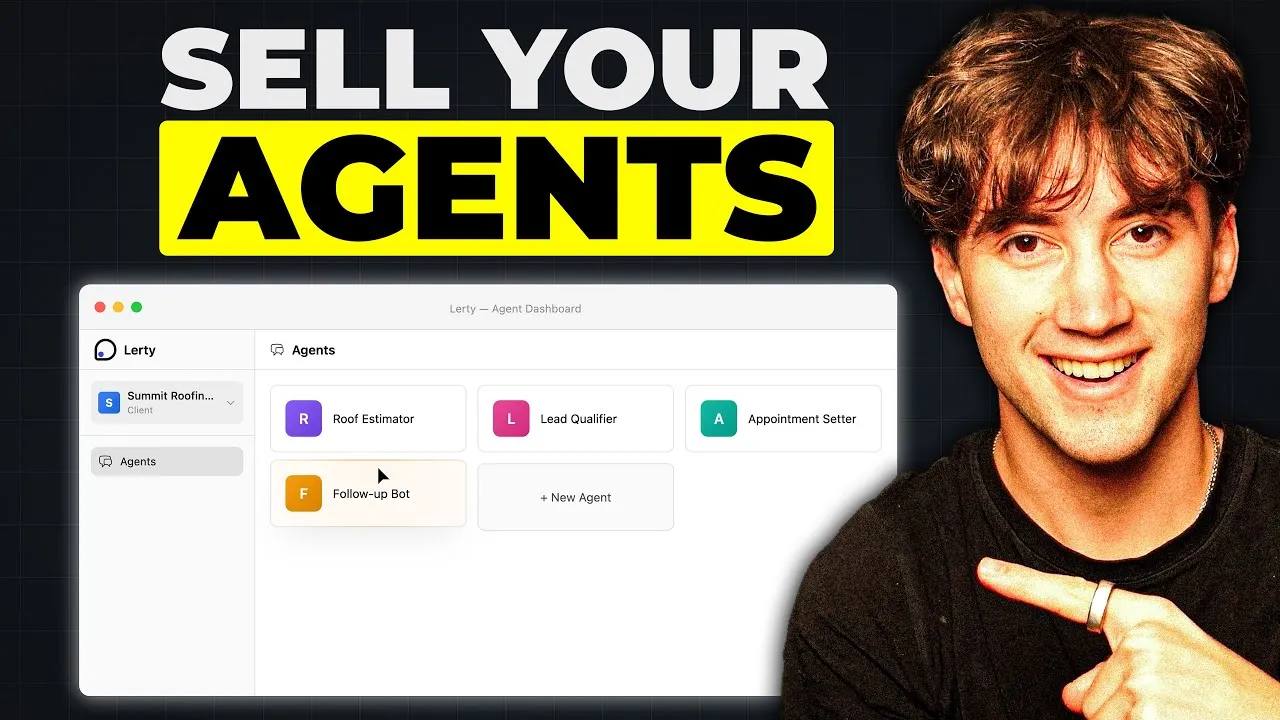
Lerty Launches to Streamline AI Agent Sales
In the rapidly evolving landscape of artificial intelligence, the ability to effectively deploy and monetize AI agents has become a critical challenge for businesses and developers alike. Addressing this gap, a new platform called Lerty has emerged, aiming to simplify the process of selling and distributing AI agents at scale. Designed with agency owners and independent developers in mind, Lerty promises an intuitive solution for integrating AI capabilities into client offerings and establishing new revenue streams.
The core problem Lerty seeks to solve is the difficulty of delivering and managing AI agents for clients. While many have learned to build sophisticated AI agents, the subsequent step of making these tools accessible, user-friendly, and commercially viable has remained a significant hurdle. Lerty positions itself as the missing piece in this ecosystem, enabling users to connect, build, and distribute AI agents across web and mobile platforms with unprecedented ease.
Connecting and Building AI Agents
Lerty’s platform is built around a flexible organizational structure. Users can create a personal organization for their own agents or set up dedicated organizations for each client. These client organizations act as dashboards where agents can be managed and shared.
The process of connecting an agent is designed to be straightforward. Lerty supports various agent types, including webhook agents, which allow integration with existing workflows built on platforms like Make (formerly Integromat) or Zapier, or any custom API. This is achieved by providing a webhook URL that connects Lerty to an external automation.
For instance, a developer could connect an agent designed to interact with YouTube video transcripts. By integrating Lerty’s webhook node into their existing Make automation, the agent can receive messages from Lerty.
To enable the agent to respond, Lerty provides an HTTP request node that can be configured using details from the agent’s connection settings. This dynamic integration allows for memory and context within conversations, as Lerty manages unique conversation IDs for each user and client, ensuring data privacy and tailored experiences.
Beyond connecting existing agents, Lerty also facilitates the creation of custom agents. The platform supports a “bring your own key” system, allowing users to connect various large language models (LLMs) from providers such as Anthropic, Gemini, Groq, OpenAI, and through OpenRouter. By simply providing an API key and a name, users can create a model profile.
These custom agents can also leverage MCP (Multi-modal Communication Protocol) connections, enabling them to interact with tools like Google Calendar. With system instructions, users can define the agent’s persona and capabilities, such as creating a Google Calendar bot that helps users book events.
Distributing Agents and Enhancing User Experience
A key differentiator for Lerty is its simplified distribution mechanism. Sharing an agent with a client is described as being easier than sharing a Google Doc. Within an organization, users can invite clients or team members by simply entering their email addresses.
Once invited, users gain access to the agents within that organization. This feature is particularly valuable for agencies looking to add monthly recurring revenue (MRR) by providing ongoing AI solutions to their existing client base.
Lerty also focuses on enhancing the user experience through customization. The chat interface can be branded with custom colors and profile photos for each agent. Custom typing indicators can be implemented, allowing workflows to display branded messages like “Finding Drake’s latest videos…” This provides users with real-time feedback on the agent’s activity, making the interaction more engaging and transparent.
Human-in-the-Loop and Mobile Accessibility
A significant innovation highlighted by Lerty is its custom “human-in-the-loop” (HITL) payload. This feature allows developers to embed interactive forms directly within agent workflows. These forms can be used for various purposes, such as requesting user input, obtaining approvals, or allowing revisions.
For example, an e-commerce agent could present an order for approval, displaying all relevant details. Users can then choose to approve or reject the request, with the decision feeding back into the workflow. More complex scenarios include advanced forms that allow users to select options, such as choosing an introduction for a blog post or specifying a writing style.
The platform’s utility extends to mobile with a fully synced iOS application. This app allows users and their clients to access and interact with AI agents on the go. The mobile experience mirrors the web interface, providing access to all agents and organizations.
Crucially, the iOS app integrates with push notifications, enabling users to receive alerts and even approve or reject requests directly from their lock screen without needing to open the Lerty app. This extends to Siri integration and Shortcuts, allowing for voice commands and automated workflows triggered by various iOS events, such as location changes or alarms.
Lerty introduces “Live Activities” for iOS, which provide real-time progress updates on ongoing processes. For instance, an e-commerce business could use this to track an order’s journey from placement to delivery, with the widget on the user’s iPhone updating dynamically as each stage is completed. This feature is invaluable for businesses that need to provide clients with live visibility into critical operations.
Why This Matters
Lerty addresses a crucial bottleneck in the AI agent market: distribution and monetization. By simplifying the process of selling and delivering AI agents, the platform empowers agencies and developers to:
- Generate Recurring Revenue: Lerty’s focus on client dashboards and easy access makes it ideal for offering AI solutions as a service, fostering monthly recurring revenue.
- Scale Operations: The ability to distribute agents in minutes, akin to sharing a document, allows businesses to scale their AI offerings rapidly.
- Enhance Client Value: By providing user-friendly interfaces, custom branding, and interactive features like human-in-the-loop, Lerty helps clients derive maximum value from AI tools, making them indispensable.
- Improve User Adoption: The intuitive web and mobile interfaces, coupled with custom branding and notifications, encourage wider adoption of AI agents within client organizations.
The platform is currently offering a founding member program for a limited group of 20-30 individuals or agencies. This program requires an investment but provides close collaboration with the Lerty team, input on the product roadmap, and access to a private community.
While not everyone will be accepted, Lerty aims to work with users who are serious about selling AI agents and can benefit from the platform’s capabilities. Public access is expected soon.
Source: Deploy & Sell AI Agents in Minutes… (Introducing Lerty) (YouTube)