AI Agents Automate Your YouTube Consumption
In a move that could significantly alter how individuals manage information overload, a new framework leveraging AI agents within the n8n automation platform promises to automate the decision-making process for consuming online content, starting with YouTube videos. This system aims to reclaim users’ time by intelligently filtering content based on personal and business goals.
The Problem: Information Overload and Wasted Time
The digital age presents a constant barrage of information through emails, news updates, social media, and video platforms. Users are often left spending a significant portion of their mental energy deciding what is relevant and what is not. This framework addresses the challenge of information overload by delegating the initial filtering and decision-making to AI agents.
The Solution: Agentic Systems in n8n
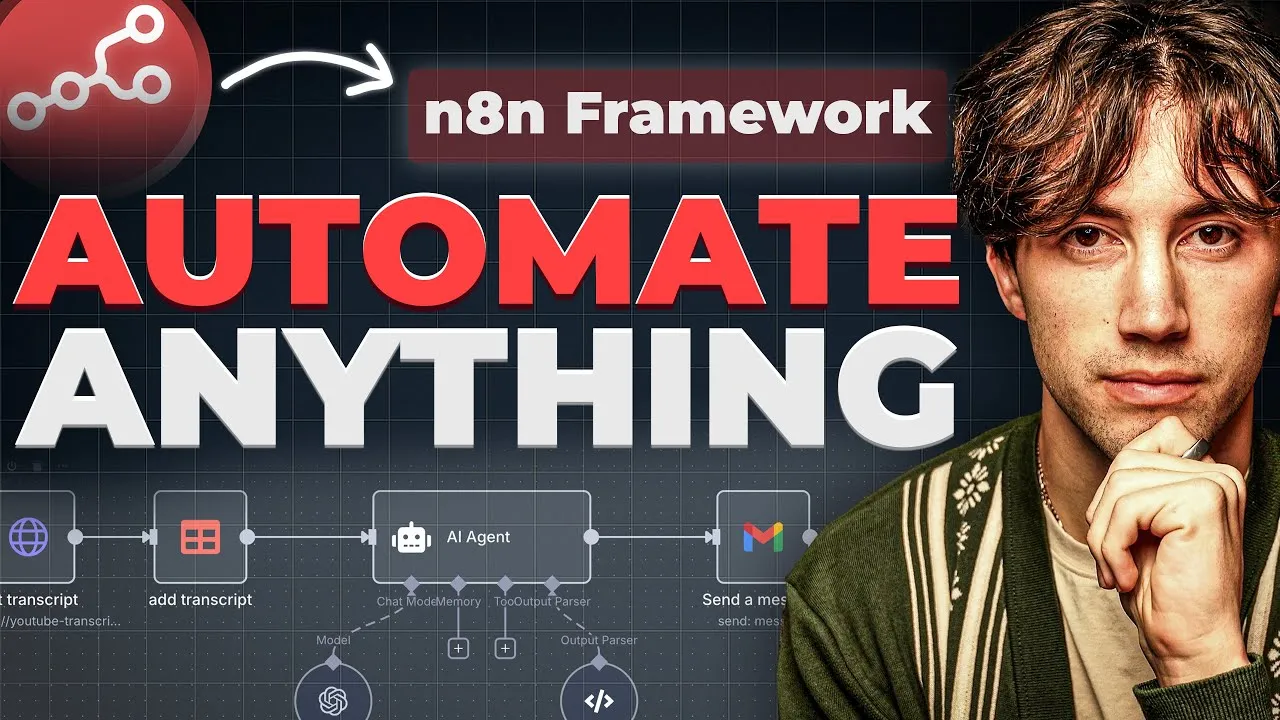
The core of this innovation lies in building agentic systems – automated workflows where an AI agent acts on behalf of the user. The described system automates the process of monitoring YouTube channels, extracting video transcripts, and then using an AI agent to determine the video’s relevance.
The agent, trained on the user’s goals and preferences, provides a summary, an ROI (Return on Investment) score, and a justification for its recommendation, all delivered via email. This eliminates the need for users to manually sift through every new video upload.
How It Works: A Step-by-Step Breakdown
The automation process involves several key stages:
- Input Monitoring: The system uses RSS feeds to monitor specified YouTube channels for new uploads.
- Data Collection: When a new video is detected, its title, URL, author, and publish date are captured.
- Transcript Extraction: A crucial step involves fetching the full transcript of the YouTube video. This is achieved using a third-party API, such as one found on RapidAPI, which can be accessed for free up to a certain limit per month.
- Database Storage: All collected information, including the transcript, is stored in a database created within n8n’s data tables feature. This ensures data persistence and accessibility.
- AI Agent Analysis: The AI agent, integrated into the n8n workflow, receives the video transcript and associated metadata.
- Decision Making: The agent is provided with the user’s defined goals, personal information, and business objectives. Based on this context, it analyzes the transcript to determine the video’s signal-to-noise ratio and overall value.
- Output and Notification: The agent outputs a concise summary of the video, an ROI score (e.g., High, Medium, Low), and the reasoning behind the score. This information is then sent to the user via email, along with a direct link to the video.
Building the Agent: Defining Goals and Instructions
A critical component of this system is the effective training of the AI agent. This involves:
- Understanding the Database: The agent must be able to access and interpret the data stored in the n8n database.
- Understanding User Goals: The agent needs clear instructions about the user’s broad objectives, such as learning specific skills, staying updated on industry trends, or identifying business opportunities. This is facilitated by a ‘root cause analysis’ process, often involving a series of ‘why’ questions to uncover the true purpose behind the automation.
- Defining Output Guidelines: The agent is instructed on how to format its responses, ensuring clarity and consistency. This often involves using JSON objects for structured output.
The system emphasizes that AI should enhance existing workflows rather than completely replace human involvement. Users remain in control, with the AI providing curated insights and recommendations.
n8n’s Role and Data Tables
The n8n platform serves as the central hub for this automation. Its recent addition of data tables is highlighted as a significant improvement, simplifying the creation and management of databases directly within the workflow environment. This eliminates the need for external database tools for many common automation tasks.
Access and Further Learning
While the video provides a framework for building these agentic systems, it suggests that a comprehensive understanding of AI agent development might require more in-depth training. The creators offer an extensive course with over 40 modules within their AI Foundations community, providing structured learning, templates, and direct support from a team of experts. A free introductory video is available for those interested in exploring the community’s offerings.
Why This Matters
This development signifies a shift towards more intelligent automation, where AI agents don’t just execute tasks but also make informed decisions. For individuals and businesses, this means:
- Time Savings: Automating content filtering frees up significant time previously spent on manual review.
- Improved Focus: By presenting only relevant information, users can concentrate on high-value activities.
- Personalized Information Flow: AI agents can be tailored to individual needs, ensuring that the content consumed aligns with personal and professional growth objectives.
- Enhanced Productivity: Delegating decision-making for routine information intake allows professionals to dedicate more cognitive resources to complex problem-solving and creative tasks.
The ability to automate the analysis of vast amounts of information, like YouTube transcripts, and receive actionable insights is a powerful application of current AI technology, making advanced automation accessible to a wider audience through platforms like n8n.
Source: Automate ANY task using AI Agents in n8n! (full system) (YouTube)