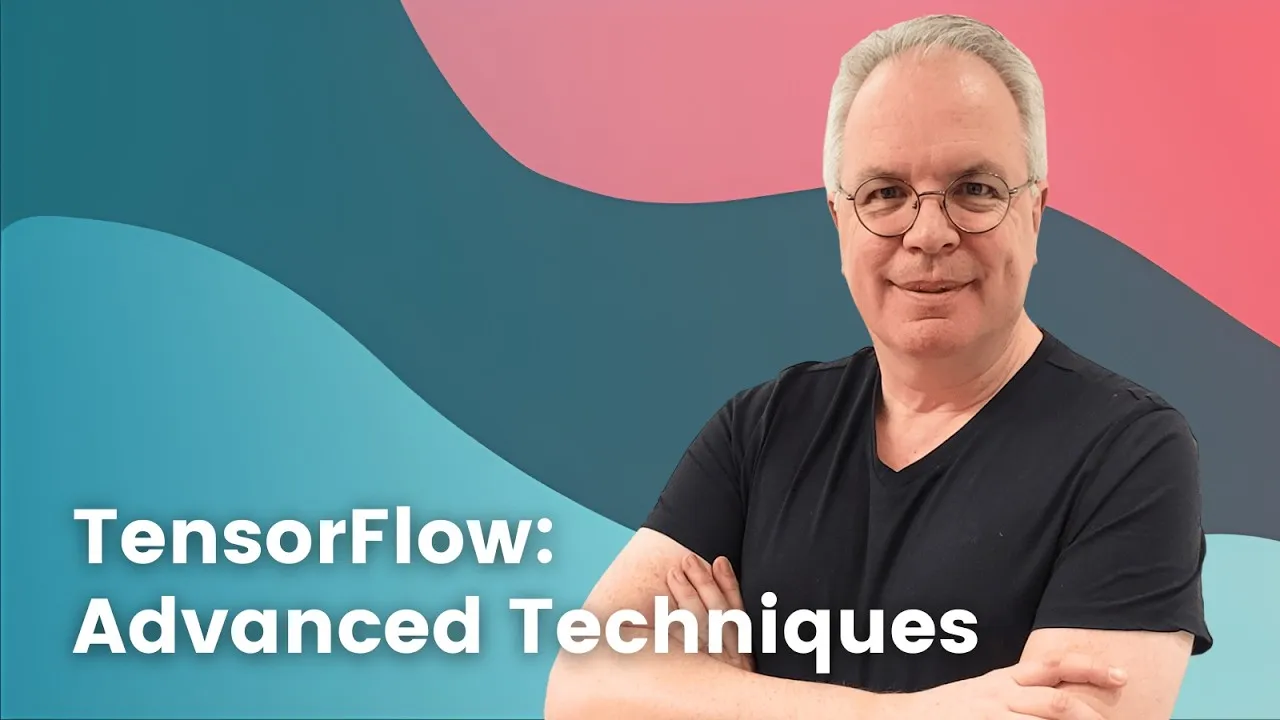
TensorFlow Advances: Build Complex AI Models
The landscape of artificial intelligence is constantly evolving, with researchers and developers pushing the boundaries of what’s possible. For those looking to move beyond standard machine learning models and dig into more sophisticated AI architectures, Google’s Developer Advocate, Laurence Moril, and DeepLearning.AI have launched a new specialization focused on advanced techniques within the TensorFlow framework. This program aims to equip learners with the skills to build and train complex neural networks, tackle challenging computer vision problems, and explore the exciting world of generative AI.
Beyond Sequential Models: The Need for Advanced Architectures
Many developers begin their machine learning journey with sequential models, where data flows linearly through a series of layers, much like a basic feedforward neural network. While effective for many tasks, these models have limitations when dealing with more intricate problems. Laurence Moril, an instructor for the specialization and author of the “AI and ML Book for Coders,” highlighted this challenge: “When I first started on my machine learning journey, I like many developers learned about how to build things in sequence…
But then I had the question like how do I do for example something like object detection? Because to train with object detection, I need to detect an object and its bounding box.
So I’d have multiple outputs. But with a sequential API like that, I couldn’t figure out how that would be done.”
This is precisely where the new specialization steps in. It addresses the need for models that can handle multiple inputs and outputs, incorporate loops for more dynamic processing, and utilize custom loss functions – elements often found in cutting-edge research papers but difficult to implement with basic sequential APIs.
Introducing the Functional API and Customization
A cornerstone of this advanced training is the introduction to TensorFlow’s Functional API. This powerful tool allows developers to define models that are not restricted to a linear flow.
“We’re going to learn how to use something called a Functional API in TensorFlow to allow us to do exactly that,” Moril explained. This enables the creation of complex, non-linear network architectures, enabling more advanced applications.
The specialization is structured into four courses, each building upon the last:
- Course 1: Custom Models, Layers, and Loss Functions: Learners will break free from pre-built TensorFlow components. This course empowers them to create their own custom layers, models, and loss functions, offering unparalleled flexibility in AI development.
- Course 2: Training Loops and Distributed Training: Moving beyond the simplicity of `model.fit()`, this course digs into the intricacies of the training loop. Participants will learn how to customize the training process and explore distributed training strategies, enabling them to leverage multiple GPUs or TPUs for faster and more scalable model training. This includes understanding how loss is reduced across different cores.
- Course 3: Advanced Computer Vision: This course applies the techniques learned in the first two to solve complex computer vision challenges. Topics include image segmentation, object detection (with a fun “zombie detector” project), and model interpretation. These are skills directly applicable to many commercial AI applications.
- Course 4: Generative Deep Learning: The final course introduces the fascinating field of generative AI. It covers techniques like neural style transfer, autoencoders, variational autoencoders, and provides an introduction to Generative Adversarial Networks (GANs). While a dedicated GAN specialization exists, this course aims to spark further interest.
Prerequisites and Target Audience
While the specialization dives deep into advanced topics, the creators aim to keep it accessible. The primary prerequisites include a solid understanding of Python and some foundational knowledge of TensorFlow.
While not requiring deep TensorFlow expertise, prior completion of the “TensorFlow Developer Specialization” from DeepLearning.AI is strongly recommended. This ensures learners have a grasp of basic concepts like sequential models and convolutions, which are revisited in the context of advanced computer vision problems.
Why This Matters
The ability to build and train complex AI models is becoming increasingly critical as AI applications mature. From more accurate object detection in autonomous vehicles to sophisticated image analysis in medical diagnostics, the demand for advanced AI capabilities is soaring.
This specialization democratizes access to these advanced techniques, allowing a wider range of developers to contribute to the next generation of AI innovation. By mastering custom architectures, efficient training loops, and generative models, developers can unlock new possibilities and create more powerful, tailored AI solutions.
Source: TensorFlow: Advanced Techniques Specialization (YouTube)