A Standard Protocol Emerges to Connect Disparate AI Agents
The rapidly evolving landscape of artificial intelligence is seeing a significant push towards interoperability, with the recent introduction of the Agent-to-Agent (A2A) protocol aiming to break down the silos that have long hindered seamless AI collaboration. Developed in a partnership between Google Cloud and IBM Research, A2A offers an open standard for how AI agents, regardless of the framework they are built upon or the teams that developed them, can discover and communicate with each other. This initiative promises to streamline the integration process, which has traditionally required extensive custom development.
Understanding the A2A Protocol
Fundamentally, A2A operates on a client-server communication model. An A2A client, which can be integrated into an application or directly within an AI agent, sends requests to an A2A server.
This server, in turn, hosts AI agents that are capable of responding to these requests. This standardized approach allows different development teams to build agents independently, expose them as A2A servers, and then enable A2A clients to discover and connect to them.
This architecture facilitates the creation of complex, multi-agent systems. For instance, in a hierarchical agentic setup, an orchestrator agent can leverage A2A clients to delegate tasks to specialized remote agents. This not only promotes the reuse of existing agents across various projects but also allows individual agents to be updated or improved without necessitating a complete overhaul of the entire system.
Industry Backing and Open Governance
A2A was initially announced by Google Cloud in April 2025 and was subsequently donated to the Linux Foundation in June 2025. This move ensures that the protocol remains open-source and governed by the community, fostering broader adoption and development.
IBM’s own Agent Communication Protocol (ACP) was merged with A2A shortly after, further solidifying its position as an emerging industry standard. A2A is designed to work in conjunction with ACP; agents using A2A can leverage ACP to access external services and data before utilizing A2A to collaborate with peer agents.
Learning and Building with A2A
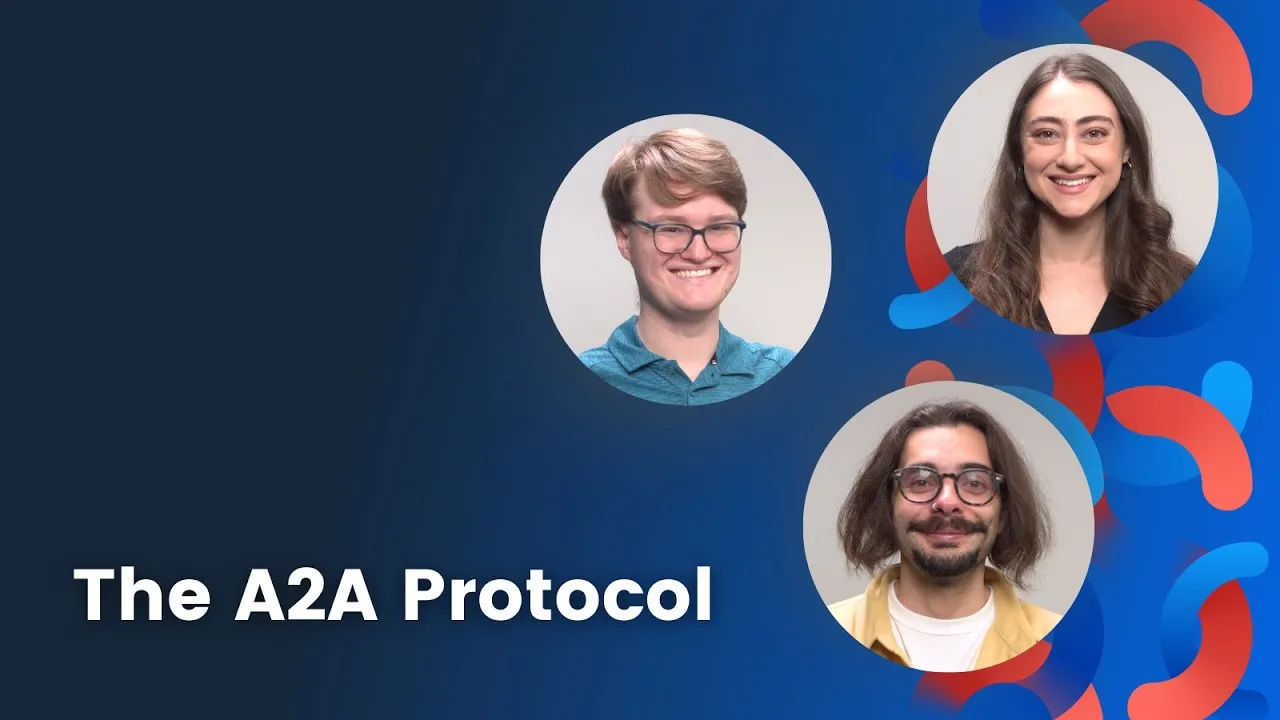
A comprehensive course, co-hosted by Ivan Nardini and Sandy Bessen, has been developed to guide users through the intricacies of A2A. The curriculum focuses on practical application, teaching participants how to create A2A-compliant agents. This involves setting up an agent within a server and interacting with it via an A2A client.
The course features hands-on projects that build three distinct A2A remote agents:
- An insurance assistant agent built without a specific framework.
- An EL research agent utilizing Google’s Agent Development Kit (ADK).
- A doctor matching agent developed with LangGraph.
Participants will then learn to chain these agents together in sequential workflows, initially using Google’s ADK. The training progresses to dynamic orchestration using IBM Research’s BAI framework. Within the BAI framework, a requirement agent can be used to intelligently hand off tasks to specialized A2A agents as needed.
The final step in the learning process involves deploying these A2A agents onto Agent Stack. Agent Stack is an open-source, self-hostable infrastructure designed to simplify the deployment, operation, and sharing of A2A agents within an organization.
Why This Matters
The A2A protocol represents a significant step forward in the development of sophisticated AI systems. By standardizing how AI agents communicate, A2A breaks down technical barriers that have previously limited collaboration. This is particularly impactful for:
- Inter-Team Collaboration: Teams working on different AI components can integrate their work more easily, even if they use different development tools or languages.
- Reusability of AI Assets: Organizations can build a library of specialized AI agents that can be readily deployed across various projects, saving time and resources.
- System Scalability and Maintainability: Complex AI systems can be built modularly, allowing for easier updates, scaling, and troubleshooting of individual components without affecting the entire system.
- Democratization of AI Development: By providing an open standard and accessible tools, A2A can lower the barrier to entry for developing and deploying advanced AI applications.
The collaboration between IBM and Google on A2A highlights the industry’s recognition of the need for standardized agent communication. As AI systems become more pervasive and complex, protocols like A2A will be crucial for unlocking their full potential and enabling a new era of intelligent automation and collaboration.
Source: Use A2A to connect agents across different frameworks and teams (YouTube)