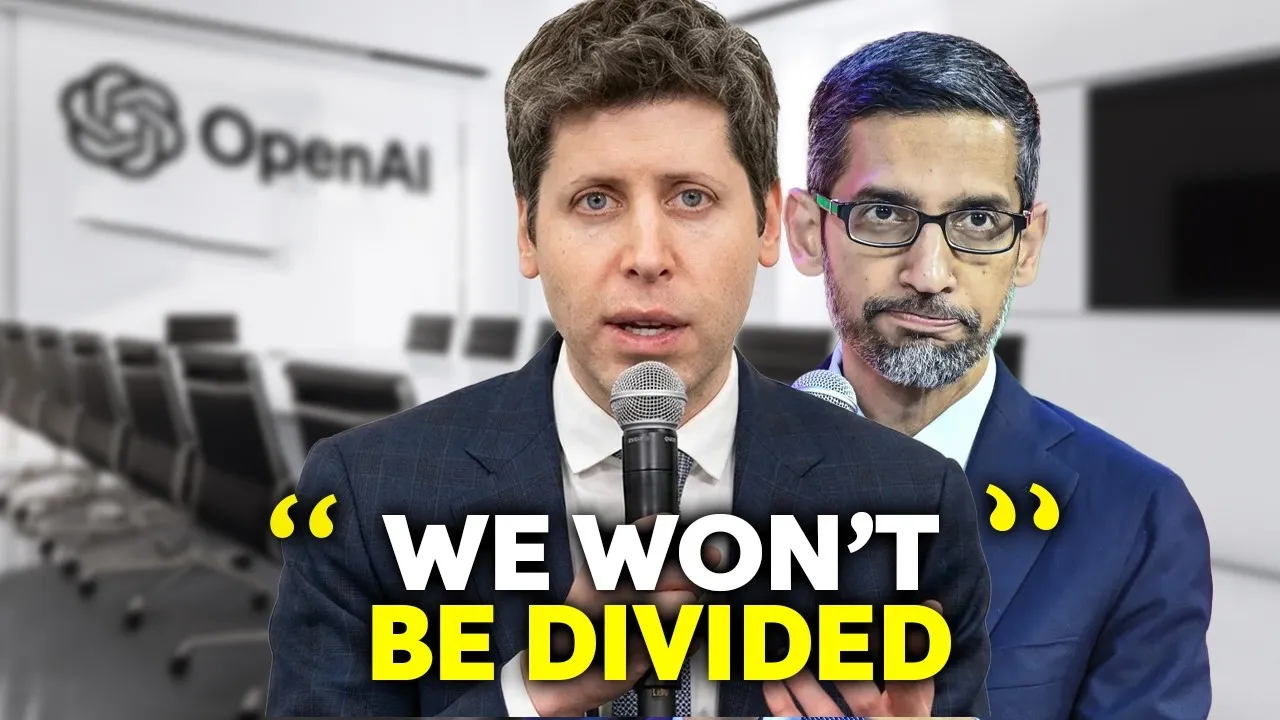
AI Giants Unite Against Military AI Demands
In a significant development that underscores growing ethical concerns within the artificial intelligence industry, employees from Google and OpenAI have jointly penned an open letter urging their leadership to refuse U.S. government demands for AI models to be used in military applications, specifically for mass domestic surveillance and autonomous killing without human oversight. This unprecedented collaboration between two of the world’s leading AI developers signals a powerful stance against potentially harmful applications of their technology.
A United Front Against Unchecked AI Deployment
The open letter, which has gained traction on social media, highlights a growing divide between AI developers and certain governmental military objectives. While companies like Anthropic have previously voiced reservations and set boundaries regarding the military use of their AI models, the involvement of Google and OpenAI amplifies the pressure. The letter states, “We hope our leaders will put aside their differences and stand together to continue to refuse the Department of War’s current demands for permissions to use our models for mass domestic surveillance and autonomously killing people without human oversight.”
The signatories represent a substantial portion of the top talent at these organizations. At the time of the letter’s publication, 209 Google employees and 64 OpenAI employees had signed on, with the expectation that more would join. This collective action is rooted in a moral understanding of right and wrong, particularly as the technology may not yet be sufficiently mature or safe for such critical applications.
The Defense Production Act and Shifting Negotiations
The situation has intensified as the U.S. government, particularly the Department of Defense, has reportedly considered invoking the Defense Production Act (DPA). This act could compel companies like Anthropic to comply with military demands, potentially labeling non-compliance as a supply chain risk. Anthropic, however, has remained firm on its red lines, refusing to allow its models, like Claude, to be used for domestic mass surveillance or autonomous killing without human oversight.
Discussions between the Pentagon and major AI firms are ongoing. While Google’s Gemini, OpenAI’s models, and Elon Musk’s XAI Grok are reportedly available on the military’s unclassified systems, the core of the contention lies in the “all lawful uses” clause.
This broad criterion, which allows the government to define what constitutes a lawful use, is a point of significant unease for many AI researchers. They fear that this could lead to the normalization of ethically questionable applications, turning AI development into a tool for immoral ends.
Sources suggest the Pentagon has been actively engaging with OpenAI to accelerate talks, though significant hurdles remain. While Google was initially perceived as being closer to an agreement, a defense official disputed this, stating that talks were active with both companies and that the department expected both to sign.
However, the “all lawful uses” standard remains a critical sticking point. OpenAI’s researchers, in particular, are reportedly hesitant, influenced by Anthropic’s established ethical stance.
Solidarity in the Face of Pressure
The open letter explicitly addresses the government’s potential strategy of divide and conquer. “The strategy only works if none of us know where the others stand,” the letter reads, emphasizing its role in fostering “shared understanding and solidarity in the face of pressure from the department of war.” The AI community recognizes the government’s tactic of offering incentives and highlighting rivals’ progress to pressure companies into compliance. By banding together, these employees aim to present a unified front, arguing that the technology is not yet ready for the proposed military applications and that proceeding would be reckless.
The leadership shown by Anthropic is widely acknowledged as a catalyst. Their willingness to hold firm on ethical principles has seemingly emboldened other companies and their employees to question and resist potentially harmful government demands. This collective resistance could compel the government to re-evaluate its requests and explore more collaborative approaches to AI development for defense purposes.
The XAI Exception?
Elon Musk’s AI venture, XAI, appears to be taking a different path. Reports suggest that XAI has reached a deal with the Pentagon to use its Grok model within classified systems, potentially agreeing to the “all lawful uses” standard. This stands in contrast to the unified stance of Google and OpenAI employees, raising concerns among those advocating for stricter ethical controls on AI in warfare.
A Historical Precedent: The 2018 Pledge
The current debate is not without historical context. In 2018, a significant number of AI researchers, including prominent figures like Google DeepMind’s Chief Scientist Jeff Dean, signed the “Lethal Autonomous Weapons Pledge.” This pledge explicitly stated, “the decision to take a human life should never be delegated to a machine.” The letter garnered over 5,000 signatures and warned against an arms race in autonomous weapons, highlighting their potential for violence and oppression when combined with surveillance technologies.
The 2018 pledge emphasized that lethal autonomous weapons differ from traditional weapons of mass destruction and that unilateral development could trigger an unmanageable arms race. The concerns raised then—the difficulty of assigning risk, the potential for misuse, and the lack of global governance—remain highly relevant today. The current stance by Anthropic, OpenAI, and Google employees echoes these long-standing ethical considerations, suggesting a persistent commitment within the AI community to prevent the weaponization of advanced AI.
Why This Matters
The collective action by employees at Google and OpenAI is a critical development in the ongoing debate about the ethical deployment of artificial intelligence. It demonstrates that the individuals building these powerful tools are increasingly concerned about their potential misuse, particularly in contexts that involve lethal force and mass surveillance. This internal pressure could significantly influence corporate policy and governmental negotiations.
If major AI developers collectively refuse to provide technology for applications deemed unethical or unsafe, it could force a re-evaluation of military AI strategies and accelerate the development of robust international norms and regulations. The stance taken by these employees could ultimately shape the future trajectory of AI, ensuring it serves humanity rather than poses an existential threat.
Source: OpenAI & Google Just JOINED FORCES – Staff Demand “No Killer AI” (YouTube)