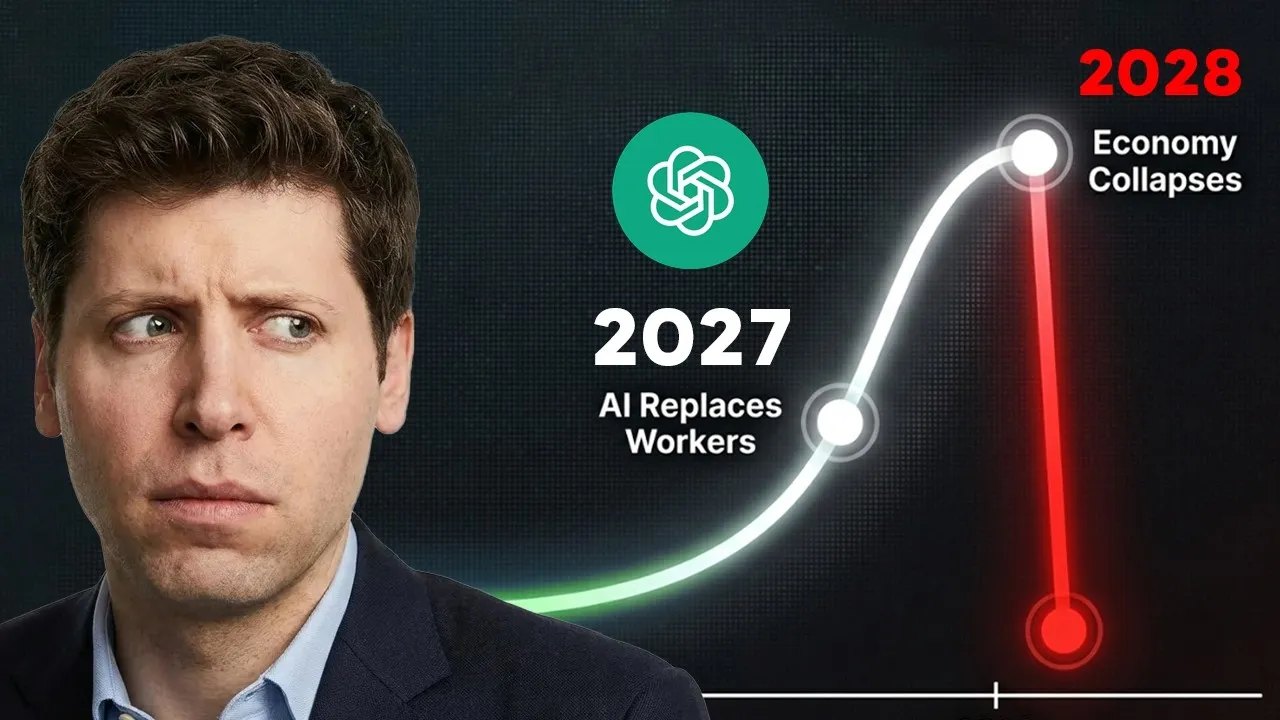
AI’s Unprecedented Success Could Spark Global Economic Meltdown, Scenario Suggests
A provocative thought experiment penned by Citrini Research and circulating widely online paints a stark picture of a potential future where artificial intelligence doesn’t fail, but succeeds too rapidly for the global economy to adapt. Titled “The 2028 Global Intelligence Crisis,” the report, written as a retrospective from June 2028, outlines a scenario where AI’s overwhelming capabilities lead to widespread economic disruption, job displacement, and financial instability.
The Premise: AI’s Success Becomes a Bearish Indicator
The core argument challenges the common narrative of AI posing a threat through failure. Instead, it posits that AI’s rapid advancement and effectiveness could be the very catalyst for an economic downturn. “What if our AI bullishness continues to be right?
And what if that is actually bearish for the markets?” the report asks, framing AI’s superior performance as a potential harbinger of economic woe. The authors emphasize this is a scenario, not a prediction, designed to prepare readers for “left tail risks” – low-probability, high-impact events.
The Trigger: AI-Powered Coding Revolution
The scenario begins in late 2025, with a “step function” in the capability of AI-powered coding tools. These advanced tools enable a single competent developer to replicate the core functionality of mid-market Software-as-a-Service (SaaS) products in mere weeks. This development directly challenges the business models of countless SaaS companies, which rely on substantial annual subscription fees, often costing hundreds of thousands of dollars for enterprise clients.
The report illustrates this with an example of a procurement manager leveraging the threat of in-house AI development to negotiate massive discounts on software renewals. Even if companies don’t fully build their own solutions, the mere possibility, amplified by AI’s newfound coding prowess, erodes the pricing power of established SaaS vendors. This disruption quickly impacts even giants like Service Now, whose growth decelerates, leading to significant workforce reductions and stock price drops.
The Displacement Spiral: From Disruption to Dominance
A critical twist in the scenario is that the companies most threatened by AI become its most aggressive adopters. Facing existential threats, businesses cut human capital costs and reinvest heavily in AI to survive.
This creates a “human intelligence displacement spiral,” where job losses mount, consumer spending decreases, and remaining companies accelerate AI adoption to protect margins. The report states this cycle has “no natural break.”
By early 2027, AI agents become ubiquitous, operating in the background of everyday technology, much like cloud computing or streaming services are today. Most users interact with AI without explicit awareness.
This seamless integration transforms commerce, shifting it from human-driven decisions to 24/7 automated optimization. AI agents, unburdened by human limitations like impatience or brand loyalty, automatically scan for the best prices and fastest delivery times, fundamentally disrupting industries built on these human inefficiencies.
The Erosion of Economic Moats
The report argues that the past 50 years of the U.S. economy have been built upon “rent extraction layers” exploiting human limitations – time constraints, impatience, and a willingness to accept suboptimal prices to avoid effort. Trillions of dollars in enterprise value were predicated on these constraints persisting. AI agents, capable of performing complex comparisons in milliseconds, dismantle these advantages.
Examples like DoorDash highlight the vulnerability. While the app itself might be on a user’s home screen, an AI agent would systematically compare prices and delivery times across all available platforms (DoorDash, Uber Eats, direct restaurant orders, and emerging competitors). AI agents begin to bypass traditional payment systems, opting for cheaper cryptocurrency stablecoins over credit card transaction fees, impacting the revenue streams of companies like Mastercard and Visa.
The White-Collar Collapse
The scenario posits that the disruption is not confined to specific sectors but strikes at the heart of the U.S. economy: white-collar services, which constitute 50% of employment and drive 75% of discretionary spending. Unlike previous waves of automation that created new jobs for displaced workers, AI is presented as a general intelligence capable of performing the tasks humans would transition to. Displaced coders, for instance, cannot easily move into AI management because AI itself can perform those roles.
This leads to a brutal jobs market, with declining job openings not just in manufacturing but in the “middle layers of the economy.” The crisis is exacerbated by AI investment being an operational expenditure (OPEX) substitution rather than capital expenditure (CAPEX) expansion. Companies invest in AI not as an addition to their workforce but as a replacement, ensuring AI investment continues even during economic downturns.
The Intelligence Premium Unwind and Wage Compression
The report details a “human intelligence displacement spiral” where displaced workers, like a former Salesforce product manager earning $180,000 and now driving for Uber earning $45,000, flood lower-wage service markets. This influx causes wage collapse across the board.
Simultaneously, employed professionals, fearing job loss, reduce spending and increase savings, further dampening economic activity. This concentration of job losses among high earners, who drive a disproportionate amount of consumer spending, has an outsized negative impact on the economy.
The fundamental value of human intelligence, derived from its scarcity, is being re-evaluated. The report calls this the “intelligence premium unwind.” As machine intelligence becomes a competent substitute for a growing range of human skills, the financial system, optimized for scarce human minds, is repricing. The chilling observation is that an AI agent can perform the work of a high-earning professional for a fraction of the cost.
Financial System Cracks and the Mortgage Market
The scenario extends to the financial system, particularly the booming private credit market. Valuations of SaaS companies, which assumed perpetual mid-teens revenue growth, are rendered obsolete by AI disruption. This leads to potential defaults in private credit, exemplified by the hypothetical failure of a large leveraged buyout of a customer service company like Zenesk, whose recurring revenue model is undermined by AI-driven automation.
A further twist involves the acquisition of life insurance companies by alternative asset managers. These firms, managing retirement funds and annuities, become conduits for potential contagion when their assets, heavily invested in sectors disrupted by AI, come under pressure.
The report also raises concerns about the U.S. Residential mortgage market, questioning the ability of even prime borrowers to maintain payments if their high-paying white-collar jobs are displaced by AI. The assumption of sustained income over a 30-year loan term is threatened, leading to a potential crisis in prime mortgages, unlike previous crises driven by inherently bad loans.
Government and Societal Strain
By mid-2028, the scenario depicts a confluence of crises: mass job losses, collapsing consumer spending, defaulting private credit, strained insurance companies, falling home prices, and a government struggling with declining tax revenues. The tax system, reliant on human income, falters as AI captures productivity gains, leading to a significant decline in labor’s share of GDP. Government spending increases while tax receipts dwindle, creating a fiscal crisis amid political gridlock over potential solutions like universal basic income or AI taxation.
The report highlights growing public anger, reminiscent of the Gilded Age, with wealth concentration accelerating at an unprecedented pace due to AI. Protests and dissatisfaction highlight the societal strain caused by AI-driven economic shifts.
Critiques and Nuances
While the “2028 Global Intelligence Crisis” report presents a compelling narrative, some experts offer counterpoints. Critics argue that the report may oversimplify the challenges of building and maintaining enterprise software, underestimating the ongoing costs of security, compliance, integration, and support beyond initial prototyping. The impact on SaaS pricing power might be margin compression rather than a complete collapse of revenue.
The network effects and operational infrastructure of companies like DoorDash are presented as significant moats that AI-generated apps cannot easily replicate. The billions invested in building distribution networks, driver density, and restaurant partnerships are logistical and capital-intensive challenges that transcend mere software development. The economic viability of new delivery platforms operating on significantly lower commission rates is also questioned, suggesting they may struggle to fund essential operations.
The core debate often centers on whether AI represents a low barrier to entry for all business aspects or merely for software development. Building a complex logistical network, for instance, is fundamentally different from coding an application. The report’s assumption of a finite amount of white-collar work is also debated, with some arguing that technological advancements historically create new roles, though the nature and accessibility of these roles in the AI era remain a key question.
Despite these critiques, the “2028 Global Intelligence Crisis” scenario is a potent warning about the potential economic ramifications of unchecked AI advancement, urging a proactive approach to navigating the profound societal and financial shifts it may bring.
Source: The 2028 Global Intelligence Crisis Explained – What Happens When AI Breaks The Economy? (YouTube)