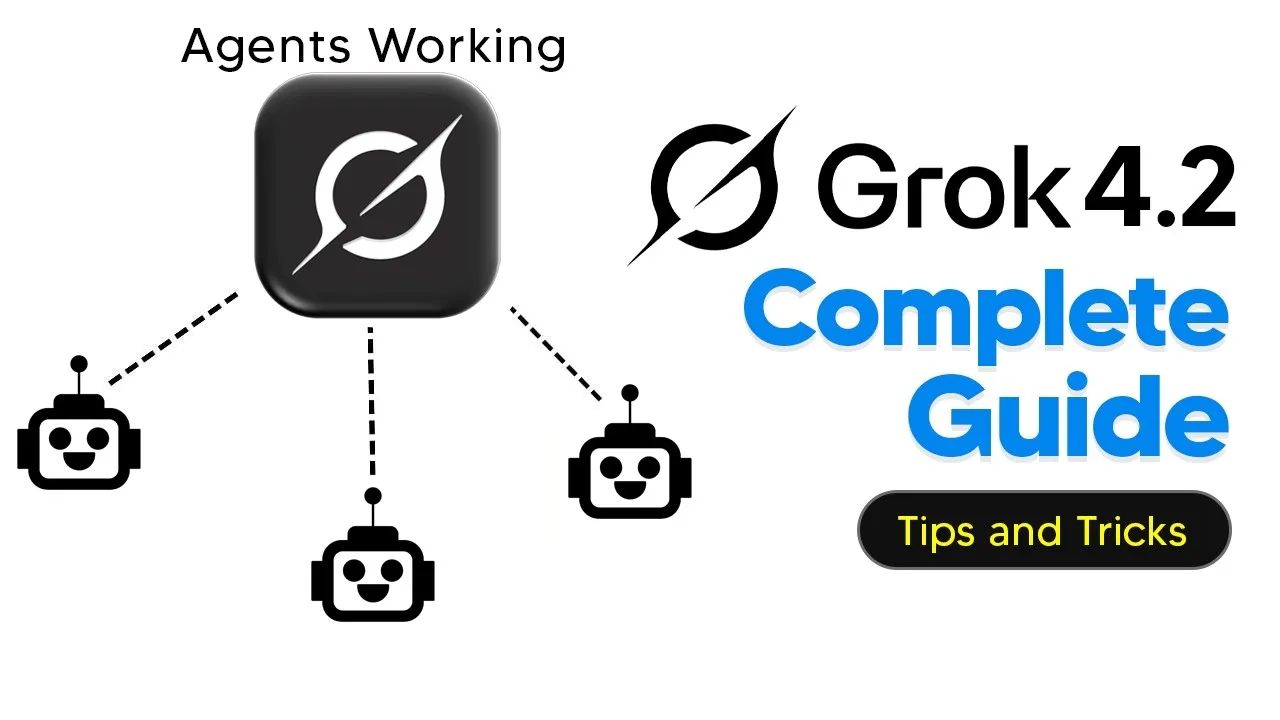
Grok 4.20 Unleashes AI Agents for Deeper Reasoning
The AI landscape is constantly evolving, and a significant recent development comes from Elon Musk’s xAI with the beta release of Grok 4.20. This isn’t just another iteration of a large language model; Grok 4.20 introduces a novel approach by functioning as a suite of specialized AI agents, designed to tackle complex queries through collaborative reasoning. This new framework aims to provide more nuanced and accurate responses by distributing tasks among distinct AI personalities, each with a defined role.
Accessing Grok 4.20
For users eager to explore Grok 4.20, access is not universal. The advanced capabilities of Grok 4.20 are currently exclusive to subscribers of the premium tier, which is priced at $30 per month. It is not available on the free tier of Grok.
Understanding the Agent Framework
Grok 4.20 operates not as a single monolithic AI, but as a team of four specialized agents. This multi-agent system is designed to enhance the quality of responses, particularly for complex or open-ended questions where multiple perspectives are beneficial. The agents and their roles are:
- Captain Grok: The coordinator, responsible for assigning tasks to the other agents and synthesizing their findings into a final output.
- Harper: The research and fact-finding expert, tasked with gathering information and evidence.
- Lucas: Focused on creativity and balancing different viewpoints, often exploring opposing arguments or synthesizing information.
- Benjamin: The specialist in mathematics, coding, and logical reasoning, responsible for fact-checking and analytical tasks.
This collaborative structure is key to Grok 4.20’s enhanced reasoning capabilities. By having distinct agents handle different aspects of a query – research, counter-arguments, fact-checking, and summarization – the system aims to reduce the likelihood of AI hallucinations and provide more balanced, well-supported answers.
Prompting for Optimal Results
The effectiveness of Grok 4.20 hinges on how users structure their prompts. The multi-agent system thrives on prompts that encourage collaboration and diverse input.
A key strategy involves directing specific agents to perform particular tasks. For instance, when seeking an answer to a question with no clear consensus, like the optimal time to buy Bitcoin, a structured prompt might look like this:
“Harper, please research information on the best time to buy Bitcoin. Then, Lucas, consider opposing views via research too.
Benjamin, fact-check their results. Finally, Captain Grok, please summarize and provide a final output.”
This prompt guides Harper to gather supporting information, Lucas to find counter-arguments, Benjamin to verify the findings, and Captain Grok to compile everything into a coherent answer. This structured approach ensures that the AI considers multiple facets of an issue, leading to a more robust and less biased output.
Use Cases and Examples
Grok 4.20 shines in scenarios demanding nuanced analysis, such as exploring controversial topics or complex economic questions. Consider a prompt regarding universal basic income (UBI):
“I believe that universal basic income will lead to a 20% decrease in GDP. Benjamin, find the strongest data supporting my claim. Harper, find the strongest data refuting it using certain economic reports.
Lucas, create a synthesis that explains the middle ground theory. Then, ask Lucas to fact-check all findings, ensuring accuracy. Finally, Captain Grok, act as a judge and tell me which agent presented the more logically sound argument based on the evidence provided and reach a logical conclusion.”
In this case, Benjamin would seek data supporting the negative GDP impact, Harper would find evidence against it, Lucas would synthesize these points and fact-check, and Captain Grok would evaluate the arguments. This process allows the AI to present a balanced view, highlighting the complexities and dependencies of the issue, rather than offering a simplistic answer.
Addressing Limitations and Nuances
Despite its advanced capabilities, users must be aware of Grok 4.20’s limitations. The model is noted to be highly computer-intensive, meaning users may encounter usage limits relatively quickly, especially when leveraging its advanced reasoning functions.
The transcript highlights an instance where a user hit their limit after fewer than 10 messages. Therefore, careful consideration of when to deploy Grok 4.20 for its complex reasoning is advised.
While the agent system helps reduce hallucinations, AI responses should always be critically evaluated. The system doesn’t possess long-term memory, so providing sufficient context in prompts is crucial for accurate and relevant outputs.
Why This Matters
The introduction of Grok 4.20’s multi-agent system represents a significant step forward in AI usability. By breaking down complex tasks and assigning them to specialized AI agents, Grok 4.20 moves beyond simple text generation towards more sophisticated problem-solving and analytical capabilities. This approach has the potential to:
- Improve Accuracy: The division of labor and built-in fact-checking mechanisms can lead to more reliable information.
- Enhance Nuance: By considering opposing viewpoints and synthesizing information, the AI can offer more balanced and comprehensive analyses.
- Democratize Complex Reasoning: Users can leverage a powerful reasoning engine without needing to be AI experts, by structuring their prompts effectively.
- Reduce Hallucinations: The collaborative process, with distinct roles for research, counter-argument, and verification, is designed to mitigate the generation of false information.
This development could have profound implications across various fields, from academic research and financial analysis to creative problem-solving and informed decision-making. The ability to query an AI that can effectively simulate a council of experts, each with a different specialization, offers a powerful new tool for information processing and understanding.
Comparison to Standard Prompts
The difference in output quality when using structured, agent-directed prompts versus basic prompts is substantial. A simple prompt like “Is this right?” will yield a less detailed and potentially less accurate response, even when using the agent framework implicitly.
In contrast, the explicit instruction to specific agents to research, counter-argue, and fact-check results in a more thorough, step-by-step analysis that provides greater confidence in the conclusion. The ability to review the reasoning trace, showing how each agent contributed, further demystifies the AI’s process and builds trust.
Availability and Future Outlook
Grok 4.20 is currently in beta and accessible via a $30 per month premium subscription. While not designed for coding or highly technical tasks in the same vein as some other models, its strength lies in its advanced reasoning and analytical capabilities. This focus on day-to-day usefulness, as envisioned by Elon Musk, positions Grok 4.20 as a tool for deeper understanding and informed decision-making, rather than just a generative assistant.
Source: Grok 4.2 Agents For Beginners – Grok 4.2 Full Guide With Usecases (YouTube)