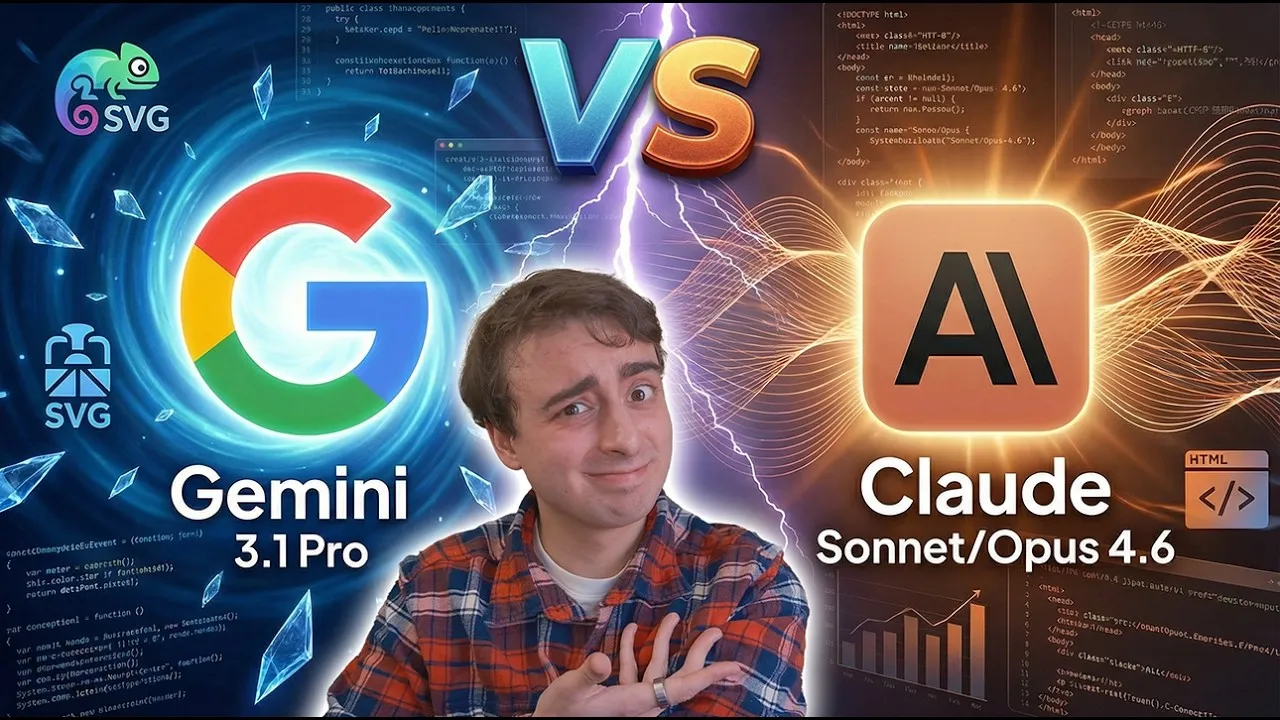
Google’s Gemini 3.1 Emerges as a Powerhouse AI
Google has officially launched Gemini 3.1, its latest and most advanced artificial intelligence model. Building upon the foundational capabilities of its predecessor, Gemini 3.1 promises enhanced performance and versatility, setting a new benchmark in the rapidly evolving AI landscape. Early demonstrations and community testing reveal significant leaps in areas like complex code generation, creative content production, and sophisticated 3D spatial reasoning, positioning Gemini 3.1 as a formidable competitor against established models like OpenAI’s GPT series and Anthropic’s Claude.
Key Advancements in Gemini 3.1
Gemini 3.1 is designed to impress with its breadth of capabilities. Unlike earlier models that might generate single images or simple text outputs, Gemini 3.1 can now produce complex, animated assets.
For instance, it has demonstrated the ability to animate a full SVG of a train moving through a mountain landscape, a task that requires a deep understanding of animation, spatial relationships, and coding. This level of creative output was previously considered highly advanced and time-consuming for AI models.
Comparing with Competitors
In direct comparisons, Gemini 3.1 Pro has shown remarkable performance. When pitted against Grok 4.20, which utilizes four Grok agents simultaneously, Gemini 3.1 Pro’s output for a complex prompt was deemed superior. While Grok’s attempt included elements like all four seasons and a tunnel, the execution was described as rudimentary.
In contrast, Gemini 3.1 Pro generated a train animation that included lighting effects within the tunnel, showcasing a higher degree of detail and realism. The speed of Gemini 3.1’s response is also noteworthy; while a full animated SVG generation might take a couple of minutes, it significantly outperforms models like ChatGPT Pro, which would typically require much longer. The closest competitor in terms of trading blows back and forth remains Claude Opus 4.6, indicating a tight race at the top tier of AI development.
Visual Understanding and Spatial Reasoning
A standout feature of Gemini 3.1 is its enhanced visual understanding and reasoning capabilities. The model can accurately identify actors and scenes from blurry images, proof of its advanced image recognition. Gemini 3.1 is being hailed for its state-of-the-art 3D spatial reasoning.
Community demos have showcased the AI generating intricate 3D models and simulations. For example, users have generated detailed 3D reconstructions of dirt bikes, complete with visible engines, wheels, and frames, all constructed by the AI writing code to define the spatial relationships and object properties.
Similarly, pneumatic cylinder simulators with live data feeds, ocean simulations with realistic wave dynamics, and even complex double wishbone suspension systems for vehicles have been generated. These demonstrations highlight Gemini 3.1’s ability to not only understand visual input but also to translate that understanding into complex, coded 3D structures.
Web App vs. API Performance
Testing Gemini 3.1 through its web app interface reveals a focus on speed and efficiency for quick chats. While impressive for rapid responses, this interface sometimes appears to operate in a ‘low-thinking mode,’ potentially limiting its ability for more complex, long-term tasks. For more demanding applications, using the Gemini 3.1 Pro API is recommended.
With settings like ‘Deep Think’ or ‘high thinking’ enabled via the API, the model demonstrates a greater capacity for intricate problem-solving and detailed output. However, even with these settings, achieving perfect results on massive projects can still be challenging, sometimes requiring multiple passes or refinements. The AI Studio’s ‘vibe coding’ interface also offers a way to build apps, with Gemini 3.1 available, though its performance on extensive projects can vary.
Gemini Deep Think and Anti-Gravity Environments
Google’s Gemini Deep Think, which recently received an update, appears to leverage Gemini 3.1’s capabilities for more intensive tasks. When forced into a heavy thinking mode, it provides significantly better results than the standard web app.
The ‘Anti-Gravity’ environment, a desktop application for building apps, also integrates Gemini 3.1 Pro and has shown exceptional results, particularly when allowed multiple passes for complex projects. This environment has produced the most impressive Gemini 3.1 outputs observed, including sophisticated website designs with skeuomorphic aesthetics, detailed data visualizations, and even interactive 3D elements, albeit with some limitations in areas like suspension simulation.
Comparison with Claude 4.6
When directly comparing Gemini 3.1 Pro with Claude Sonnet 4.6 and Opus 4.6, nuanced differences emerge. While Gemini 3.1 Pro excels in certain areas, Claude models often exhibit a more ‘agentic’ and personable behavior, feeling more alive and hardworking, even within their web interfaces. Claude Sonnet 4.6, for instance, produced a highly animated and informative website comparing vehicle generations, including detailed graphs and rudimentary 3D suspension models.
Claude Opus 4.6, when used with extended thinking, generated an entire HTML file for a comparative analysis, showcasing excellent web design, functional 3D visualizations for learning about suspension types, and highly accurate torque curve graphs. In complex creative tasks, such as synthesizing xenobiological scenarios for alien planets, Claude models, particularly Opus 4.6, provided more detailed, structured, and well-sourced responses compared to Gemini 3.1 Pro’s output via the web app.
Pricing and Availability
Gemini 3.1 Pro is currently available through the Google AI Studio and via API. Pricing details indicate Gemini 3.1 Pro costs $2 per million input tokens and $12 per million output tokens. This positions it competitively against Claude Sonnet 4.6, which is priced at $3 per million input tokens and $15 per million output tokens, making Gemini 3.1 Pro generally more cost-effective for comparable tasks.
Why This Matters
The release of Gemini 3.1 signifies a significant step forward in AI’s ability to handle complex, multi-modal tasks. Its improved 3D spatial reasoning and creative generation capabilities open doors for new applications in game development, product design, scientific simulation, and educational tools.
The ongoing competition between Google, OpenAI, and Anthropic is driving rapid innovation, pushing the boundaries of what AI can achieve and making these powerful tools increasingly accessible. While challenges remain in areas like consistent performance across different interfaces and the generation of highly complex interactive 3D environments, Gemini 3.1’s advancements suggest a future where AI can assist in even more sophisticated and creative endeavors.
Source: All about Gemini 3.1 whether it beats Claude 4.6 and what to use it for! (YouTube)