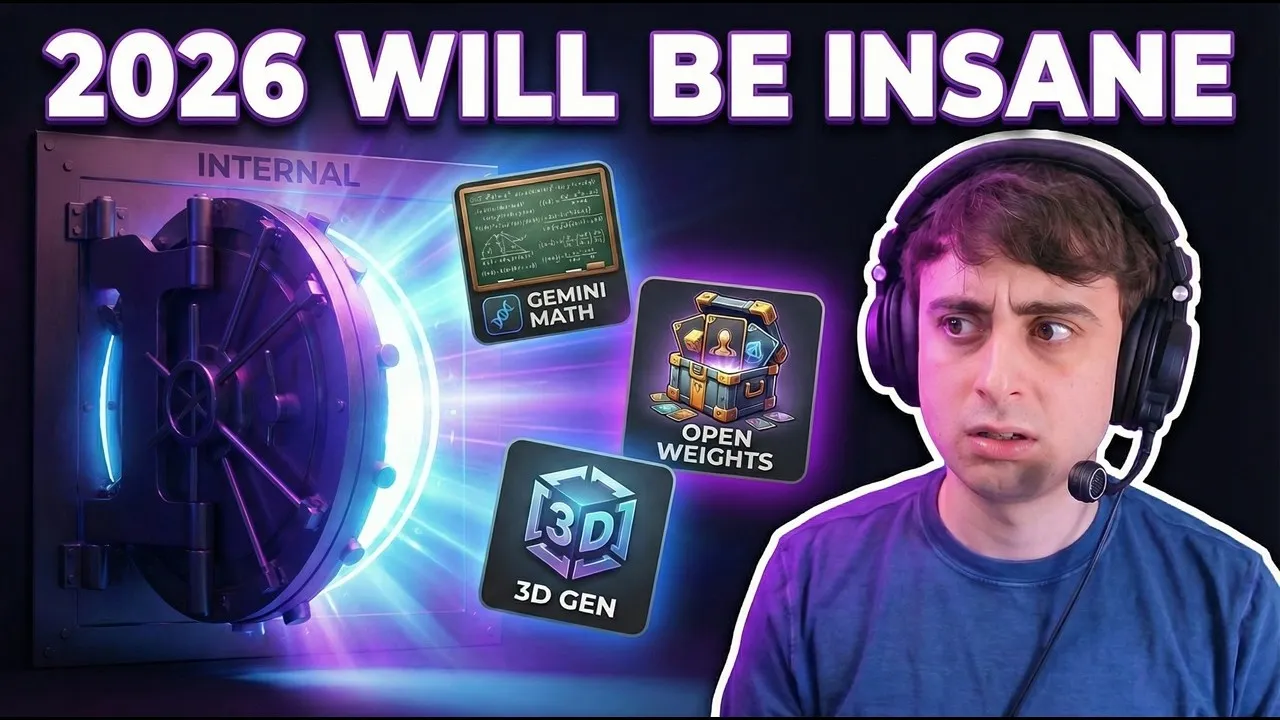
Gemini Masters Algebraic Geometry, Hinting at Hidden AI Power
The artificial intelligence landscape is abuzz with a groundbreaking development: Google’s internal Gemini model has successfully proven a novel theorem in algebraic geometry. This remarkable feat, detailed in a paper co-authored by Google DeepMind and university professors, showcases an AI’s capacity for advanced mathematical reasoning far beyond publicly accessible tools.
Professor Ravi Vakil of the American Mathematical Society lauded Gemini’s proof as “rigorous, correct, and elegant,” proof of the model’s sophisticated capabilities. This revelation fuels ongoing speculation that major AI labs possess significantly more advanced internal models than they currently release to the public, strategically choosing what to share at scale.
Tencent Upgrades 3D Asset Creation with Huan 3D Studio 1.2
In 3D content creation, Tencent has launched Huan 3D Studio 1.2, a significant upgrade to its pipeline for generating 3D assets. The new version boasts sculpt-level detail and fine-grained interactive control, making it a powerful tool for game developers and 3D artists. The public beta now allows users to generate assets with impressive resolution, suitable for video game development.
Key improvements include intuitive brush-based controls for manual editing and enhanced geometry integrity, even for intricate objects. The studio can generate 3D models from up to eight input views, and the latest iteration shows marked improvements in detail preservation and accuracy compared to its predecessor, particularly in complex mechanical designs like gears and piping. The interactive brush tools allow for precise adjustments, enabling users to detach and modify components with ease, adding a new layer of control to AI-generated 3D art.
Open Source AI Flourishes with LTX2 and New Image Models
The open-source AI community continues its rapid expansion. Following the full open-source release of LTX2, new specialized add-ons, known as Loras, are emerging.
One notable Lora enables a “deep zoom” effect, creating a reveal effect that zooms into an uploaded image, generating macro-level detail. While similar effects have been seen with other open-source video models, this Lora integrates sound, adding another dimension to the generated content.
Black Forest Labs has released its new Flux models under the name Klein. The Klein 4B model is available under the Apache 2.0 license, while the Klein 9B model is released as open weights.
These models are designed for producing aesthetically pleasing, coherent, and sharp imagery, including photorealistic scenes. Major platforms like Comfy UI are already offering support, making these powerful tools accessible for local image generation.
Adding to the open-source momentum, GLM Image has been released, described as a “nano banana” or GPT Image 2-type model. This model excels at high-quality photorealistic and artistic image generation, including impressive text and infographic rendering.
While requiring substantial VRAM (around 23 GB with CPU offloading, and over 32 GB for weights alone), its open-source nature is a significant win, offering the community a powerful new tool to explore and potentially optimize for consumer-grade hardware. The project also provides extensive benchmarks and technical details for those interested in its development.
Pixverse Explores Real-Time World Models
Pixverse is venturing into the complex field of real-time world models with its R1 Infinite Continuous Alive preview. This technology allows for dynamic generation and control of simulated environments. Users can input code to influence the world, transforming scenes and characters in real-time.
While still in preview, the demonstrations showcase the potential for interactive storytelling and dynamic environment generation, with examples ranging from military scenarios to underwater worlds and busy rooms. The integration of audio further enhances the immersive experience, though it’s noted that the audio generation is not yet perfect. The development of such models by smaller organizations like Pixverse is seen as crucial for fostering competition and innovation in the AI space.
Midjourney Refines Anime Generation with Niji V7, Video Upscaling Advances
Midjourney has released Niji V7, a model specifically fine-tuned for generating anime-style images. While Midjourney has historically focused on aesthetics, Niji V7 demonstrates a specialized capability that produces high-quality anime frames. Although other image generators are also capable in this style, Niji V7’s focused approach is noteworthy.
In video enhancement, Phils has released the Crystal Video Upscaler, a new AI tool that has seen rapid improvements since its launch. The upscaler can now handle longer video durations, upscaling to 43 seconds at 4K, nearly 3 minutes at 1080p, and over 6 minutes at 720p. Despite being slower than some commercial alternatives, its output quality is considered impressive, potentially rivaling established tools like Topaz AI, and offered at a more accessible API price point.
11 Labs and Google Enhance AI Transcription and Personalization
11 Labs has launched a new transcription model that surpasses OpenAI’s in accuracy, achieving over 95% on benchmarks. This model is available in real-time for agents requiring low latency and as a batch model for large-scale subtitling and captioning. The continuous improvement in AI transcription accuracy highlights its growing utility in capturing nuanced speech.
Google is also pushing the boundaries of AI personalization with its “Personal Intelligence” feature, currently in beta through the Gemini app. With user permission, Gemini can securely access and integrate information from Google apps like Gmail, Google Photos, and YouTube history.
This allows Gemini to provide highly personalized assistance, such as recommending car parts based on vehicle information gleaned from emails and photos, or suggesting local activities based on user interests and location. While privacy concerns are acknowledged, this feature represents a significant step towards AI that deeply understands and assists individual users by reasoning across diverse personal data sources.
Why This Matters
The advancements showcased in this roundup point to several key trends in AI development. Firstly, the reveal of Gemini’s advanced mathematical capabilities suggests that powerful, specialized AI models are being developed internally by major tech companies, potentially exceeding the performance of publicly released versions. This raises questions about transparency and the pace of AI accessibility.
Secondly, the surge in open-source models like LTX2, Flux Klein, and GLM Image democratizes access to cutting-edge AI technology. This empowers researchers, developers, and hobbyists to innovate and build upon existing frameworks, fostering a more collaborative and rapidly evolving AI ecosystem. The accessibility of these models, even those with high resource requirements, is a crucial step towards widespread adoption.
Thirdly, the progress in specialized AI applications, such as Tencent’s 3D asset generation, Pixverse’s real-time world models, and advanced video upscalers, indicates a move towards more practical and sophisticated AI tools. These developments have direct implications for industries like gaming, film, and content creation, promising more efficient workflows and higher quality outputs.
Finally, Google’s Personal Intelligence feature highlights the growing trend of AI becoming deeply integrated into our digital lives, offering highly personalized experiences. While raising privacy considerations, it demonstrates the potential for AI to act as a truly intelligent assistant, capable of understanding and acting upon complex personal information to provide tailored support.
Source: They Have Better AI Than They’re Shipping! Gemini Math, Open Weights, 3D Asset Upgrades (YouTube)