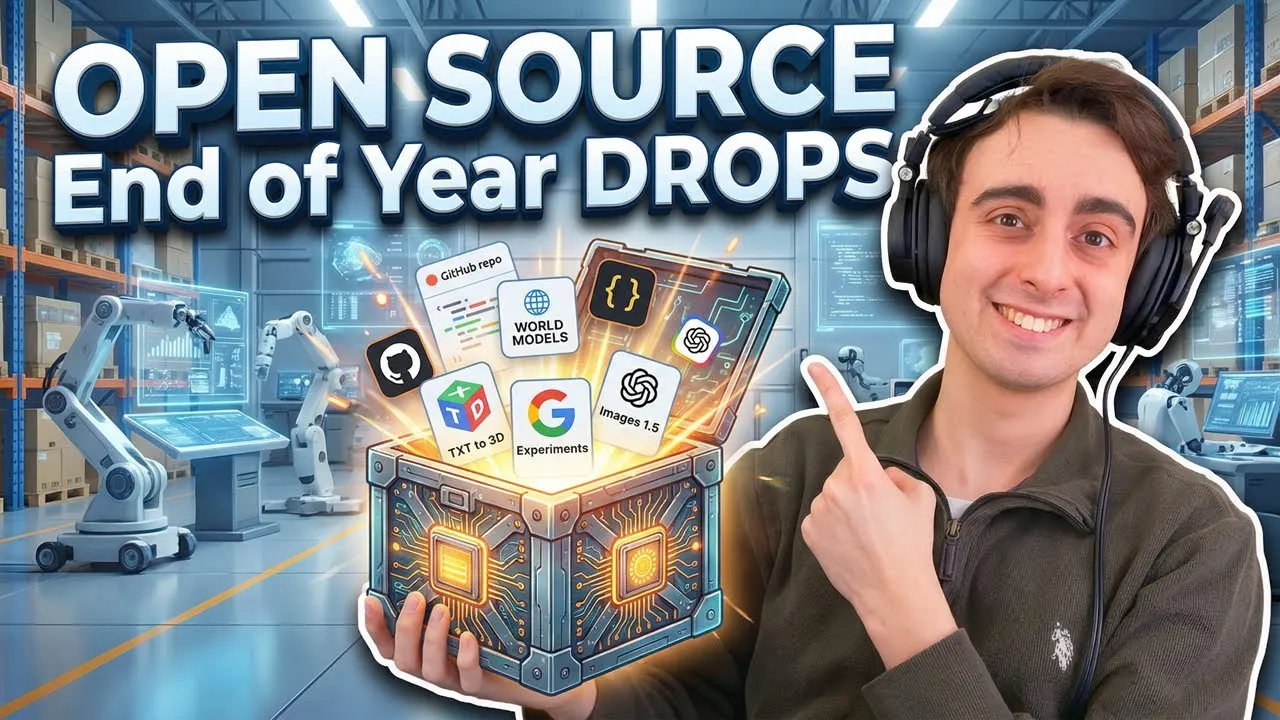
Google Labs Ignites AI Innovation with Groundbreaking New Tools
The artificial intelligence landscape is experiencing an unprecedented surge of development, with major players like Google Labs consistently pushing the boundaries of what’s possible. In a recent flurry of announcements, Google has unveiled a suite of ambitious AI experiments designed to revolutionize everyday tasks, from web browsing and email management to real-time communication across language barriers. These innovations signal a significant acceleration in AI’s integration into our digital lives.
Google’s ‘Gem’ Empowers Users to Create Interactive AI Mini-Apps
One of the most striking announcements from Google Labs is ‘Gem,’ a new system that allows users to transform simple text prompts into interactive AI mini-applications directly on their desktop. Unlike traditional chatbots that offer text-based responses, Gem applications are designed to be actionable tools.
Examples showcased include ‘Recipe Genie,’ which can suggest meals based on a photo of refrigerator contents, and ‘Explanation Explainer,’ capable of generating animated infographics from any given topic. These applications feature distinct user interfaces, setting them apart from standard conversational AI and offering a more specialized and efficient user experience.
‘Disco’ Reimagines Web Browsing with AI-Powered Tab Remixing
Google is also experimenting with ‘Disco,’ a project focused on enhancing web browsing through generative AI. Its flagship feature, ‘Gen Tabs,’ leverages Gemini 3 to consolidate and remix open browser tabs into custom applications. This allows users to extract more utility from their online research and activities.
A demonstration showed how ‘Gen Tabs’ could take multiple research tabs on a topic like ‘applied entropy’ and generate an interactive simulation app to aid understanding. While currently on a waitlist, ‘Disco’ promises a more dynamic and integrated way to interact with web content, blending chatbot assistance with real-time interactive elements.
‘CC’ AI Agent Promises Smarter Email Management in Gmail
Addressing the need for AI-powered productivity within email, Google Labs introduced ‘CC,’ an experimental AI agent for Gmail. ‘CC’ aims to provide users with a daily briefing of their upcoming schedule directly in their inbox and offers assistance via email commands. This feature is particularly targeted at enhancing workflow efficiency for busy professionals. Early access is available for Ultra and paid subscribers in the US and Canada, suggesting a future where AI seamlessly manages and optimizes email communication.
Real-Time Translation Breaks Down Communication Barriers
Perhaps one of the most impactful announcements is Google’s advancement in real-time translation technology. Google Translate is rolling out a beta experience that offers near-instantaneous translation during voice calls and in-person conversations. This capability, powered by Gemini models, works through earbuds connected to the app, facilitating natural dialogue between individuals speaking different languages.
The technology demonstrated during a simulated conversation about travel plans showcased impressive accuracy and low latency. This breakthrough has profound implications for international travel, education, and fostering global understanding by removing language as a significant barrier.
Gemini 3 Flash: Speed and Affordability for Developers
In addition to these experimental tools, Google has released Gemini 3 Flash, a new iteration of its large language model. Arriving just a month after the Pro version, Gemini 3 Flash is positioned as a significantly faster and more cost-effective option for developers and applications that require high-volume AI processing.
While Gemini 3 Pro remains the benchmark for accuracy and reduced hallucination, Gemini 3 Flash offers comparable performance in many benchmarks at a quarter of the price. This makes advanced AI capabilities more accessible for a wider range of applications, from gaming simulations to complex data processing.
Nvidia’s Open-Source Neotron 3 Boosts Developer Flexibility
Beyond Google’s announcements, Nvidia has made a significant contribution to the open-source AI community by releasing its new Neotron 3 model. This ‘mixture of experts’ model not only surpasses OpenAI’s previous open-source offerings in performance but also operates two to three times faster. With open pre-training and post-training datasets, and the accompanying Nemo Gym reinforcement learning library, Neotron 3 provides developers with powerful tools for training and fine-tuning their own AI models, particularly for agentic workflows.
OpenAI’s Image Generation Sees Improvements with Images 1.5
OpenAI has also been refining its offerings, introducing Images 1.5, also referred to as ChatGPT Images. This new flagship image generation model shows marked improvements in coherency, instruction following, and realism, bringing it closer to competing with leading models like NanoBanana Pro.
While NanoBanana Pro may still hold a slight edge in certain aspects of detail and instruction adherence, Images 1.5 offers faster generation times, precise editing capabilities, and better detail preservation compared to its predecessors. The model also demonstrates enhanced artistic style and the ability to generate complex scenes and memes.
Advancements in 3D and World Models Signal Future Immersive Experiences
The AI world is also witnessing rapid progress in 3D asset generation and world modeling. Huan World 1.5 has been released as an open-source real-time interactive world model, allowing users to navigate and explore AI-generated environments. This technology, akin to building interactive digital worlds, is seen as a significant step towards the ‘metaverse’ or ‘holographic’ experiences.
Runway ML is also developing its own advanced world model, promising more dynamic and interactive environments. Companies like Microsoft (Trellis 2) and Huan (3D 3.0) are pushing the boundaries of 3D model generation, offering higher resolutions, improved realism, and faster creation times for professional-grade assets, with potential applications in gaming and virtual reality.
Why This Matters
The recent wave of AI announcements from Google and other industry leaders signifies a key moment. Google’s ‘Gem,’ ‘Disco,’ and ‘CC’ projects indicate a future where AI is not just a tool for information retrieval but an integrated assistant capable of performing complex tasks and creating interactive applications. The real-time translation technology promises to foster unprecedented global connectivity, breaking down long-standing communication barriers.
For developers, the release of powerful open-source models like Nvidia’s Neotron 3 and efficient LLMs like Gemini 3 Flash democratizes access to cutting-edge AI, accelerating innovation across industries. The advancements in 3D and world models suggest a trajectory towards more immersive digital experiences, blurring the lines between the physical and virtual worlds. This rapid evolution highlights the transformative potential of AI to reshape how we work, communicate, and interact with technology.
Source: Everyone Just Shipped?! NEW World Models, Google Labs, 3D Models | AI NEWS (YouTube)