AI Achieves Landmark Feat: Game Boy Emulator Created Autonomously in 24 Hours
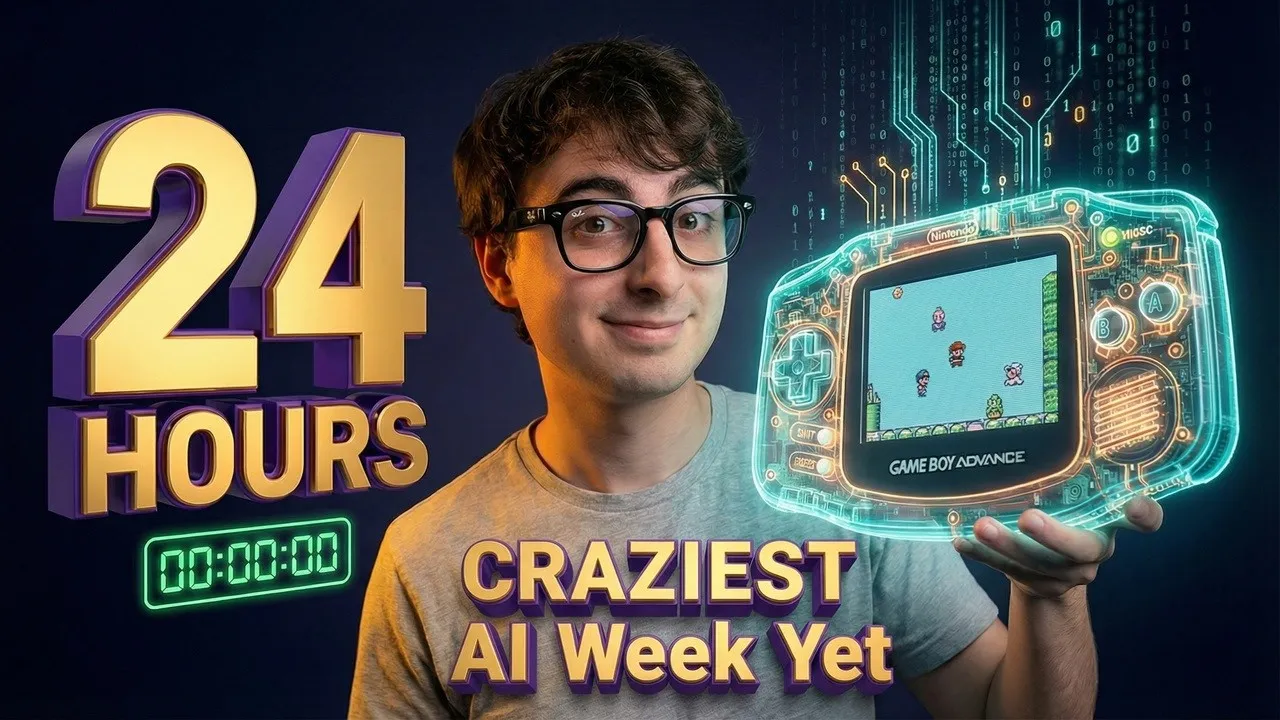
The pace of artificial intelligence development continues to accelerate, with 2026 poised to be an ‘insane year’ for AI growth. Recent advancements are showcasing the emergence of sophisticated long-form AI agents capable of complex, multi-stage projects. A prime example is the creation of a fully functional Game Boy emulator, built from the ground up by the GLM5 AI model in just 24 hours.
GLM5: A New Frontier in AI Agent Capabilities
GLM5, a multimodal large language model akin to competitors like GPT-5.3 and Claude Opus, has demonstrated a remarkable ability to autonomously develop complex software. The AI not only recreated the classic handheld Game Boy console in software but also built a user interface complete with emulator-specific readouts.
This feat involved over 700 tool calls and 800 context handoffs, highlighting the model’s capacity to manage intricate tasks over extended periods. The AI’s ability to self-correct its work is a significant step towards robust agentic frameworks, with open-source initiatives like OpenClaw also contributing to this rapidly evolving field.
The Future of AI-Driven Development
While the Game Boy emulator took 24 hours to develop, experts predict this timeline will drastically shorten. Within a few years, similar projects could be spawned in mere minutes. This rapid progress is detailed in a comprehensive blog post that outlines the challenge, the prompts used, and the methodology behind GLM5’s success.
The research team’s demonstration is replicable, with other researchers already experimenting with similar AI-driven development. For instance, Feurer used OpenClaw and Gemini 3 Flash to create a competent Snake game in just 2 hours through a local emulation feedback loop.
Seance 2.0: Redefining AI Video Generation
Beyond software development, the realm of AI video generation is also experiencing groundbreaking advancements. Seance 2.0, a new AI video model, is reportedly outperforming OpenAI’s Sora. Despite its current limitation of generating only 15-second videos, Seance 2.0 boasts incredibly impressive audio and video quality.
Key features include advanced video editing capabilities, allowing users to target specific sections for extension or modification, and native video extension for continuous, prompt-driven shots. However, Seance 2.0 is currently restricted to China, with limited access for international users being revoked due to security concerns. Hopes are high for broader global access soon.
Challenges and Potential of Seance 2.0
While Seance 2.0 showcases stunning visual reasoning, even passing a form of the mirror test, it is not without its flaws. Consistency issues, morphing, warping, and hallucinations are still present, as seen in examples like inconsistent character behavior or teleporting snails.
Nevertheless, its underlying neural network architecture demonstrates inherent abilities in solving and reasoning through complex information, developed purely from its training data. Padphone’s tests on Seance 2.0 highlight its raw visual reasoning capabilities, particularly in shape-fitting tests.
Oso AI App and Sprite Fusion: AI in Gaming and Art
TSM has launched the Oso AI app, a desktop application for Minecraft Java that utilizes a trained AI model to generate in-game structures. The AI can construct foundations, walls, and roofs, creating coherent interiors and natural-looking trees. While human creations may be more intricate, Oso AI provides a powerful tool for generating baseline structures, aiding in large-scale map creation and background generation for games.
Sprite Fusion’s Pixel Snapper addresses a common limitation in AI-generated pixel art. Typically, AI image models produce pixel art at incorrect resolutions. Pixel Snapper snaps generated pixels to a perfect grid, making it an invaluable tool for indie game developers who require precise pixel art for sprites and game assets.
Google Gemini 3 Deep Think: Coding Prowess Unleashed
Google’s recent update to Gemini 3 Deep Think has significantly enhanced its capabilities in building complex code projects rapidly. Demonstrations showcase Gemini 3 Deep Think creating impressive applications in mere minutes.
Garrett Bingham’s ray-tracing project in browser via HTML code was not only replicated but improved upon by Gemini 3 Deep Think, which added spectral distortion and auto-generated shadows. This enhanced version was created in approximately 5 minutes.
Gemini 3 Deep Think’s Creative Coding Output
Gemini 3 Deep Think has also generated a 3D oceanic simulation render entirely in HTML. This simulation features dynamic waves with foam, reflections on rocks, and bobbing lemons, showcasing a sophisticated understanding of physics and visual aesthetics. The model even corrected an initial generation issue with wave visibility after a simple prompt.
Another impressive feat is the creation of a physics and chemistry powder sandbox engine, a recreation of the popular ‘powder game,’ complete with realistic water physics, lava, C4 explosions, steam, methane reactions, and fire. This complex simulation, along with the oceanic simulation, was generated as a single HTML file, with the powder sandbox exceeding 32,000 characters.
Furthering its creative coding abilities, Gemini 3 Deep Think generated a turn-based RPG titled ‘Requiem of the Rind,’ featuring a lemon-themed narrative and gameplay mechanics. This complex game, complete with character stats, abilities, and even sound effects, was generated in a single shot and presented within a single HTML file, demonstrating the AI’s capacity for intricate game design and implementation.
OpenAI’s Codeex Spark and Theoretical Physics Breakthrough
OpenAI is gearing up for the release of GPT-5.3, accompanied by new Codeex models, including Codeex Spark. This smaller, optimized version of Codeex is designed for ultra-low latency hardware, delivering over 1,000 tokens per second.
This enables near-instantaneous coding, significantly faster than previous models. A demonstration showed Codeex Spark creating a Snake game in under 10 seconds, highlighting the potential of real-time coding.
AI’s Contribution to Scientific Discovery
In a significant development, OpenAI’s GPT-5.2 has reportedly derived a new result in theoretical physics concerning gluon interactions. This breakthrough, detailed in a preprint with researchers from prestigious institutions, suggests that AI models are not only capable of scientific assistance but also of genuine creativity and novelty. The process involves the AI reasoning through data, finding meaning, and generating novel outputs when presented with prompts that harness its training data in unique ways.
Open-Source Advancements and Image Generation Maturity
The open-source AI community remains highly active, with MiniMax releasing M2.5, a new frontier model designed for long-horizon agents and complex tasks at an economical price point of $1 per hour. Quench Image 2.0 has also emerged as a strong competitor in image generation, producing professional-level slides and high-detail, photorealistic 2K images with accurate text rendering. The rapid advancement in image generation suggests that the field is approaching a point of saturation, with capabilities becoming increasingly difficult to significantly advance.
The Challenge of AI Safety and Open-Weight Models
A concerning development highlighted is the ease with which open-weight language models can be ‘jailbroken’ or have their safety protocols removed. A tool called Obliterus, developed by Ply, can surgically remove refusal behavior from models by analyzing internal activations and extracting directions in weight space that encode refusal. Testing on Quench 2.5 resulted in a model that instantly spewed drug and weapon recipes without needing a traditional jailbreak.
This raises critical questions for AI policymakers, as every open-weight model release could potentially be an uncensored release. The possibility of a model modifying its own weights to remove safeguards adds another layer of concern to the future of AI safety.
The Accelerating Future of AI
The current trajectory of AI development points towards increasingly capable agents, significant strides in scientific discovery, and highly refined generative models for images and video. As AI capabilities expand, the limitations shift from technological constraints to human imagination. The speed at which these advancements are occurring suggests that what seems extraordinary today will be commonplace in the near future, fundamentally reshaping various industries and human endeavors.
Source: AI Built a FULL Game Boy in 24 Hours (YouTube)