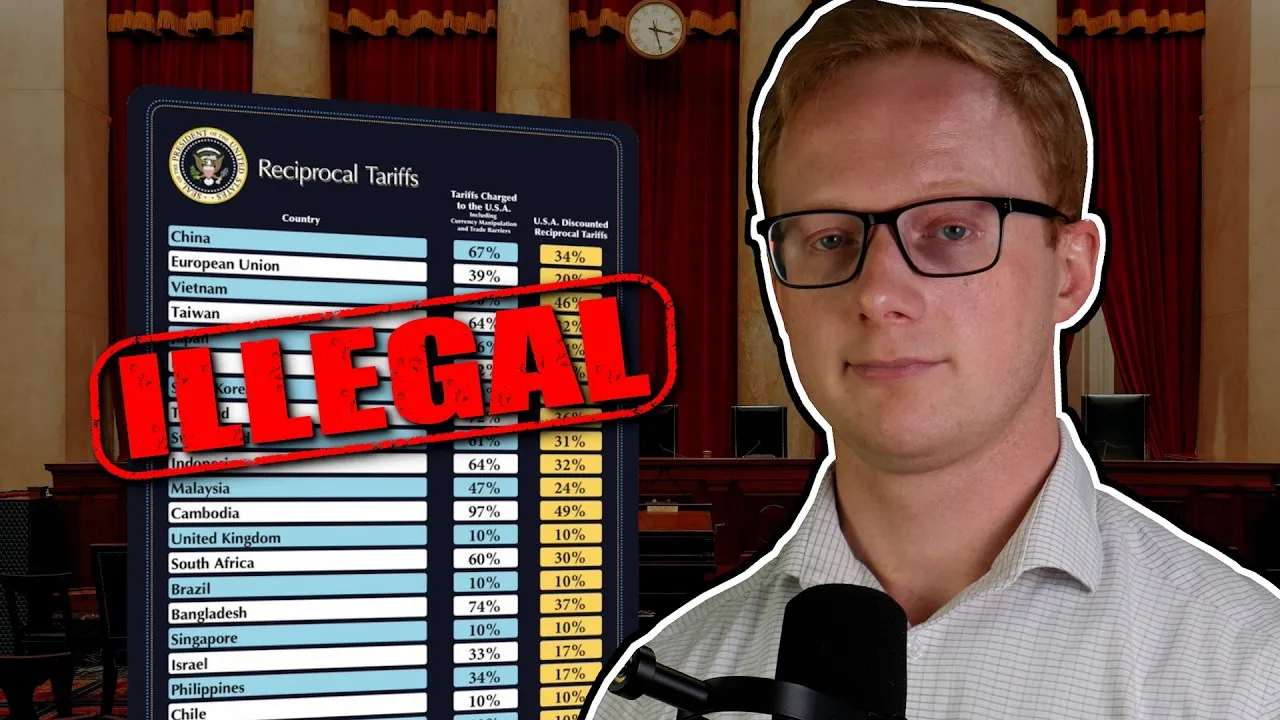
Supreme Court Rules Trump’s Tariffs Illegal, White House Responds with New Measures
In a landmark decision with significant implications for global trade, the U.S. Supreme Court has declared Donald Trump’s tariffs, enacted under the International Emergency Economic Powers Act (IEEPA), as illegal. The ruling upholds a lower court’s decision, compelling the White House to remove all tariffs previously imposed under this specific law. This verdict was initially hailed by many as a substantial setback for Trump’s protectionist trade agenda, effectively dismantling one of his primary tools in international diplomacy and negotiation.
However, this period of celebration was short-lived. President Trump swiftly responded at a fiery press conference, asserting that the Supreme Court’s ruling would not halt his tariff policies. Instead, he announced the immediate implementation of new tariffs, initially a temporary 10% levy on goods from most countries, which was later escalated to 15% over the weekend.
As of Tuesday, February 24th, the 10% tariff had taken effect. This rapid turn of events raises critical questions about the immediate impact on various industries, the fate of an estimated $175 billion in collected tariff revenue, and the legal avenues President Trump might pursue to reintroduce or increase tariffs.
The Supreme Court Ruling: Learning Resources v. Trump
The case, Learning Resources v. Trump, was brought forth by an Illinois-based toy company, Learning Resources, and later consolidated with a similar lawsuit filed by liquor company VOS Elections and twelve U.S. States. The core of the plaintiffs’ argument, which the Supreme Court justices upheld, was that the IEEPA does not grant the president the authority to impose tariffs.
The IEEPA, a law enacted in 1977, empowers the president with broad authority to restrict trade and transactions during times of an “unusual and extraordinary threat,” ostensibly allowing the president to bypass congressional approval in national security matters. However, in a 6-3 decision, with three conservative justices dissenting, the Court concluded that while the president can block imports and exports under IEEPA, the explicit power to tax rests solely with Congress, as stipulated in the Constitution.
The Court cited the “major questions doctrine,” which mandates that executive actions of significant consequence must have clear authorization from Congress, rather than relying on ambiguous statutory language. The justices argued that Trump’s extensive use of IEEPA for tariff imposition lacked this explicit congressional mandate.
The ruling specifically impacts two main sets of tariffs:
- The fentanyl-related tariffs initially imposed on China, Mexico, and Canada, which included a 10% tariff on Chinese goods, 25% on Mexican goods, and a 35% on Canadian goods.
- The broader, country-specific reciprocal tariffs announced on April 2nd and subsequent updates, effectively removing these levies from any countries previously targeted.
Tariffs Remaining Unaffected
It is crucial to note that the Supreme Court’s decision does not affect all tariffs. Sectoral tariffs implemented under Section 232 of the Trade Expansion Act of 1962 remain in place. These include levies on steel, aluminum, auto parts, copper products, timber, furniture, and semiconductor imports.
While these tariffs cover a significant portion of global trade partners, they accounted for approximately one-third of the tariff revenue generated in the final quarter of 2025, according to Reuters. The IEEPA tariffs, now struck down, were responsible for an estimated $175 billion in revenue since their inception.
The Fate of $175 Billion in Collected Revenue
The disposition of the $175 billion in tariff revenue collected under the now-illegal IEEPA tariffs presents a significant question mark. While a refund of these monies is widely expected, the Supreme Court’s ruling offers no guidance on the process. This leaves the complex task of determining reimbursement procedures to lower courts, such as the U.S. Court of International Trade.
This could lead to years of further litigation before any funds are returned. Companies like FedEx have already initiated lawsuits for tariff reclamation, with others, including Costco, having sued prior to the ruling. It is anticipated that refunds, if processed, will primarily go to importing companies, as they were the entities directly charged the tariff fees, rather than directly to consumers who bore the brunt of increased prices through pass-along costs.
Market Impact and Investor Considerations
The Supreme Court’s decision creates a mixed bag of economic consequences. While the potential return of tariff funds could provide a boost to the economy, it also presents a challenge to the U.S. Budget, as IEEPA tariffs alone represented about 10% of the projected fiscal year 2025 deficit. Economists estimate that the complete elimination of these tariffs could reduce the average effective tariff rate for consumers from 16.9% to 9.1% and halve the tariff-related price inflation from 1.2% to 0.6%.
However, the landscape of tariffs is far from settled. President Trump quickly moved to implement a temporary 10% across-the-board tariff under Section 122 of the Trade Act of 1974.
This section allows the president to impose tariffs of up to 15% for a maximum of 150 days to address significant balance of payment deficits. This measure includes numerous exemptions for critical minerals, energy products, agricultural goods, pharmaceuticals, electronics, vehicles, and goods already subject to Section 232 tariffs, as well as those covered by USMCA and CAFTA-DR agreements.
For Canada, despite a reduction in its general tariff rate from 35% to 10%, the impact is mitigated by the fact that most of its exports already entered the U.S. Tariff-free under the USMCA. The temporary nature of the new 10% tariff, requiring congressional approval for extension beyond 150 days, makes its long-term continuation uncertain, especially with upcoming midterm elections and existing congressional opposition to some tariffs.
Future Tariff Avenues
Beyond the temporary Section 122 tariffs, President Trump has other legislative tools at his disposal to reintroduce or increase tariffs:
- Section 232 of the Trade Expansion Act of 1962: Continues to allow for sectoral tariffs based on national security concerns, requiring a Department of Commerce investigation.
- Section 201 of the Trade Act of 1974: Permits product-specific tariffs when increased imports cause or threaten serious injury to domestic producers.
- Section 301 of the Trade Act of 1974: Allows for tariffs in cases of trade deal violations or unjustifiable burdens on U.S. Commerce, often requiring formal investigation. Trump has already initiated an investigation under this section.
- Section 338 of the Tariff Act of 1930: Enables the president to impose country-specific tariffs of up to 50% if a country unreasonably discriminates against U.S. Trade, though this could face legal challenges if broadly applied.
Strategic Implications
While the Supreme Court ruling has curbed the president’s ability to impose tariffs arbitrarily under IEEPA, it has not ended the use of tariffs as a policy tool. The immediate shift to a temporary 10% tariff and the highlighting of alternative legal statutes suggest a strategic recalibration rather than an abandonment of protectionist measures.
The ruling, however, does reduce the overall tariff rates for many countries and removes the president’s “big stick” of IEEPA tariffs, which were often applied for reasons perceived as less directly tied to traditional trade disputes. This may lead to greater caution in international negotiations and potentially encourage more countries to seek clarity and stability in their trade relationships with the U.S.
The long-term impact will depend on how these new legal avenues are utilized, the response from Congress, and the evolving geopolitical and economic landscape. Investors and businesses should monitor developments closely, particularly regarding the potential for further investigations and the long-term tariff strategy of the administration.
Source: Trump's Tariffs Deemed Illegal – What Now? (YouTube)