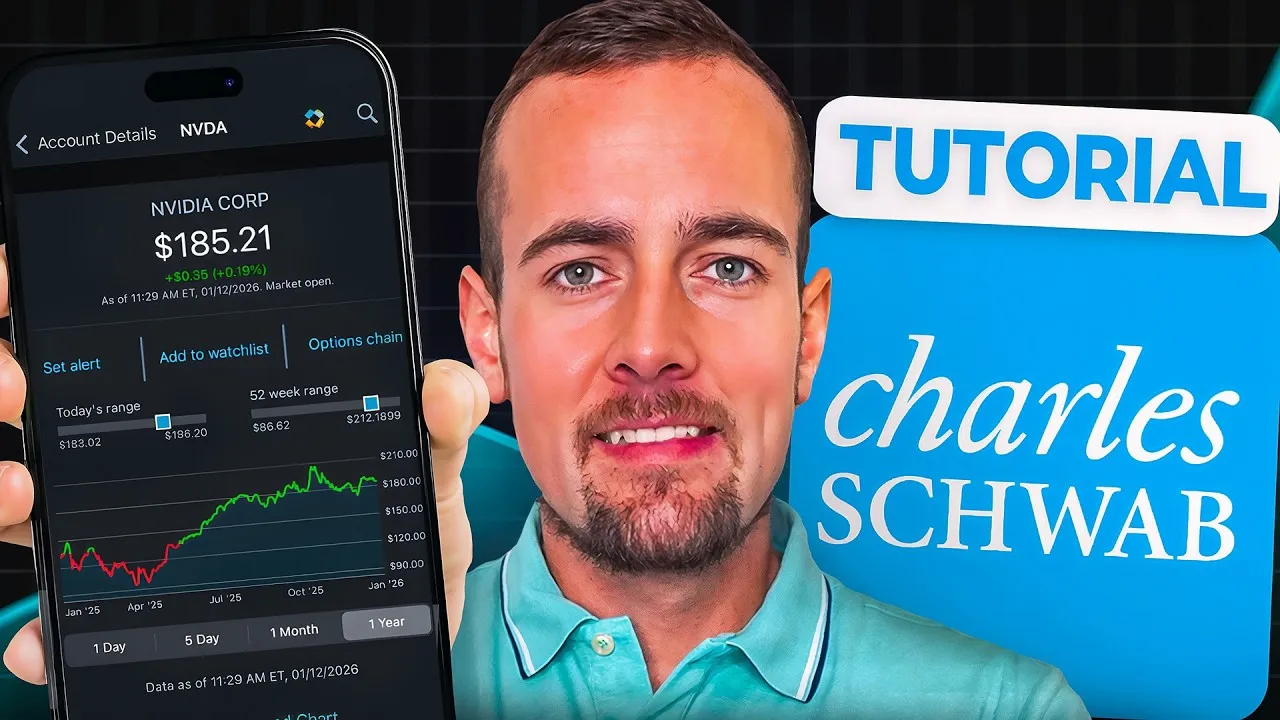
Schwab Platform Guides Beginners Through Trading
Charles Schwab, a long-standing titan in the financial services sector with over 50 years of experience and more than $10 trillion in assets under management, offers a robust platform designed for core investing needs rather than chasing the latest market fads. This tutorial explores the essential features for new investors navigating the Charles Schwab platform, from account setup and fund transfers to executing trades and utilizing research tools.
Getting Started: Account Types and Setup
Schwab provides a wide array of account options, catering to diverse financial goals. These include individual brokerage accounts, suitable for taxable investments in stocks, ETFs, and bonds, as well as specialized accounts such as 529 plans for education savings and various retirement accounts. The account opening process is fully digital, typically taking around 10 minutes, and requires standard personal information for identity verification and IRS reporting compliance.
Funding Your Account: Linking Banks and Deposits
To begin investing, linking a bank account to your Schwab profile is a crucial first step. This is managed through the ‘Move Money’ section, specifically under ‘Transfer Funds.’ Users can link external bank accounts by providing account and routing numbers, with Schwab offering instant verification or a backup method involving two small deposits over 2-4 days.
Once linked, depositing funds involves selecting the external bank account as the source and the Schwab account as the destination. While funds for major stocks trading above $1 are generally available immediately for trading, full withdrawal capabilities and the ability to trade options, futures, or stocks under $1 typically require four business days.
Navigating the Platform: Watchlists and Research Tools
The Schwab platform features a ‘Watchlist’ section, allowing investors to curate lists of securities they wish to monitor. Users can create custom watchlists, add individual stocks or ETFs by searching for their symbols or company names, and view performance data.
A unique ‘heatmap’ feature within watchlists provides a visual overview of how stocks are performing, with color intensity indicating the magnitude of price changes. This visual tool can offer a quick gauge of market sentiment for a selected group of assets.
For in-depth market analysis, the ‘Market’ section is a central hub. It provides real-time price charts for major indices like the Dow Jones, Nasdaq, and S&P 500, along with breaking news that opens directly within the app.
Professional research reports from sources like Morningstar are also accessible, offering daily market digests and stock insights. The platform highlights ‘Company Movers,’ categorizing stocks by price increases, decreases, or trading volume, and offers a daily ‘Schwab Market Update’ that can be read or listened to.
Investing Strategies: Themes, Slices, and Whole Shares
Schwab offers several avenues for investment:
- Schwab Investing Themes: These are pre-built portfolios focused on specific market trends or sectors, such as autonomous driving. They provide a diversified approach within a theme, showcasing sector weightings and individual stock allocations. Investors can trade these themes as a single basket, with a minimum investment of $250 for some themes. This feature aims to simplify thematic investing and reduce the complexity of individual stock selection.
- Schwab Stock Slices: This feature enables fractional share investing, allowing individuals to buy portions of stocks with a minimum investment of $5 per slice. This lowers the barrier to entry, particularly for high-priced stocks like Apple, where a single share might cost hundreds of dollars. Investors can select from a list of eligible stocks and choose the dollar amount they wish to invest, with an option to automatically reinvest dividends to compound returns.
- Trading Whole Shares: For traditional investing, users can buy or sell whole shares of stocks and ETFs. The platform supports various order types, including market orders (executing at the best available price immediately) and limit orders (executing only at a specified price or better). While market orders prioritize execution speed, limit orders offer price control but no guarantee of completion. For beginners, understanding the difference between bid and ask prices and the potential impact of the spread on less liquid stocks is essential.
Market Impact and Investor Considerations
Charles Schwab’s platform emphasizes foundational investing principles, providing tools and features that support both novice and experienced investors. The availability of fractional shares through Stock Slices makes investing more accessible, allowing smaller capital outlays to gain exposure to a wider range of companies. The integrated research tools, including market news, analyst reports, and sector heatmaps, empower investors to make more informed decisions.
For those new to the market, understanding the nuances of fund availability timelines after deposits and the different order types for executing trades is critical. While Schwab may not offer the real-time, cutting-edge features found on some newer platforms, its focus on core functionalities, research capabilities, and a broad selection of investment products, including mutual funds often absent on newer platforms, positions it as a reliable choice for long-term wealth building.
The platform’s design prioritizes a stable and comprehensive investing experience, eschewing the gamified elements found elsewhere in favor of robust tools for analysis and trade execution.
Investors using Schwab can leverage its extensive resources to build and manage their portfolios, benefiting from a platform that has consistently served the financial needs of millions for decades.
Source: How To Use Charles Schwab For Beginners | 2026 Tutorial (YouTube)