Contents (6)
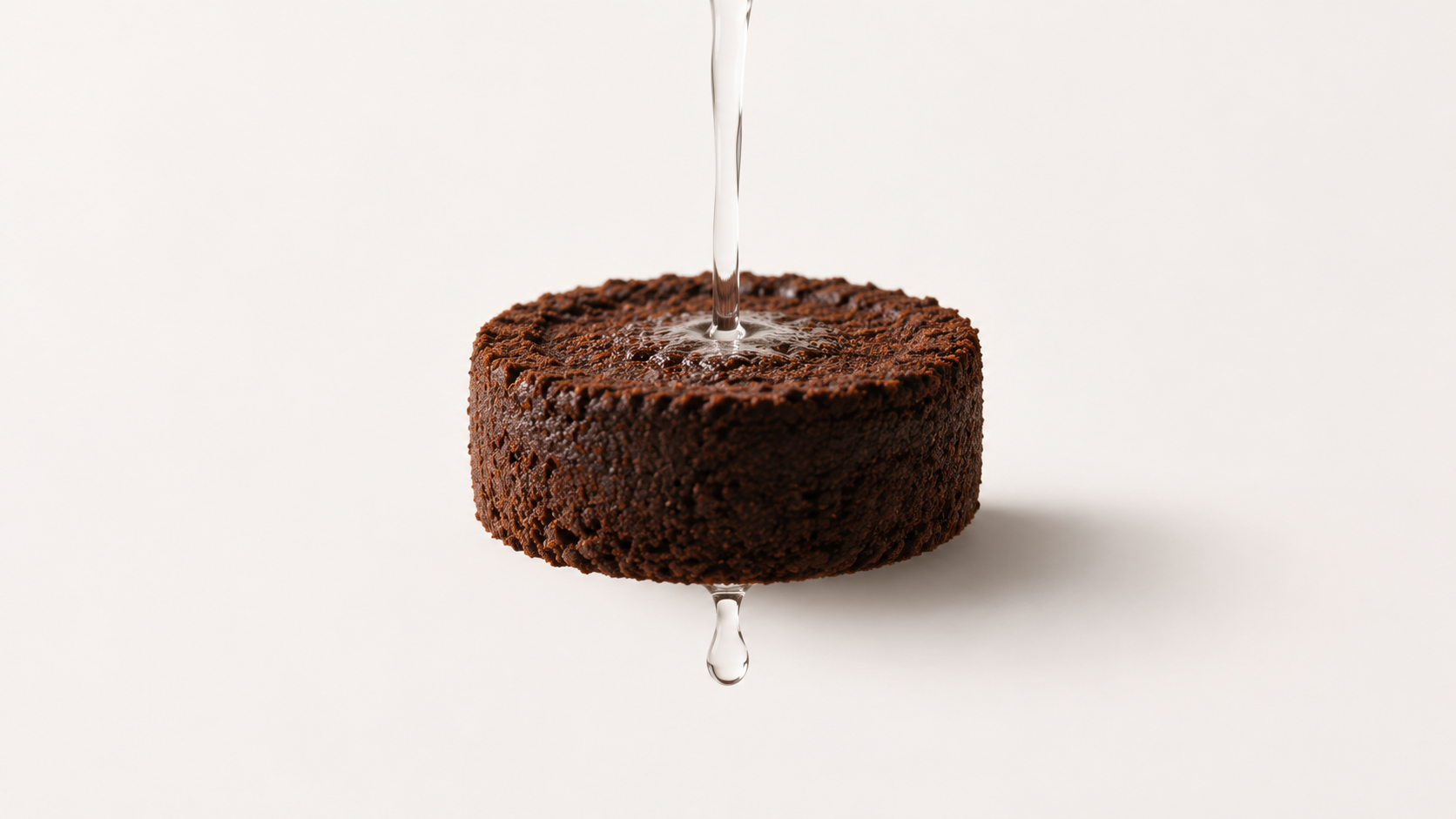
Recently, while emptying the coffee grounds container of my JURA E4 automatic espresso machine, I noticed how perfectly compacted the used coffee grounds were. They formed solid, circular discs, almost resembling small filtration cartridges.
This made me curious: could coffee grounds actually act as a natural water filter during the brewing process?
As it turns out, scientific research suggests that they can retain certain contaminants.
More Than Just a Cup of Coffee #
When an automatic espresso machine prepares coffee, it grinds the beans, compresses them into a dense puck, and forces hot water through it under pressure.
During this process, water extracts the aromatic compounds, oils, and caffeine that give coffee its distinctive flavor. However, something else can happen at the same time: the coffee grounds can capture certain substances present in the water.
This phenomenon is known as adsorption.
Unlike absorption, where a substance penetrates another material, adsorption occurs when molecules or ions attach themselves to the surface of a material.
Coffee grounds contain cellulose, lignin, and various organic compounds, along with a naturally porous structure that makes them an interesting biological adsorbent.
What Does Science Say? #
One particularly interesting scientific study, titled Removal of Soluble Cu and Pb by the Automatic Drip Coffee Brewing Process: Application to Risk Assessment, found that the coffee brewing process removed between 78% and 90% of lead and copper from the incoming water under experimental conditions.
Other scientific studies have investigated the ability of used coffee grounds to retain various metals, including:
- Lead (Pb)
- Copper (Cu)
- Cadmium (Cd)
- Zinc (Zn)
- Nickel (Ni)
Researchers have also explored the possibility of repurposing spent coffee grounds as an inexpensive and environmentally friendly material for wastewater treatment.
The underlying principle shares some similarities with activated carbon filtration, although ordinary coffee grounds are not equivalent to activated carbon.
Could an Espresso Machine Act as a Natural Filtration System? #
What I find particularly fascinating about automatic espresso machines is that they create a fresh, compacted coffee puck every time a cup is prepared.
Water passes through this organic material, and the machine subsequently discards it.
In theory, this means that every espresso is prepared using a fresh layer of naturally adsorbent material.
However, the effectiveness of this process depends on several factors, including the grind size, water temperature, contact time, chemical composition of the water, and the type of coffee used.
The results obtained with drip coffee makers cannot automatically be applied to espresso machines. Coffee beans themselves can also introduce trace metals into the beverage.
Therefore, coffee should not be considered a substitute for a certified water purification system, nor should contaminated water be used to prepare coffee.
Turning Coffee Waste Into Something Valuable #
Billions of cups of coffee are consumed around the world, generating enormous quantities of spent coffee grounds.
What most people consider ordinary waste could potentially become a valuable resource for environmental engineering, wastewater treatment, and sustainable filtration technologies.
Instead of manufacturing every filtration material from scratch, perhaps we can make better use of materials that nature already provides.
Final Thoughts #
Sometimes, the most interesting discoveries begin with observing something ordinary.
A simple disc of compressed coffee grounds, something most of us throw away without a second thought, possesses remarkable chemical and physical properties.
Coffee is much more than a popular beverage. It is also a fascinating natural material with potential applications that extend far beyond the kitchen.
The next time you empty your espresso machine, take a closer look at those little coffee pucks.
There is more science behind them than you might imagine.
Scientific References #
- Removal of Soluble Cu and Pb by the Automatic Drip Coffee Brewing Process: Application to Risk Assessment
- Removal of Lead Ions in Drinking Water by Coffee Grounds as Vegetable Biomass
- Adsorption of Heavy Metals by Exhausted Coffee Grounds as a Potential Treatment Method for Waste Waters
- Effect of Exhausted Coffee Ground Particle Size on Metal Ion Adsorption Rates and Capacities
- Essential and Nonessential Elements, Lipids and Volatile Compounds in Coffee and Transfer to Coffee Brews

Leave a Reply