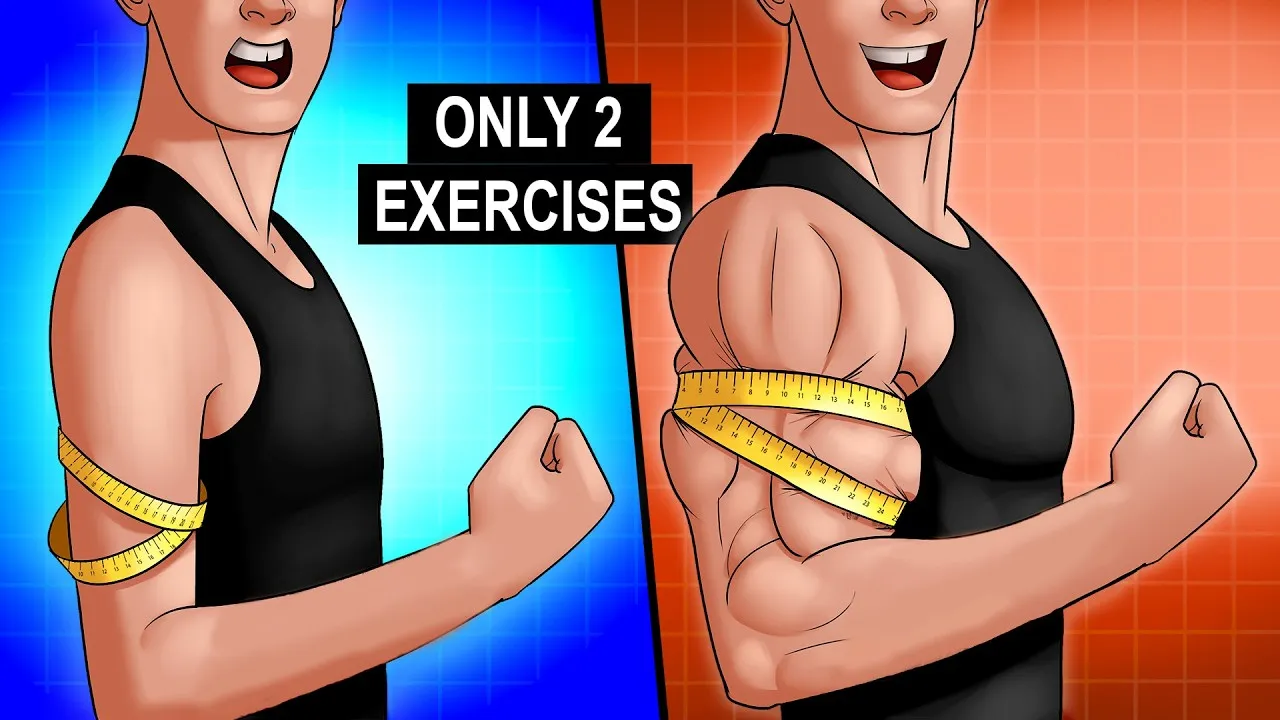
Build Bigger Biceps With Just Two Powerful Exercises
Achieving impressive bicep growth doesn’t require a complex gym routine or an arsenal of specialized equipment. In fact, focusing on two fundamental exercises can be highly effective for building larger, more defined biceps. These exercises, when performed correctly and progressively, can lead to significant gains, helping your arms fill out your clothing more noticeably.
Understanding Your Biceps
To train your biceps effectively, it’s helpful to understand their anatomy. The bicep muscle, as the name suggests, has two distinct heads: the short head, located on the inner side of your arm, and the long head, on the outer side. Both heads originate from separate points on the scapula (shoulder blade) and converge to attach to the radius bone in your forearm.
While they function as a single muscle, certain exercises and hand grips can emphasize one head over the other. The following two exercises are designed to comprehensively target both heads for optimal growth.
The Barbell Bicep Curl: The Mass Builder
The barbell bicep curl is widely considered the most effective exercise for adding overall mass and size to your biceps. By using a grip that is about shoulder-width apart or slightly closer, you can place a greater emphasis on the long head of the bicep, though the short head will still be well-engaged. This exercise allows you to lift a heavier weight load simultaneously with both arms, which is a key factor in stimulating muscle hypertrophy (growth) more efficiently compared to exercises that isolate each arm independently, such as dumbbell curls.
Proper Form and Progression
To perform the barbell curl correctly:
- Grip the barbell with your hands at shoulder-width apart or slightly closer.
- Keep your elbows tucked in and stationary at your sides throughout the movement. Avoid letting them flare out or move forward.
- Curl the barbell upwards towards your shoulders in a controlled motion.
- Slowly lower the barbell back to the starting position, fully extending your arms without resting at the bottom.
- Maintain an upright, neutral spine and avoid leaning back or using momentum from your torso to lift the weight.
Crucially, to continue making progress, you must focus on progressive overload. This means gradually increasing the weight you lift over time. If you can comfortably complete sets of 9-10 repetitions, it’s a sign that you should increase the weight.
Aim to work within a rep range of 6-10 repetitions for this exercise, focusing on lifting heavier weights as you get stronger. A common strategy is to increase the weight, then work to achieve the higher end of the rep range, and then increase the weight again. Aim for 3-5 heavy sets of barbell curls per workout.
The Preacher Curl: Isolating and Defining
The preacher curl is an excellent exercise for isolating the biceps and promoting definition. It effectively limits momentum and ensures that the bicep muscles are doing the majority of the work. While a straight barbell can be used, an EZ-bar is often recommended for preacher curls as it can be more comfortable on the wrists.
Similar to the standard barbell curl, you can vary your grip width to target different aspects of the bicep. If you used a closer grip on standing barbell curls, opt for a wider grip here, and vice versa, to ensure comprehensive development of both bicep heads over time.
Execution and Variations
To perform the preacher curl:
- Position yourself at a preacher curl bench, resting your armpits and the back of your upper arms against the padded support.
- Grip the barbell (EZ-bar or straight bar) with your desired hand width.
- Keeping your elbows and upper arms firmly planted on the pad, curl the weight towards your shoulders.
- Avoid curling the weight past the point where your forearms are perpendicular to the ground to maintain constant tension on the biceps.
- Lower the weight slowly and with control back to the starting position.
- Ensure your elbows remain on the pad and avoid lifting your hips or using your body to swing the weight.
Aim for 3-5 sets of preacher curls. You can alternate grip widths weekly or between workouts to further stimulate muscle growth. This exercise is particularly effective when focusing on the mind-muscle connection and controlling the eccentric (lowering) phase of the movement.
Supercharging Your Bicep Growth
For an intensified workout that can save time and enhance muscle pump, consider supersetting these two exercises. A powerful combination involves performing a heavy set of close-grip barbell bicep curls for 6-10 repetitions, immediately followed by a lighter set of wide-grip preacher curls for a higher rep range, aiming for 15-20 repetitions.
This superset strategy helps build strength with the heavy curls and improves muscular endurance with the higher reps. If you can’t reach the target reps on the preacher curls, it’s a sign the weight is appropriate; if you easily hit 20 reps, consider increasing the weight in your next session.
A total of 8-9 sets for biceps per workout, distributed between these two exercises (e.g., 4-5 sets of barbell curls and 3-4 sets of preacher curls), can be sufficient for significant growth. The key principle remains progressive overload: consistently challenge your muscles by increasing the weight, reps, or sets over time.
Beyond the Exercises: Nutrition for Growth
While these two exercises are highly effective, muscle growth is a two-part equation. Nutrition plays an equally critical role. To support muscle repair and growth, adequate protein intake is essential.
Aim for at least 0.75 grams of protein per pound of body weight daily. Consuming a slight calorie surplus—about 5-10% above your daily maintenance calories—provides the necessary energy for muscle building. If you struggle to gain weight, you may need to aim for the higher end of this range or slightly above.
Carbohydrates are vital for fueling intense workouts. They are stored as glycogen in your muscles and liver, providing the primary energy source for heavy lifting.
Prioritizing carbohydrates after meeting your protein goals can help ensure your glycogen stores are full, enabling you to lift heavier weights and stimulate more growth. A balanced macronutrient distribution might involve 25-30% of daily calories from fats, with the remainder from protein and carbohydrates.
By combining these two powerful bicep exercises with a consistent, progressive training approach and a dialed-in nutrition plan, you can effectively build bigger, stronger, and more defined biceps.
Key Health Takeaways
- Focus on compound movements like the barbell bicep curl for overall mass and the preacher curl for isolation and definition.
- Prioritize proper form to maximize muscle engagement and prevent injury.
- Implement progressive overload by gradually increasing the weight you lift over time.
- Ensure adequate protein intake (approx. 0.75g per pound of body weight) to support muscle repair and growth.
- Consume a slight calorie surplus to provide the energy needed for muscle building.
- Consider supersetting exercises for time efficiency and an enhanced muscle pump.
Disclaimer: This article is for informational purposes only and does not constitute medical advice. Always consult with a qualified healthcare provider or a certified personal trainer before beginning any new exercise program or making changes to your diet, especially if you have any underlying health conditions.
Source: The ONLY 2 Exercises that GREW my Biceps (YouTube)