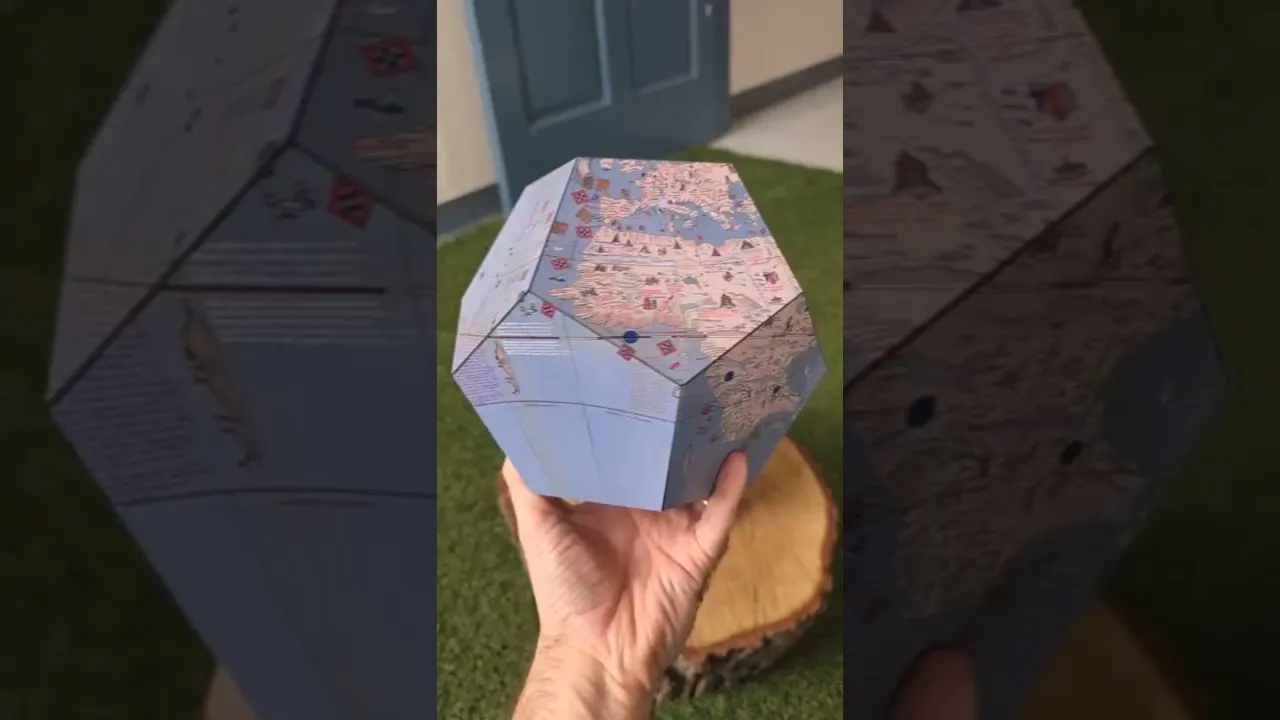
Assemble Your Own 15th-Century Globe Replica Model
This tutorial will guide you through the process of assembling a dodecahedral replica model of the Earth, inspired by the oldest surviving globe, the “Apple” globe created by Martin Beheim in 1492. You’ll learn how to connect pentagonal pieces to form a spherical representation of the world as it was understood just before Columbus’s return to Europe, complete with fascinating historical details and mythical creatures.
Overview of the “Apple” Globe
The original “Apple” globe, crafted by German cartographer Martin Beheim, was finished in 1492. It predates Columbus’s return to Europe, which means the American continents are notably absent. While globes existed before this one, Beheim’s “Apple” is the earliest known round model of our planet that still survives.
The original is housed at the Germanisches Nationalmuseum in Nuremberg. This replica project allows you to create a mathematically interesting and visually rich representation of this historical artifact.
What You Will Learn
- How to assemble a dodecahedral model using pentagonal pieces.
- An understanding of the historical context of the 1492 “Apple” globe and its cartographical limitations.
- To identify and appreciate the unique details depicted on the globe, such as mythical creatures and geographical inaccuracies by modern standards.
Prerequisites
- A kit containing pentagonal pieces designed to assemble into a dodecahedral globe replica.
- A clear workspace.
Assembly Instructions
Prepare Your Pieces
Unpack your kit and identify all the pentagonal pieces. These will form the faces of your dodecahedral globe. Familiarize yourself with the markings on each piece, as they represent different geographical or mythical elements of the 1492 world map.
Begin Constructing the Dodecahedron
A dodecahedron has 12 pentagonal faces. Start connecting the pieces according to the kit’s instructions.
Typically, you will begin by forming a base or an initial structure, joining the edges of the pentagons together. Ensure the connections are secure.
Incorporate Geographical Details
As you assemble, pay attention to the details printed on each face. For instance, you might notice Japan depicted off the coast of Northern Africa, a significant geographical inaccuracy by today’s standards but reflective of the knowledge at the time.
Add Mythical and Historical Elements
The “Apple” globe is rich with interesting depictions. Look for elements like Noah’s Ark resting on Mount Ararat. These additions highlight the blend of religious belief, folklore, and nascent scientific understanding present in the 15th century.
Assemble the Monopods
You may also find depictions of mythical creatures, such as the ‘monopods.’ These were believed by some, dating back to ancient Greek times, to be a type of human with a single leg and a large foot used as a sunshade. The presence of such myths reflects the speculative nature of geography and zoology before extensive exploration and empirical evidence.
Expert Note: The belief in creatures like the monopod was partly fueled by the ancient idea that for every land animal, there must be a corresponding sea animal. It’s hypothesized that the remains of certain sharks might have been misinterpreted as evidence for such land-dwelling, one-legged beings.
Complete the Globe Structure
Continue connecting the pentagonal faces until the dodecahedron is fully formed, creating a spherical replica of the 1492 globe. Ensure all edges are properly joined to maintain the structural integrity of the model.
Display Your Historical Replica
Once assembled, your dodecahedral globe is a fascinating display piece. It’s a tangible representation of historical cartography and the world’s understanding of geography at a key moment in history.
Additional Information (Optional Kit Contents)
Some versions of this kit may include additional items, such as a desk calendar. This calendar might show the relative angular positions of the planets for a given year, like 2026.
By flipping through the pages, you can observe the daily movements of celestial bodies, noting how quickly Earth orbits compared to slower-moving planets like Saturn. This adds another layer of scientific and astronomical interest to the historical artifact reproduction.
Source: We Recreated The Oldest Surviving Globe (YouTube)