Discover the Science Behind Feeling Wet
Have you ever wondered why touching water feels wet? It seems like a straightforward sensation, but the reality is quite fascinating. In this guide, we’ll explore the science behind our perception of wetness through a simple, yet revealing, experiment.
You’ll learn that our bodies don’t directly detect wetness but instead rely on temperature changes as a proxy. We’ll also touch upon how this sensory mechanism differs for insects, revealing a surprising evolutionary advantage.
The Experiment: Testing Your Wetness Perception
This experiment is designed to demonstrate how our sense of ‘wetness’ is actually a perception based on temperature. It highlights that what we feel as wetness is often our body’s response to heat loss.
Prepare Your Materials
You will need:
- A latex glove (or any similar impermeable glove)
- A bowl or container filled with ice-cold water
Put on the Glove
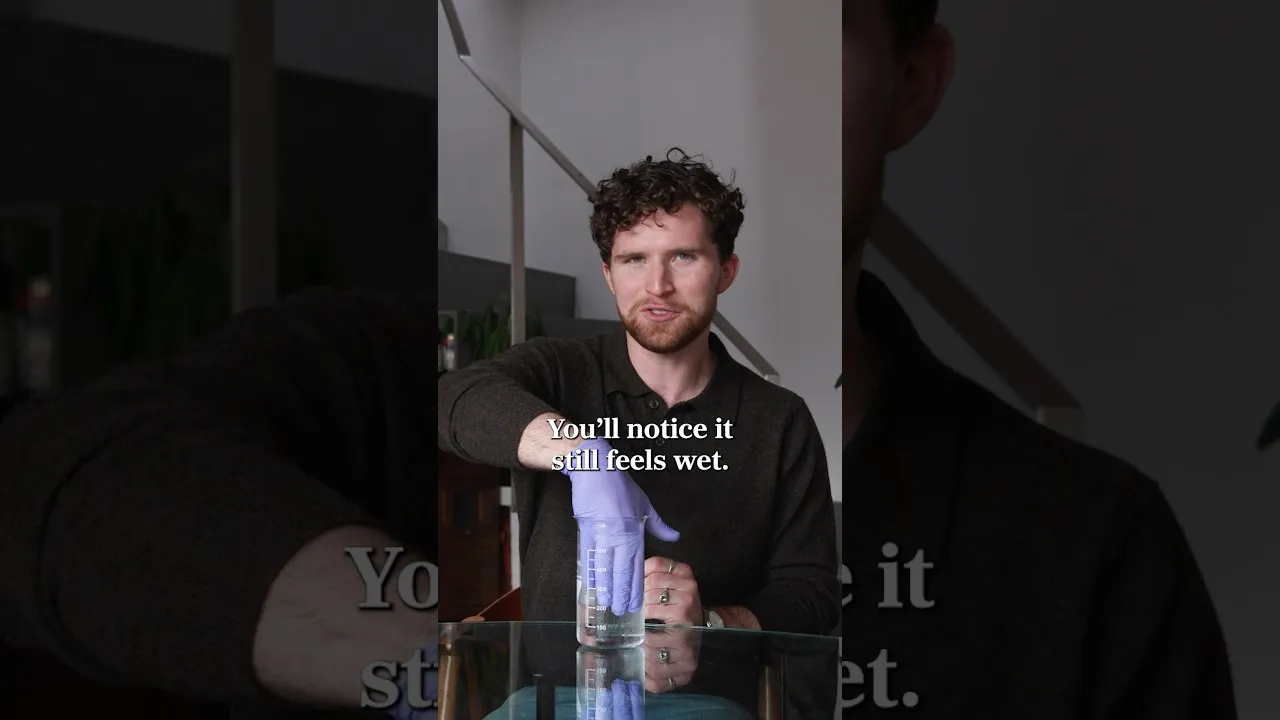
Carefully put on the latex glove. Ensure it fits snugly but comfortably, without any major air gaps.
Submerge Your Hand
Slowly submerge your gloved hand into the ice-cold water. Keep your hand in the water for a short period, paying close attention to the sensations.
Observe the Sensation
What do you feel? Despite the glove being impermeable to water, you will likely still perceive the sensation of wetness. This is the core of the experiment and the phenomenon we will explain.
Remove Your Hand and Reflect
Take your hand out of the water. Notice if the sensation changes. Consider why, even with a barrier, the feeling of wetness persists.
The Science Explained: Why It Feels Wet
The reason you still feel wetness, even with a glove on, is that our bodies don’t have a direct sensory receptor for ‘wetness’ itself. Instead, we use temperature changes as a proxy for detecting moisture.
Heat Transfer: The Key to Perception
Water is an excellent conductor of heat. In fact, it conducts heat approximately 23 times faster than air. When your skin comes into contact with water, the water rapidly draws heat away from your skin.
Your brain interprets this sudden loss of heat as the sensation of ‘wet.’ This is why 15°C water feels significantly colder than 15°C air. The water is much more effective at pulling heat away from your body, creating a stronger cooling sensation.
The Impermeable Glove Paradox
In the experiment, the latex glove prevents actual water from touching your skin. However, the water on the outside of the glove still draws heat away from the glove material, and subsequently, from your hand. This continuous heat loss is what tricks your brain into interpreting the sensation as ‘wet,’ even though your skin is technically dry.
Evolutionary Adaptation: A Matter of Scale
For humans and many larger organisms, this reliance on temperature change as a proxy for wetness has been sufficient for survival. As long as it prevented us from getting too cold and risking hypothermia, this sensory mechanism worked well enough.
However, at the microscopic scale, the physics of water changes. For insects, water is not just a cooling agent; it can be dangerously ‘sticky’ due to surface tension. For many insects, this stickiness can be a significant threat, impeding movement or even causing them to drown.
Insects’ Direct Detection
To cope with these challenges, many insects have evolved specialized structures, such as microscopic hairs on their bodies. These hairs are designed to deform or change shape in the presence of moisture. This physical deformation allows insects to directly detect water, rather than relying on indirect temperature cues.
This means that flies, for instance, possess a sensory capability that we, as humans, lack. They can directly sense water in a way that bypasses the temperature-dependent interpretation our brains use.
Conclusion
The simple act of feeling wet is a complex neurological process rooted in our body’s interpretation of temperature. By conducting the latex glove experiment, you’ve experienced firsthand how our perception can be guided by indirect cues. Understanding this phenomenon not only clarifies our own sensory systems but also reveals the diverse and ingenious adaptations found in the natural world, particularly in insects navigating a world where water behaves very differently at their scale.
Source: You Can't Feel Wet (YouTube)