How to Find Derivatives of Composite Natural Log Functions
This tutorial will guide you through the process of finding the derivative of composite natural log functions using the chain rule. We will break down the steps, explaining the formulas and their application to a specific example.
Understanding the Formulas
Before we begin, let’s review the key formulas we’ll be using:
- Power Rule for Derivatives: The derivative of $u^n$ is $n cdot u^{n-1} cdot u’$.
- Derivative of the Natural Logarithm: The derivative of $ln(u)$ is $frac{u’}{u}$.
Step-by-Step Example
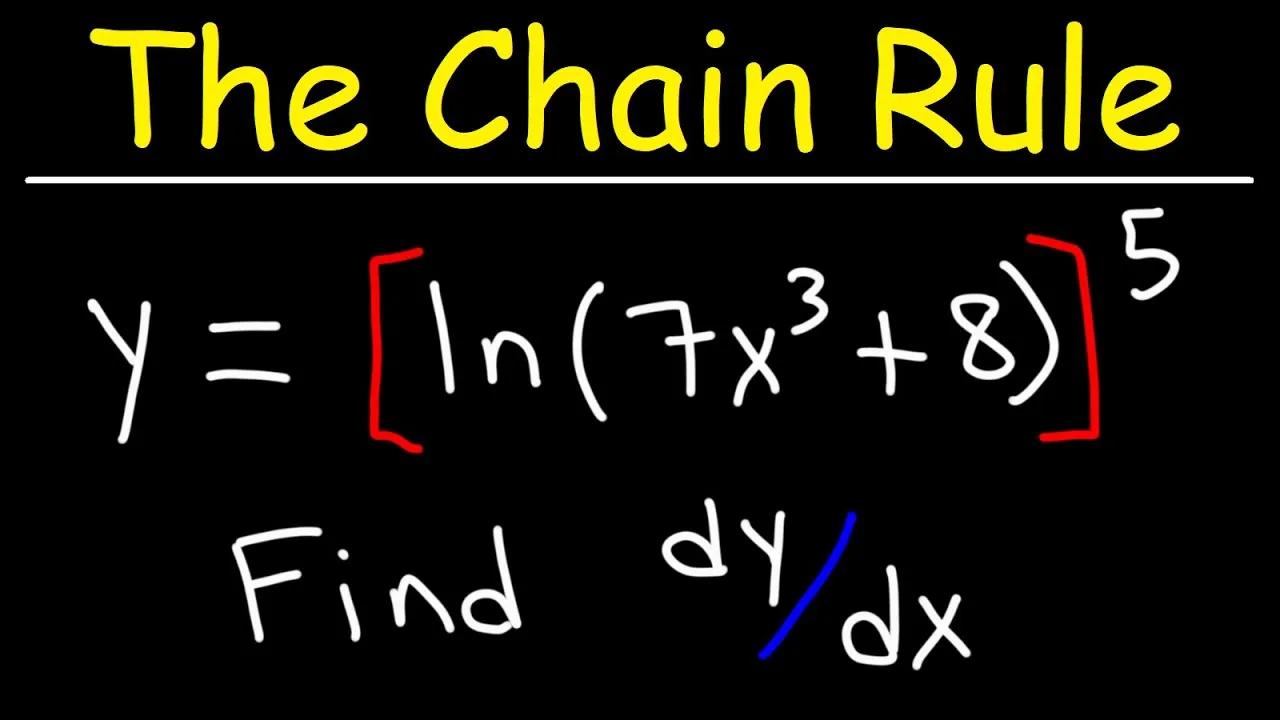
Let’s find the derivative of the function $y = (ln(7x^3 + 8))^5$. We need to find $frac{dy}{dx}$.
Apply the Power Rule to the Outer Function
Our function is in the form of $u^n$, where $u = ln(7x^3 + 8)$ and $n = 5$. Applying the power rule, the derivative is:
$frac{dy}{dx} = n cdot u^{n-1} cdot u’$
Substituting our values:
$frac{dy}{dx} = 5 cdot (ln(7x^3 + 8))^{5-1} cdot frac{d}{dx}(ln(7x^3 + 8))$
This simplifies to:
$frac{dy}{dx} = 5 (ln(7x^3 + 8))^4 cdot frac{d}{dx}(ln(7x^3 + 8))$
Find the Derivative of the Inner Function (Natural Log)
Now we need to find the derivative of the inner function, which is $ln(7x^3 + 8)$. We use the formula for the derivative of a natural logarithm: $frac{u’}{u}$.
In this case, the $u$ for the natural log derivative is $(7x^3 + 8)$. We need to find its derivative, $u’$.
The derivative of $(7x^3 + 8)$ is found by differentiating each term:
- The derivative of $7x^3$ is $7 cdot 3x^{3-1} = 21x^2$.
- The derivative of $8$ is $0$.
So, the derivative of $(7x^3 + 8)$ is $21x^2$. This is our $u’$ for the natural log derivative.
Now, apply the natural log derivative formula: $frac{u’}{u}$
$frac{d}{dx}(ln(7x^3 + 8)) = frac{21x^2}{7x^3 + 8}$
Combine the Derivatives
Substitute the derivative of the inner function back into our equation from Step 1:
$frac{dy}{dx} = 5 (ln(7x^3 + 8))^4 cdot frac{21x^2}{7x^3 + 8}$
Simplify the Expression
To simplify, we can multiply the constants and combine the terms into a single fraction. Multiply $5$ by $21x^2$:
$5 cdot 21x^2 = 105x^2$
Now, rewrite the entire expression:
$frac{dy}{dx} = frac{105x^2 (ln(7x^3 + 8))^4}{7x^3 + 8}$
Final Answer
The derivative of $y = (ln(7x^3 + 8))^5$ is:
$frac{dy}{dx} = frac{105x^2 (ln(7x^3 + 8))^4}{7x^3 + 8}$
Expert Notes
- Chain Rule is Key: Remember that the chain rule is applied whenever you have a composite function (a function within a function).
- Distinguish ‘u’: Be mindful that the variable ‘u’ can represent different parts of the function at different stages of the differentiation process. Always clarify what ‘u’ refers to in each step.
- Simplification: While the unsimplified form is technically correct, always look for opportunities to simplify your final answer by combining terms and constants.
Prerequisites
- Basic understanding of derivatives.
- Familiarity with the power rule.
- Knowledge of the derivative of the natural logarithm function.
- Understanding of algebraic manipulation.
Source: Derivatives of Composite Natural Log Functions with the Chain Rule (YouTube)