How to Find the Slope of a Tangent Line Using Implicit Differentiation
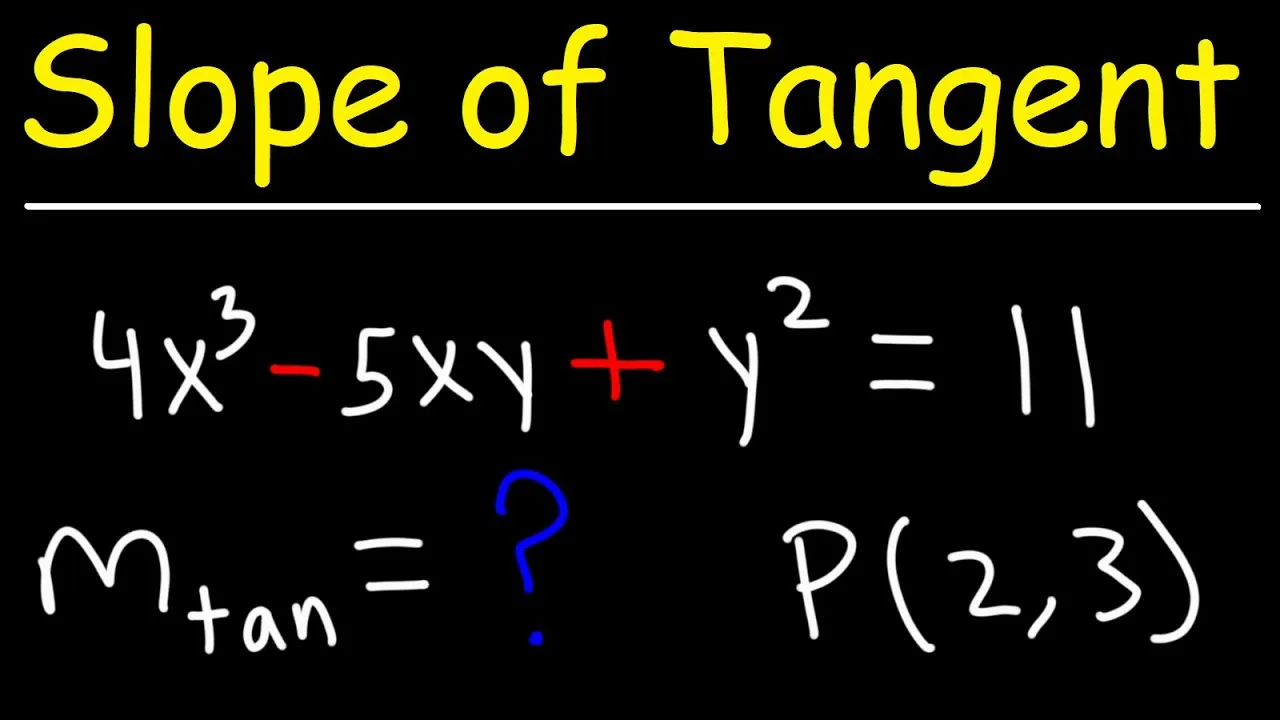
This tutorial will guide you through the process of finding the slope of a tangent line to a curve defined by an implicit equation. You will learn how to apply implicit differentiation to find the derivative $frac{dy}{dx}$ and then evaluate it at a specific point to determine the slope of the tangent line.
Prerequisites
- Basic understanding of derivatives.
- Familiarity with the product rule for differentiation.
Steps
Identify the Goal
The primary goal is to find the slope of the tangent line at a given point. The slope of the tangent line is represented by the derivative $frac{dy}{dx}$ evaluated at that specific point.
Apply Implicit Differentiation
To find $frac{dy}{dx}$ for an equation where y is not explicitly defined in terms of x (an implicit equation), we use implicit differentiation. Differentiate both sides of the equation with respect to x.
- Differentiating terms with x: Use standard differentiation rules. For example, the derivative of $x^3$ with respect to x is $3x^2$.
- Differentiating terms with y: When differentiating a term involving y, remember to multiply by $frac{dy}{dx}$ (or $y’$) because y is treated as a function of x. For example, the derivative of $y^2$ with respect to x is $2y frac{dy}{dx}$.
- Differentiating terms with both x and y: Use the product rule. If you have a term like $5xy$, let $f = 5x$ and $g = y$. The product rule states that the derivative is $f’g + fg’$.
- The derivative of $f$ ($5x$) is $5$.
- The derivative of $g$ ($y$) with respect to x is $frac{dy}{dx}$.
- Applying the product rule: $(5)(y) + (5x)(frac{dy}{dx}) = 5y + 5x frac{dy}{dx}$.
- Differentiating constants: The derivative of a constant is always 0. For example, the derivative of 11 is 0.
Substitute the Given Point
Once you have differentiated both sides of the equation, you will have an equation that includes $frac{dy}{dx}$. You can now substitute the coordinates of the given point (in this example, (2, 3)) into the equation for x and y.
This can be done before or after solving for $frac{dy}{dx}$. For this example, we will substitute the point first.
Let’s assume our implicit equation is $4x^3 + 5xy – y^2 = 11$ and the point is $(2, 3)$.
- Differentiating the equation implicitly with respect to x:
- Derivative of $4x^3$ is $12x^2$.
- Derivative of $5xy$ using the product rule: $5y + 5x frac{dy}{dx}$.
- Derivative of $-y^2$ is $-2y frac{dy}{dx}$.
- Derivative of $11$ is $0$.
- So, the differentiated equation is: $12x^2 + 5y + 5x frac{dy}{dx} – 2y frac{dy}{dx} = 0$.
Now, substitute $x=2$ and $y=3$ into this equation:
- $12(2)^2 + 5(3) + 5(2) frac{dy}{dx} – 2(3) frac{dy}{dx} = 0$
- $12(4) + 15 + 10 frac{dy}{dx} – 6 frac{dy}{dx} = 0$
- $48 + 15 + 10 frac{dy}{dx} – 6 frac{dy}{dx} = 0$
Solve for $frac{dy}{dx}$
Now, rearrange the equation to solve for $frac{dy}{dx}$.
- Combine constant terms: $48 + 15 = 63$.
- Combine terms with $frac{dy}{dx}$: $10 frac{dy}{dx} – 6 frac{dy}{dx} = 4 frac{dy}{dx}$.
- The equation becomes: $63 + 4 frac{dy}{dx} = 0$.
- Move the constant term to the other side: $4 frac{dy}{dx} = -63$.
- Divide by 4 to isolate $frac{dy}{dx}$: $frac{dy}{dx} = -frac{63}{4}$.
The slope of the tangent line at the point (2, 3) is $-frac{63}{4}$.
Alternative: Solve for $frac{dy}{dx}$ First
Alternatively, you could first solve the differentiated equation for $frac{dy}{dx}$ before substituting the point. From the step $12x^2 + 5y + 5x frac{dy}{dx} – 2y frac{dy}{dx} = 0$, group terms with $frac{dy}{dx}$:
- $5x frac{dy}{dx} – 2y frac{dy}{dx} = -12x^2 – 5y$
- Factor out $frac{dy}{dx}$: $frac{dy}{dx}(5x – 2y) = -12x^2 – 5y$
- Solve for $frac{dy}{dx}$: $frac{dy}{dx} = frac{-12x^2 – 5y}{5x – 2y}$
Now substitute the point $(2, 3)$ into this expression:
- $frac{dy}{dx} = frac{-12(2)^2 – 5(3)}{5(2) – 2(3)}$
- $frac{dy}{dx} = frac{-12(4) – 15}{10 – 6}$
- $frac{dy}{dx} = frac{-48 – 15}{4}$
- $frac{dy}{dx} = frac{-63}{4}$
Both methods yield the same result.
Expert Note:
When dealing with implicit differentiation, be careful to correctly apply the product rule and chain rule. Always remember to multiply by $frac{dy}{dx}$ when differentiating a term involving y. The order of substitution (before or after solving for $frac{dy}{dx}$) usually does not affect the final answer but can sometimes simplify calculations.
Source: How to Find the Slope of the Tangent Line Using Implicit Differentiation (YouTube)