Master Derivatives: Product & Chain Rule in Action
In this tutorial, you will learn how to find the derivative of a complex function involving both the product rule and the chain rule. We will break down the process step-by-step, starting with identifying the two functions that make up the product and then applying the chain rule to differentiate each function individually. Finally, we will combine these results using the product rule and simplify the expression.
Prerequisites
Before you begin, ensure you have a basic understanding of:
- The power rule for differentiation.
- The concept of a derivative.
Step-by-Step Guide
Step 1: Identify the Functions for the Product Rule
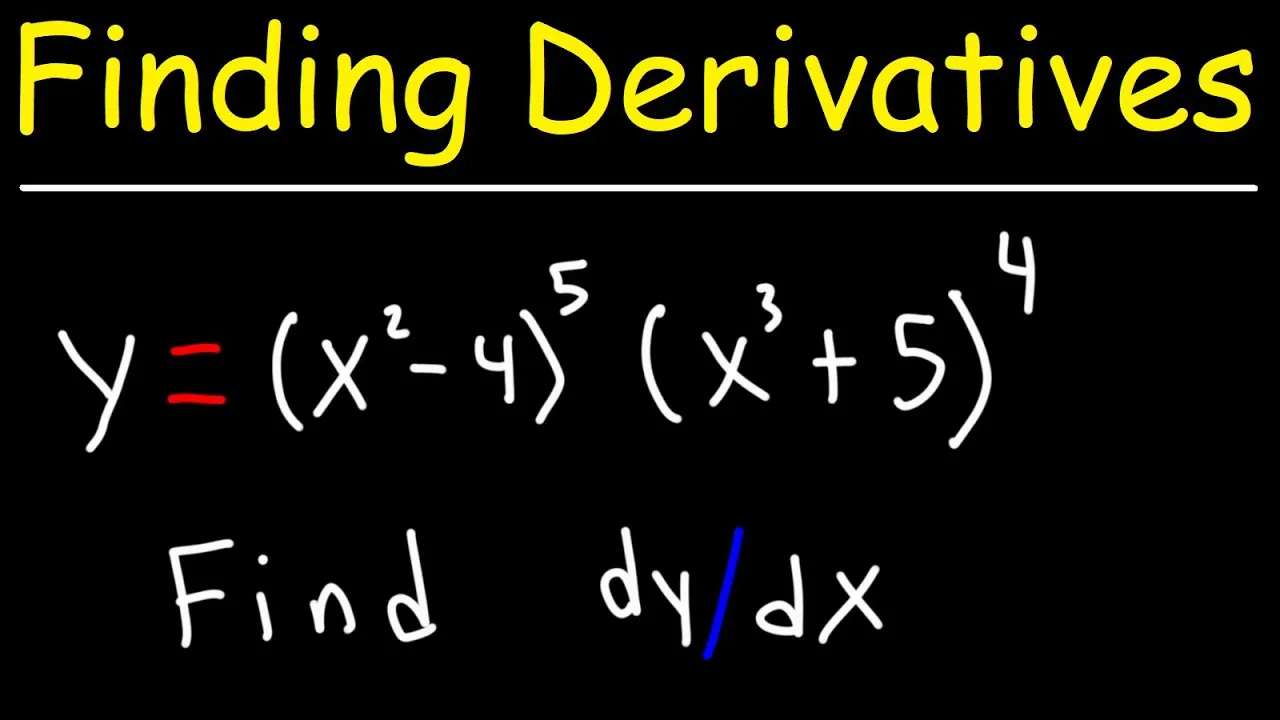
The product rule states that the derivative of a product of two functions, f(x) and g(x), is given by: (f * g)’ = f’g + fg’. In our example, the function we want to differentiate is: (x2 – 4)5 * (x3 + 5)4.
Let’s define our two functions:
- Let f(x) = (x2 – 4)5
- Let g(x) = (x3 + 5)4
Our goal is to find f'(x) and g'(x) using the chain rule, and then plug them into the product rule formula.
Step 2: Differentiate the First Function (f) Using the Chain Rule
To find the derivative of f(x) = (x2 – 4)5, we use the chain rule, which is a version of the power rule for composite functions. The formula for the derivative of un is n * un-1 * u’.
- Here, n = 5.
- The inner function u = x2 – 4.
- The derivative of the inner function, u’, is the derivative of x2 – 4, which is 2x.
Applying the chain rule formula:
F'(x) = 5 * (x2 – 4)(5-1) * (2x)
F'(x) = 5 * (x2 – 4)4 * 2x
F'(x) = 10x * (x2 – 4)4
Step 3: Differentiate the Second Function (g) Using the Chain Rule
Similarly, to find the derivative of g(x) = (x3 + 5)4, we use the chain rule.
- Here, n = 4.
- The inner function u = x3 + 5.
- The derivative of the inner function, u’, is the derivative of x3 + 5, which is 3x2.
Applying the chain rule formula:
G'(x) = 4 * (x3 + 5)(4-1) * (3x2)
G'(x) = 4 * (x3 + 5)3 * 3x2
G'(x) = 12x2 * (x3 + 5)3
Step 4: Apply the Product Rule
Now we have all the components to apply the product rule: f’g + fg’.
- f = (x2 – 4)5
- g = (x3 + 5)4
- f’ = 10x * (x2 – 4)4
- g’ = 12x2 * (x3 + 5)3
Substitute these into the product rule formula:
Derivative = [10x * (x2 – 4)4] * [(x3 + 5)4] + [(x2 – 4)5] * [12x2 * (x3 + 5)3]
Step 5: Simplify the Expression by Factoring
To simplify, we will first combine the coefficients and then factor out the greatest common factor (GCF) from the terms.
Let’s simplify the coefficients and terms:
Term 1: 10x * (x2 – 4)4 * (x3 + 5)4
Term 2: 12x2 * (x2 – 4)5 * (x3 + 5)3
Identify the GCF:
- For the numerical coefficients (10 and 12), the GCF is 2.
- For the ‘x’ terms (x and x2), the GCF is x (the lowest power).
- For the (x2 – 4) terms, the powers are 4 and 5. The GCF is (x2 – 4)4 (the lowest power).
- For the (x3 + 5) terms, the powers are 4 and 3. The GCF is (x3 + 5)3 (the lowest power).
So, the overall GCF is 2x * (x2 – 4)4 * (x3 + 5)3.
Now, factor out the GCF from each term:
Derivative = 2x * (x2 – 4)4 * (x3 + 5)3 * [ (5) * (x3 + 5)1 + (6x) * (x2 – 4)1 ]
Step 6: Simplify the Expression Inside the Brackets
Now, focus on simplifying the expression within the square brackets:
5 * (x3 + 5) + 6x * (x2 – 4)
Distribute the constants and terms:
- 5 * x3 + 5 * 5 = 5x3 + 25
- 6x * x2 – 6x * 4 = 6x3 – 24x
Combine these results:
5x3 + 25 + 6x3 – 24x
Add like terms:
(5x3 + 6x3) – 24x + 25
11x3 – 24x + 25
Step 7: Write the Final Derivative
Substitute the simplified expression back into the factored form:
Derivative = 2x * (x2 – 4)4 * (x3 + 5)3 * (11x3 – 24x + 25)
Expert Note: While factoring out the GCF is a common simplification technique, always ensure that no further simplification is possible within the remaining polynomial terms. In this case, the polynomial (11x3 – 24x + 25) cannot be easily factored further.
Source: Finding Derivatives Using the Product Rule and The Chain Rule (YouTube)