How to Clear a 16-Square Bacterial Grid
This article guides you through a fascinating puzzle involving bacterial replication on a grid. You’ll learn the rules of bacterial movement and replication, and how to strategically clear a specific 4×4 area of the grid, aiming for the minimum number of moves. This challenge is designed to test your logical thinking and problem-solving skills.
Understanding the Game
Imagine a grid, like a chessboard. We start with a single bacterium placed at the origin (0,0).
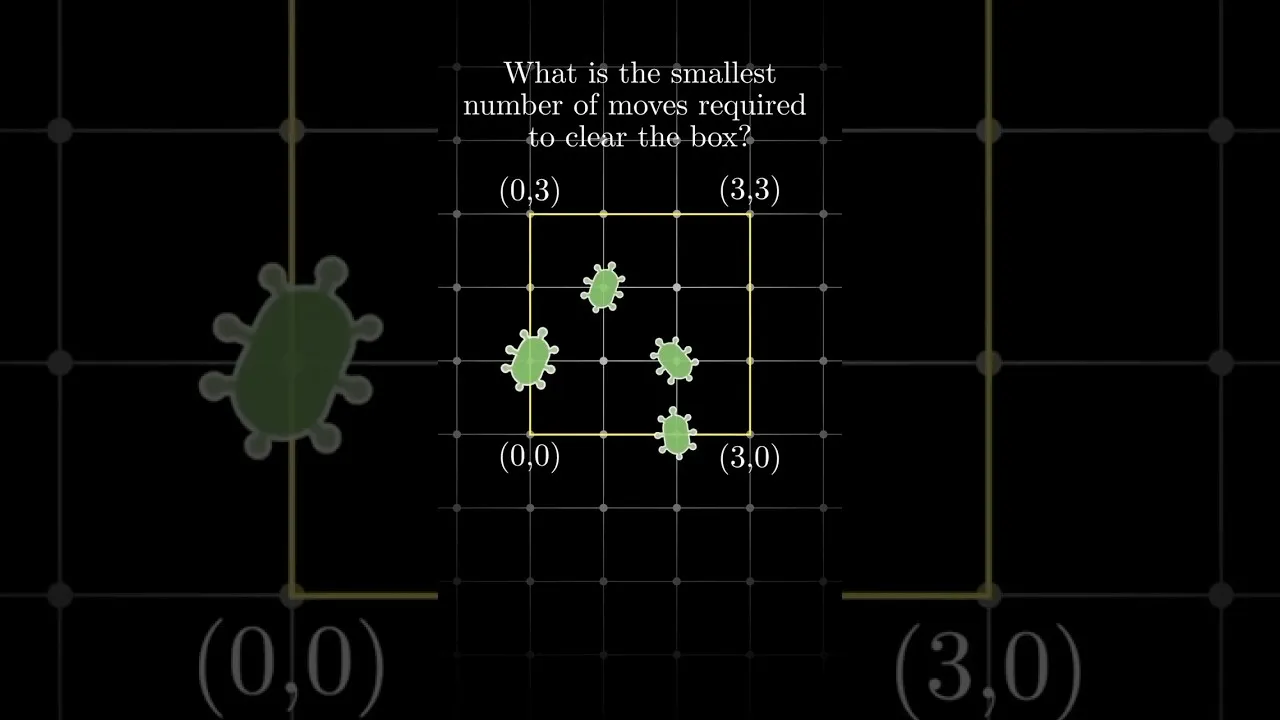
The goal is to make sure that a specific 4×4 area of the grid, defined by the points (0,0) to (3,3), is completely empty. This means all 16 lattice points within this box must eventually be cleared of bacteria.
The Rules of Replication
Here’s how the bacteria behave:
- Selection: At any time, you can choose a single bacterium on the grid.
- Replication Condition: For a selected bacterium to replicate, two specific adjacent spots must be empty: the spot directly above it and the spot directly to its right.
- Replication Action: If both the spot above and the spot to the right are empty, the bacterium replicates. It creates two ‘children’ bacteria that occupy these two empty spots. Simultaneously, the original bacterium vacates its current spot, leaving it empty.
- Constraint: Only one bacterium can occupy a single spot on the grid at any given time. If either the spot above or the spot to the right is already occupied, the bacterium cannot replicate.
The Puzzle: Clearing the 4×4 Box
Your objective is to determine the minimum number of replication moves required to ensure that all 16 lattice points within the box defined by corners at (0,0), (3,0), (0,3), and (3,3) are empty. You start with a single bacterium at the origin (0,0).
Step-by-Step Strategy (Conceptual)
While a specific sequence of moves isn’t provided in the transcript, the core of the puzzle lies in understanding how replication affects the grid and how to use it to your advantage to eventually clear the target area. This often involves a process of moving bacteria out of the target area or using them to clear other bacteria.
Initial State:
You begin with one bacterium at (0,0).
The Goal State:
All grid points (x,y) where 0 ≤ x ≤ 3 and 0 ≤ y ≤ 3 must be empty.
General Approach:
1. Analyze Movement: Observe how a bacterium at (x,y) can move. If it replicates, it effectively moves from (x,y) to (x, y+1) and (x+1, y), leaving (x,y) empty. This means bacteria tend to spread upwards and to the right.
2. Identify Bottlenecks: Consider which bacteria are blocking the clearing of the target 4×4 box. Bacteria outside this box might need to be moved in, and then replicated to move out, or used to push other bacteria out.
3. Strategic Replication: To clear a spot, you generally need the bacterium occupying it to replicate. This means ensuring the spots above and to its right are free. If a bacterium is within the 4×4 box and you want to clear its spot, you might need to move other bacteria out of its replication targets, or move the bacterium itself to a position where it can replicate and move out of the box.
4. Work Backwards or Forwards: You can either try to find a sequence of moves that leads to the desired empty state, or consider the final empty state and work backward to see what the previous state must have been, repeating this process until you reach the initial state.
5. Minimization: The key challenge is finding the *smallest* number of moves. This implies that each move should be as productive as possible, ideally contributing directly to clearing the target area or setting up future clearing moves efficiently.
Example Scenario (Illustrative):
Suppose you have a bacterium at (0,0). To clear it, it needs to replicate. If (0,1) and (1,0) are empty, it can replicate.
Now you have bacteria at (0,1) and (1,0). To clear (0,1), it needs (0,2) and (1,1) to be empty. To clear (1,0), it needs (1,1) and (2,0) to be empty.
Notice that (1,1) is a target for both. This interplay is crucial.
The Challenge
The puzzle asks for the *smallest* number of moves. This suggests that there might be many ways to clear the box, but only one (or a few) that uses the fewest steps. This often involves finding clever ways to use the replication mechanic to clear multiple spots simultaneously or to efficiently move bacteria out of the way.
Expert Insight:
This type of puzzle is reminiscent of cellular automata or grid-based simulation problems. The constraint of only one bacterium per spot and the specific replication rule (up and right) create a unique dynamic. Solutions often involve understanding how the ‘wave’ of replication propagates and how to control its direction and extent to achieve the goal state.
Prerequisites
- Basic understanding of coordinates (x,y) on a 2D grid.
- Logical reasoning and problem-solving skills.
Conclusion
The challenge is to find the minimum number of replication moves to clear the 4×4 box starting from a single bacterium at the origin. This puzzle requires careful planning and an understanding of how bacterial replication affects the grid state. The exact solution and minimum number of moves are complex and often discovered through exploration and logical deduction, with further explanation available from puzzle creators.
Source: The lattice bacteria puzzle (YouTube)