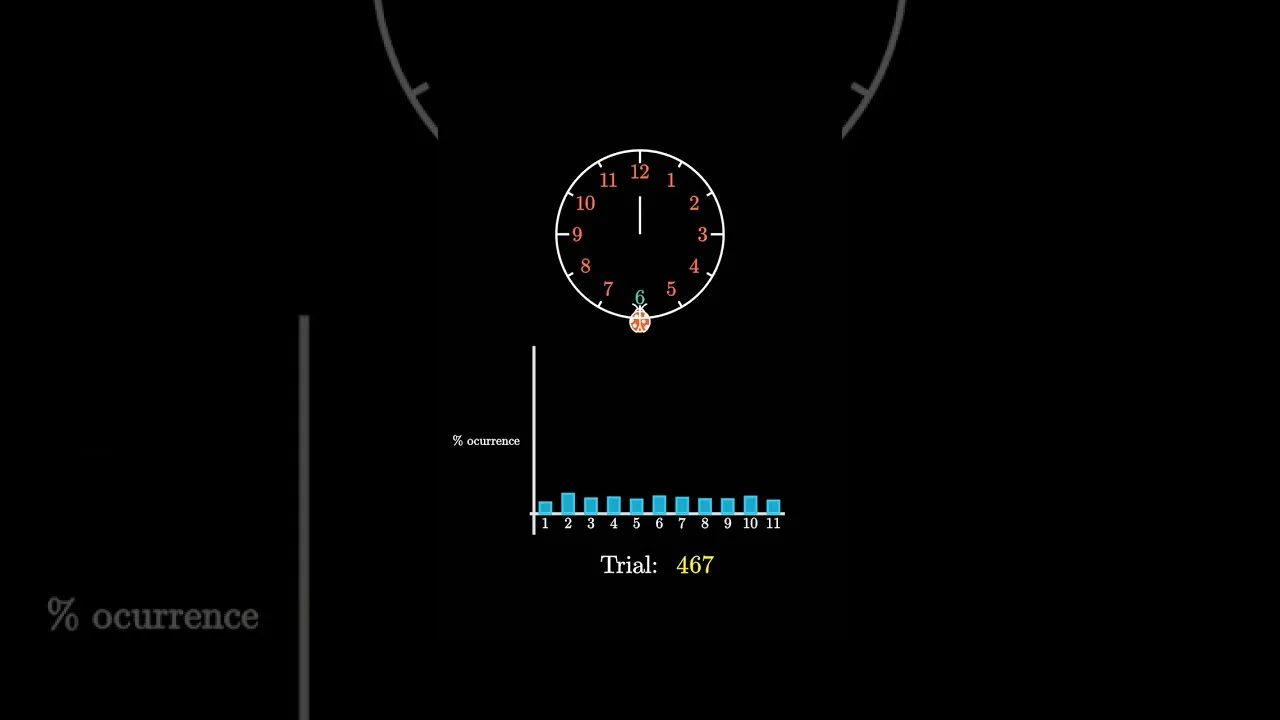
Solve the Ladybug Clock Puzzle: Find the Last Number Colored
This article will guide you through the solution to a fascinating probability puzzle involving a ladybug on a clock face. You’ll learn how to approach a seemingly complex random walk problem by reframing the question and understand why all numbers (except the starting point) have an equal chance of being the last one colored red.
Understanding the Puzzle
Imagine a standard 12-hour clock face. A ladybug starts at the number 12. It then takes a series of random steps, moving either clockwise or counterclockwise with equal probability (50/50 chance) for each step.
As the ladybug lands on each number, that number is colored red. The puzzle is to determine the probability that the number 6 is the *last* number to be colored red.
When this puzzle is simulated many times, an interesting pattern emerges: all the numbers from 1 to 11 appear to be roughly equally likely to be the last one colored. This might seem counterintuitive at first, as one might expect numbers closer to the starting point (12) to be colored earlier, and thus less likely to be the last. However, the simulation results suggest otherwise.
The Key Insight: Reframing the Problem
The core of solving this puzzle lies in a clever shift in perspective. Instead of directly calculating the probability of ending on 6 from the very beginning, we can simplify the problem by focusing on a specific intermediate condition.
Consider the number 6. Its immediate neighbors on the clock are 5 and 7.
The key insight is to wait for the ladybug to reach either the 5 or the 7 for the *first time*. Once the ladybug lands on either of these two numbers, we then ask: what is the probability that 6 will be the last number colored red *from this point forward*?
You might wonder if this changes the overall probability. It doesn’t.
The reason is that, with probability one (meaning it’s guaranteed to happen eventually), the ladybug *will* land on either 5 or 7 at some point during its random walk. Therefore, waiting for this condition doesn’t alter the final outcome’s probability.
Solving for the Probability of Landing on 6
Let’s assume the ladybug has just landed on, say, the number 7 (the logic is identical if it landed on 5). From this position, what must happen for 6 to be the last number colored red?
For 6 to be the last number colored, the ladybug must reach the number 5 *before* it ever reaches the number 6 again. If it hits 5 first, it means it has effectively traversed all the other numbers between 7 and 5 (going clockwise, i.e., 8, 9, 10, 11, 12, 1, 2, 3, 4) before reaching 6. Once all other numbers are colored, 6 is inevitably the last one.
This scenario can be visualized as a 1-dimensional random walk. Imagine straightening out the clock face and considering a walk where each step is either +1 or -1 with a 50% chance. From our position (let’s say we just hit 7, so we are effectively ‘zero’ relative to the target numbers), we want to know the probability of reaching a point 10 steps away in one direction (landing on 5 before 6) before reaching a point 1 step away in the other direction (landing on 6 before 5).
While calculating this specific probability directly can be complex, the crucial point is that this calculation is the *same* for any target number between 1 and 11.
Generalizing the Solution
The puzzle has nothing inherently special about the number 6. Let’s consider another number, say 3. What is the probability that 3 is the last number colored?
- Wait for a Neighbor: First, let the ladybug wander until it lands on one of the neighbors of 3, which are 2 or 4. This is guaranteed to happen eventually.
- Define the Goal: From the moment it lands on either 2 or 4, ask: what is the probability that it reaches the number 4 *before* it reaches the number 2? If it reaches 4 first, it means it has colored all numbers between 2 and 4 (i.e., 3) before reaching 2.
- Equivalent Random Walk: This is again equivalent to a 1-dimensional random walk. From a starting point, what’s the probability of reaching a point 2 steps away in one direction before reaching a point 1 step away in the other direction?
The probability calculation for reaching 4 before 2 is identical to the probability calculation for reaching 5 before 6 (or 7 before 6). This holds true for any number ‘n’ between 1 and 11. The ladybug starts at 12.
To find the probability that ‘n’ is the last number colored, we wait until it hits ‘n-1’ or ‘n+1’. From that point, the probability that ‘n’ is the last colored is the probability of reaching the further neighbor before the closer neighbor.
The Result
Since the probability calculation is identical for each of the 11 numbers (1 through 11) to be the last one colored, and these probabilities must sum up to 1 (because one of these numbers *must* be the last one colored, as the starting point 12 will always be colored before any other number if it’s not the first step), each of these 11 numbers has an equal probability.
Therefore, the probability that any specific number between 1 and 11 is the last one colored is:
1 / 11
This means the probability of the ladybug coloring 6 last is 1/11, the probability of it coloring 3 last is 1/11, and so on, for all numbers except the starting point.
Conclusion
The ladybug clock puzzle, while initially seeming complex, reveals a beautiful symmetry. By reframing the problem around the first encounter with a neighbor of the target number, we transform it into a standard random walk problem. The fact that the calculation is identical for all numbers from 1 to 11 leads to the surprising but elegant conclusion that each has an equal probability of being the last number colored.
Source: Solution to the ladybug clock puzzle (YouTube)