Understanding the Dynamics of e^(πi)
The expression eπi, famously known as Euler’s Identity, is often cited as the most beautiful equation in mathematics. But what does it truly mean? This guide will break down the concept by exploring the dynamic interpretation of the exponential function, et, and how substituting imaginary values leads us to this profound result.
What is et from a Dynamic Perspective?
To grasp eπi, we first need to understand the function et through the lens of dynamics. In this context, et is the unique function that possesses a remarkable property: its rate of change (its derivative) is equal to itself. When you input the value 1 into this function, the output is 1.
The Growth of et
Imagine et representing a position over time. This means that at any given moment, the velocity (the rate of change of position) is precisely equal to the numerical value of the position itself. So, if the position is 5, the velocity is also 5.
If the position is 10, the velocity is 10. This relationship implies a system that grows at an ever-increasing rate. The larger the position becomes, the faster it grows.
Exponential Growth with a Constant Multiplier
Now, consider what happens when we introduce a constant into the exponent, such as 2t. According to the chain rule in calculus, this function’s rate of change is exactly 2 times its current value.
In dynamic terms, this means the velocity is always twice the position. Consequently, the system grows even more rapidly than a simple et.
Exponential Decay
If the exponent is negative, say -t, the function’s rate of change becomes negative. This signifies a shrinking or decaying process. The rate at which it shrinks, however, is proportional to its current size.
As the value gets smaller, the rate of shrinking also decreases. This behavior characterizes exponential decay, where the process slows down as it approaches zero.
Introducing the Imaginary Unit ‘i’
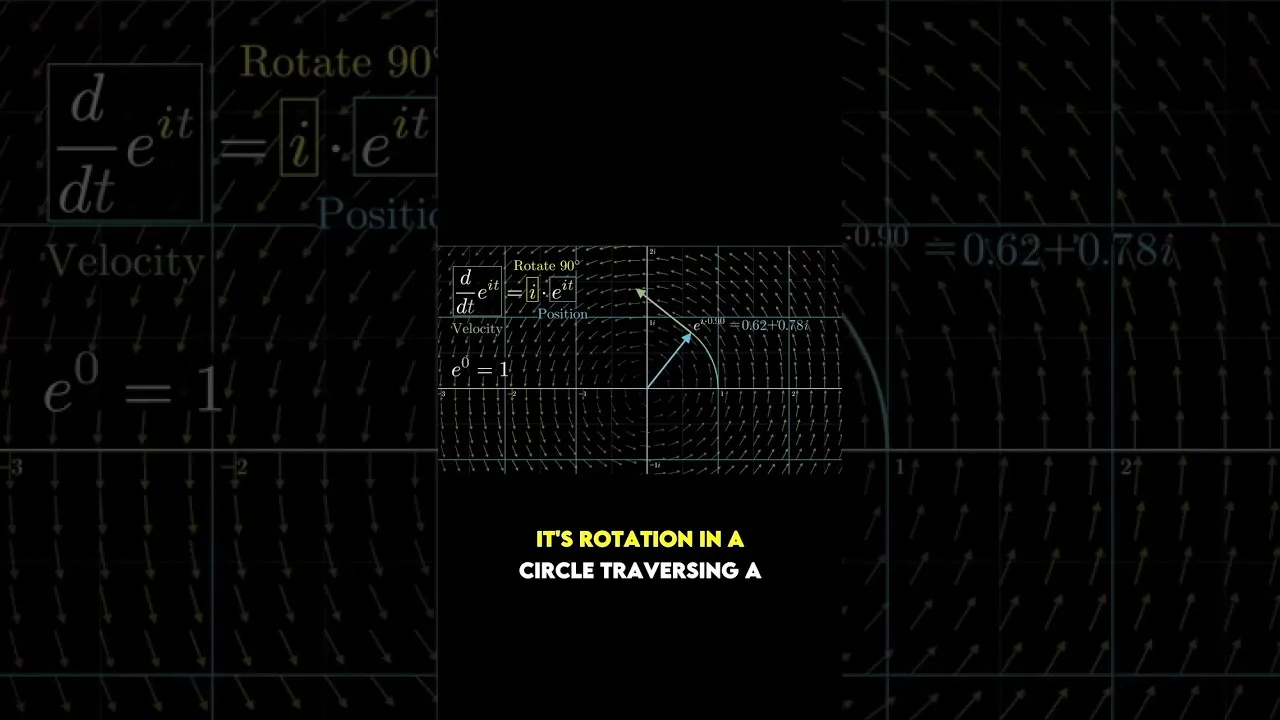
The real magic happens when we consider plugging the imaginary unit, ‘i’ (the square root of -1), into the exponent. Let’s interpret eit as a position in this dynamic framework.
The Dynamic Interpretation of eit
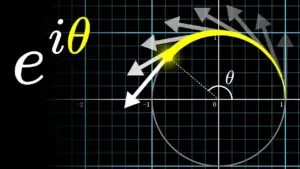
If eit represents a position, then the statement that its velocity is i times that position leads to a fascinating geometric interpretation. In the complex plane, multiplying a number by ‘i’ is equivalent to rotating that number by 90 degrees counterclockwise.
Rotation in the Complex Plane
Therefore, if eit has any meaningful interpretation, it must describe a motion where the velocity vector is always a 90-degree rotation of the position vector. What kind of motion satisfies this condition?
The only motion where the velocity is always perpendicular to the position is circular motion. Specifically, it describes movement along a circle.
Constant Speed and Arc Length
The dynamic interpretation suggests that the speed of this motion is constant, equivalent to traversing 1 unit of arc length per second. This means that after a certain amount of time, we can determine the position on the circle.
Deriving Euler’s Identity: eπi = -1
Let’s apply this understanding to the specific case of eπi. Here, our ‘time’ is represented by π (pi) seconds.
Reaching Halfway Around the Circle
Since the motion is a rotation along a circle with a unit arc length traversed per second, after π seconds, we will have moved a distance of π units along the circumference. Starting from the point 1 on the real axis (which is where e0 is), a distance of π along the circumference of a unit circle brings us exactly halfway around. Halfway around a circle, starting from 1, lands us at -1 on the real axis.
The Result
Thus, eπi, interpreted dynamically as a rotation on the unit circle for π seconds at a speed of 1 unit per second, equals -1.
Conclusion
By viewing the exponential function dynamically, we can intuitively understand how substituting the imaginary unit ‘i’ into the exponent leads to rotational motion. The specific value eπi represents a rotation of π radians (180 degrees) on the unit circle, starting from 1, which ultimately lands us at -1.
Source: The dynamics of e^(πi) (YouTube)