Unlock the Magic of AI: How CLIP Bridges Text and Images
Artificial intelligence has made incredible strides in generating realistic images and videos from simple text descriptions. This advancement is driven by sophisticated models that understand the relationship between words and visuals.
At the heart of this capability lies a model architecture called CLIP (Contrastive Language-Image Pre-training), developed by OpenAI. This article will demystify how CLIP works, explaining its underlying principles and demonstrating its power in connecting textual concepts with visual representations.
What You Will Learn
In this guide, you will discover:
- The fundamental concept behind CLIP and its two-model architecture.
- How CLIP creates a shared ’embedding space’ for text and images.
- The mathematical operations CLIP can perform on concepts within this space.
- How this connection enables AI to generate relevant images from text.
Prerequisites
No prior AI or machine learning knowledge is strictly required, but a basic understanding of concepts like data and models can be helpful.
Understanding the Core Idea: CLIP’s Architecture
CLIP is a groundbreaking model that fundamentally changed how AI processes the relationship between text and images. It’s not a single AI but rather a system composed of two distinct models working in tandem:
- The Image Model: This component takes an image as input and processes it to create a numerical representation, known as a vector.
- The Text Model: This component takes text as input and also generates a numerical vector of the same length.
The core innovation of CLIP lies in how these two models are trained. They are trained together so that the vector representing a specific image is mathematically close to the vector representing its corresponding text caption. This creates a shared ’embedding space’ where similar concepts, whether expressed in text or shown in an image, are located near each other.
The Shared Embedding Space: Where Concepts Meet
Imagine a vast, multi-dimensional library. In this library, each book (image) and each descriptive label (text) has a specific location.
CLIP’s training ensures that a book about a ‘red apple’ is placed very close to the label ‘red apple’. Similarly, a picture of a dog is placed close to the text ‘a dog’.
The output of both the image and text models is a vector of a fixed length, typically 512 dimensions. These vectors are essentially coordinates within this multi-dimensional embedding space. The goal of CLIP’s training is to align these vectors so that if an image and a piece of text describe the same concept, their respective vectors will be very similar in this space.
How CLIP Learns Connections
CLIP is trained on a massive dataset of image-text pairs scraped from the internet. During training, the model is presented with many images and their associated captions. It learns to:
- Encode an image into a vector.
- Encode its corresponding caption into a vector.
- Encode other, unrelated captions into vectors.
The model is then optimized to maximize the similarity between the image vector and its correct caption vector, while simultaneously minimizing the similarity between the image vector and all the incorrect caption vectors. This contrastive learning approach forces the model to develop a deep understanding of what makes an image and its description semantically related.
Mathematical Operations on Concepts
One of the most fascinating aspects of CLIP is its ability to perform mathematical operations on these concept vectors. This means you can manipulate the vectors to explore nuanced ideas.
Example: The ‘Hat’ Concept
Let’s illustrate this with an example:
- Input Images: Imagine you have two images of yourself. One where you are wearing a hat, and another where you are not.
- Image Encoding: You feed both images into CLIP’s image model. This produces two distinct vectors in the embedding space: Vector_Hat and Vector_No_Hat.
- Vector Subtraction: You then perform a simple mathematical operation: subtract the Vector_No_Hat from the Vector_Hat. This results in a new vector: Vector_Difference = Vector_Hat – Vector_No_Hat.
What does this ‘Vector_Difference’ represent? Intuitively, it captures the ‘essence’ or ‘concept’ of ‘wearing a hat’ by isolating it from other features present in the image (like your face, background, etc.).
Discovering Associated Text
To understand what this Vector_Difference corresponds to in terms of text, you can feed a variety of words into CLIP’s text model and compare their resulting vectors to Vector_Difference.
- Text Encoding: Pass a set of common words (e.g., ‘hat’, ‘cap’, ‘helmet’, ‘shirt’, ‘sunglasses’) through CLIP’s text encoder to get their respective vectors.
- Similarity Search: Calculate the similarity between Vector_Difference and the vectors for each of these words.
- Top Matches: CLIP will identify the words whose vectors are closest to Vector_Difference. In this case, the top matches are likely to be ‘hat’, followed by ‘cap’ and perhaps ‘helmet’.
This demonstrates that the learned geometry of CLIP’s embedding space allows for mathematical manipulation of pure ideas. You can literally subtract the concept of ‘not wearing a hat’ from the concept of ‘wearing a hat’ and find that the resulting mathematical representation closely aligns with the textual concept of ‘hat’.
How This Enables Text-to-Image Generation
This ability to connect text and image concepts mathematically is the foundation for powerful text-to-image generation models. These models often use CLIP (or similar principles) as a guide:
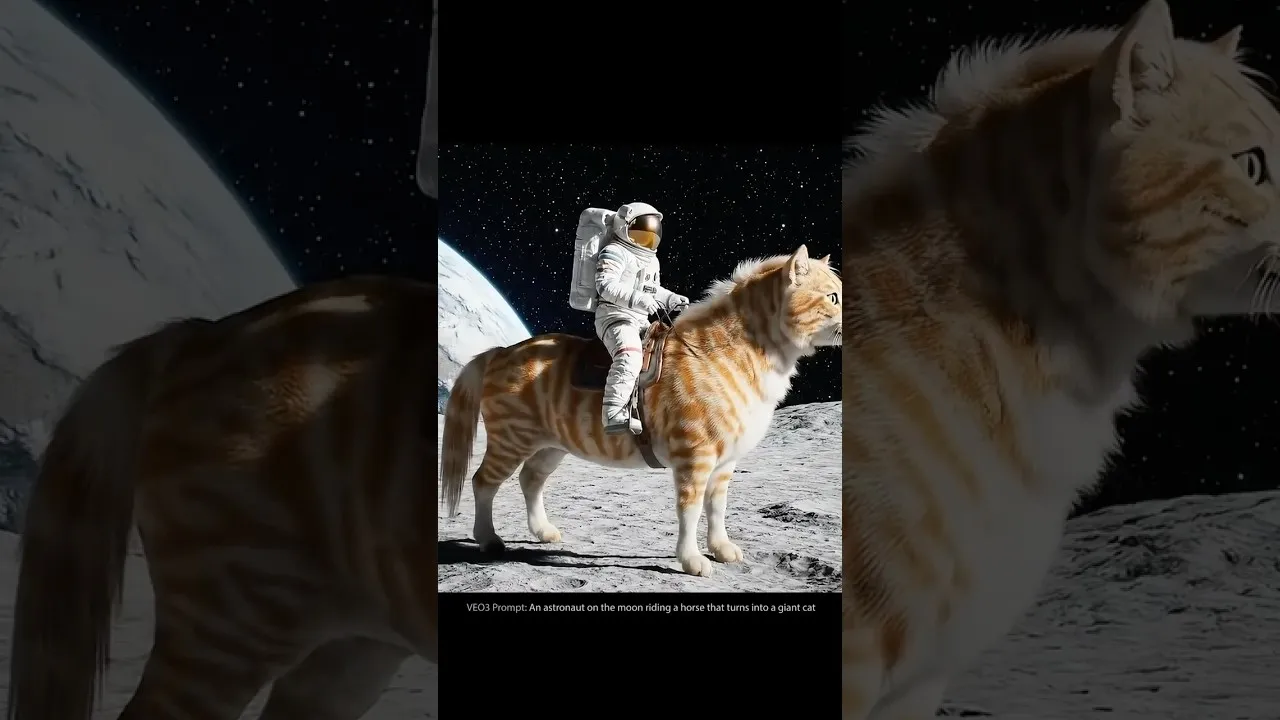
- Text Prompt: A user provides a text description (e.g., “A photo of an astronaut riding a horse on the moon”).
- CLIP’s Guidance: CLIP helps a separate image generation model (like a diffusion model) understand what the text prompt means by providing guidance in its learned embedding space.
- Iterative Refinement: The image generation model starts with random noise and iteratively refines it, using CLIP’s feedback to ensure the emerging image becomes increasingly similar to the concept described in the text prompt.
By understanding the semantic relationships between words and visual features, AI can translate abstract textual ideas into concrete visual outputs.
Conclusion
CLIP represents a significant leap in AI’s ability to understand and connect different modalities like text and images. By creating a shared embedding space and enabling mathematical operations on concepts, CLIP provides the crucial bridge that allows AI systems to interpret text prompts and generate corresponding visuals with remarkable accuracy and creativity. This underlying technology powers many of the stunning AI-generated images and videos we see today.
Source: How AI connects text and images (YouTube)