Discover the Future of The Coding Train: New Tutorials and Plans
In this article, we’ll explore the upcoming content and strategic direction for The Coding Train channel. You’ll learn about planned tutorial releases, new series focusing on p5.js and machine learning, and the channel’s new seasonal content structure. We’ll also cover how you can provide feedback and shape future tutorials.
Upcoming Edited Video Releases
The Coding Train is preparing to release several edited videos that have been extracted from recent livestreams. These will provide focused, digestible content on specific topics.
p5.js and JavaScript Enhancements
- p5.js 2 Async/Await: A tutorial covering the asynchronous programming features in p5.js version 2.
- General Async/Await: Another video dedicated to understanding and implementing async/await in JavaScript, applicable beyond p5.js.
Machine Learning and AI Topics
Several videos are planned to dig into machine learning, with a particular focus on practical applications and libraries.
- Transformers.js (tf.js): This tutorial will focus on using the Transformers.js library, clarifying its distinction from TensorFlow.js.
- Large Language Models (LLMs): An introduction to working with LLMs.
- Bayesian Text Classification: A tutorial on implementing Bayesian methods for text classification.
- Softmax, Sampling, and Temperature: A recently livestreamed topic that will be edited and released, explaining these concepts in machine learning.
The Coding Train’s New Seasonal Structure
To create a more sustainable and focused content schedule, The Coding Train is adopting a seasonal approach. This involves committing to specific periods for content creation and breaks, moving away from a constant, ad-hoc production cycle.
Semester-Based Content
The channel will operate on a semester system (e.g., Fall, Spring), with planned breaks like a winter break. This structure aims to improve the creator’s workflow and provide a more predictable release cadence for viewers.
Livestreaming Schedule
Livestreams will continue to occur every Monday. While occasional Mondays may be missed due to holidays or unforeseen circumstances, the general schedule remains consistent.
Content Categories and Planned Refreshes
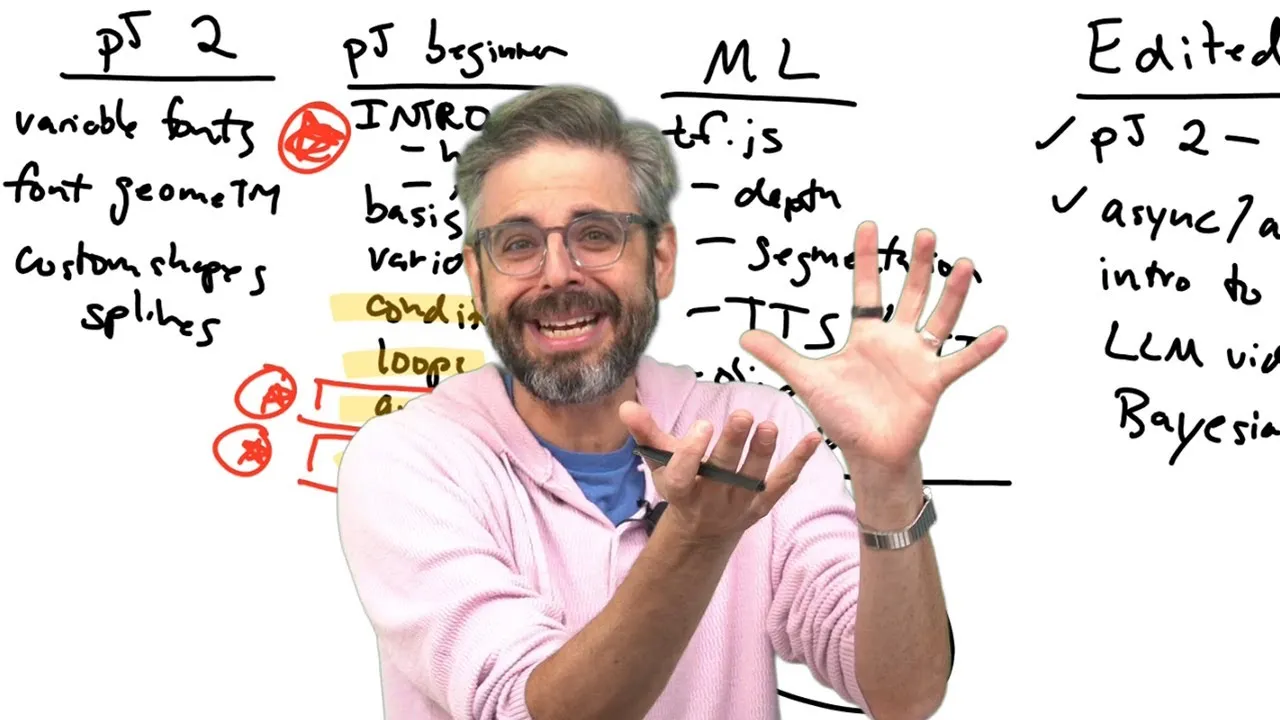
The future content will be broadly categorized into p5.js (both for beginners and advanced topics) and Machine Learning (ML). A significant focus will be placed on refreshing existing beginner p5.js tutorials to align with current best practices and the new p5.js version.
p5.js 2 Topics
Planned topics for p5.js version 2 include:
- Async/Await: Already covered in upcoming releases.
- Variable Fonts: Exploring the use of variable fonts in p5.js.
- Font Geometry: Understanding and manipulating the underlying geometry of fonts, including outlines and vertices.
- Custom Shape Changes: Focusing on advanced shape manipulation, particularly with splines.
p5.js Beginner Tutorials Refresh
The beginner series will be re-evaluated and potentially redone to reflect changes in the p5.js web editor and to align with a new teaching trajectory. The proposed order for beginner topics is:
- Basics
- Variation
- Conditionals
- Loops
- Arrays
- Functions
- Objects
Prioritization for Refresh
While the entire series may be revisited, the most urgent tutorials to be redone are those that are oldest or have concepts that are now taught differently:
- Conditionals, Loops, Arrays, Functions: These are considered the oldest and most in need of an update. The current teaching methods for arrays and functions have evolved, and older videos may use confusing approaches (like object literals in the function tutorial).
- Basics and Variation: These were redone a few years ago and might be less urgent but still part of the refresh plan.
- Objects: This topic was recently redone with the introduction of ES6 classes.
Topics Less Likely to Need Redoing
Some foundational topics are less likely to be redone as their core concepts remain unchanged:
- Map Function: The concept and implementation of the map function are considered stable.
- Random: Similarly, the random function’s core principles are unlikely to change significantly.
New Introduction Video
A new introductory video is planned, which will cover the history of creative coding and discuss the continued relevance of learning with AI tools, even with the rise of advanced ML models.
Machine Learning (ML) Topics Continued
The ML category will expand with new tutorials and coding challenges:
- Transformers.js (tf.js): Continued exploration of this library.
- Depth Estimation: Tutorials on estimating depth from images.
- Image Segmentation: Techniques for segmenting images into different regions.
- Speech-to-Text and Text-to-Speech: Exploring capabilities for voice interaction, potentially as separate tutorials or a combined chatbot challenge.
- Embeddings: A crucial topic for this semester, focusing on creating and using embeddings for tasks like sentence similarity.
- Object Detection: Tutorials on identifying and locating objects within images.
- Image Captioning: Generating textual descriptions for images.
How You Can Contribute
Your feedback is essential in shaping the future content of The Coding Train. The creator is particularly interested in input from teachers who work with beginners using p5.js.
Provide Feedback
- Comments: Leave your thoughts, ideas, and suggestions directly in the comments section of the video.
- Livestreams: Join the Monday livestreams to ask questions and discuss topics in real-time.
- Discord: Join The Coding Train Discord server to engage with the community and share your feedback.
By participating, you can help guide the direction of new tutorials and ensure the content remains relevant and valuable to the community.
Source: What's next? (YouTube)