Understand Newark Airport’s Persistent Delays
Newark Liberty International Airport (EWR) consistently ranks among the worst major airports in the United States for on-time performance and overall passenger satisfaction. While many factors contribute to air travel disruptions, the underlying design and operational constraints of Newark Airport significantly amplify these issues. This article digs into the specific structural and geographical challenges that make EWR prone to delays, particularly during adverse weather and peak travel times.
Why Newark Airport Struggles with On-Time Performance
Newark Airport’s struggles are not merely anecdotal; they are supported by years of data. The Federal Aviation Administration’s (FAA) annual on-time performance rankings consistently place EWR near the bottom. In recent years, while its ranking has improved slightly, this is often attributed to other airports performing worse rather than significant improvements at Newark.
Various aviation industry analyses, including those by The Wall Street Journal, Airhelp, and J.D. Power, have identified Newark as the worst or among the worst large airports in North America based on a broader set of metrics beyond just punctuality.
Geographical and Weather-Related Challenges
The airport’s location in proximity to the Appalachian Mountains plays a key role in its weather-related disruptions. The prevailing west-to-east wind patterns carry moisture from the Gulf of Mexico over the Appalachians. As this air is forced upward, it cools, condenses, and forms clouds, which can lead to thunderstorms as they interact with warmer air and sea breezes from the Atlantic.
Thunderstorms are particularly problematic for airports due to their unpredictable and intense winds, which can be dangerous during critical flight phases like landing and takeoff. When thunderstorms are present, inbound flights may be delayed, diverted, or forced to circle, while outbound flights are held. Lightning detection protocols often lead to the shutdown of ground operations, such as baggage handling and pushback, causing cascading delays.
Airport Layout and Infrastructure Bottlenecks
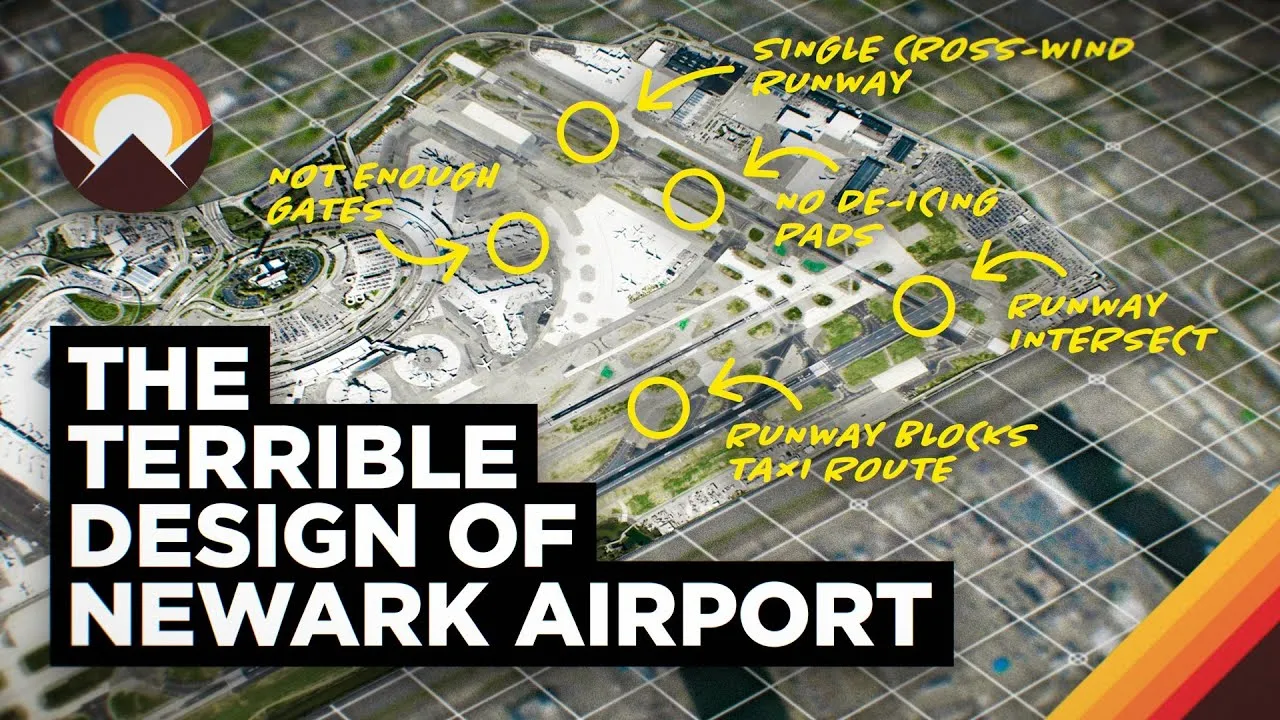
Newark’s physical layout presents significant operational challenges. Compared to its peers like JFK, which benefits from a more eastward position near the Atlantic, Newark’s airfield is relatively small and constrained, especially considering its passenger volume. The airport has three runways, but their close proximity (parallel runways are only 950 feet apart) limits their independent operation.
The FAA imposes restrictions that require coordination between these closely spaced runways, reducing overall capacity. A crosswind runway exists, but its intersection with the main runways means that at most, only two runways can be used simultaneously. This configuration effectively limits Newark’s operational capacity, making it less resilient than airports with more widely separated runways.
Runway and Taxiway Congestion
Even after landing, aircraft face further delays. The most common landing pattern involves using high-speed taxiways that require crossing an active runway to reach the terminals located to the west. This runway crossing must be carefully coordinated with air traffic control, especially when aircraft are departing, further limiting the capacity of the departure runway and causing delays for arriving planes.
Terminal and Gate Limitations
At the terminals, gate availability is another significant bottleneck, especially during peak hours. Newark Airport has limited space, resulting in a lack of surplus parking positions.
Gate schedules are tightly managed, and when outbound flights are delayed, inbound aircraft may be unable to access their assigned gates, leading to extended waits on the taxiways. A notable example is an aircraft that landed on time but was forced to wait for over three hours for a gate, ultimately causing its subsequent international flight to be canceled and impacting hundreds of passengers.
Air Traffic Control Complexity and Staffing Shortages
New York City’s airspace is one of the most complex in the world, encompassing Newark, LaGuardia, and JFK airports, as well as Teterboro (a major general aviation airport), extensive helicopter traffic, private flights, and commercial seaplanes. Managing this dense and varied traffic requires highly skilled air traffic controllers. The TRACON (Terminal Radar Approach Control) facility responsible for this airspace has faced chronic staffing shortages.
At one point, only 33 controllers were certified for the Newark airspace, far below the required number. This led to reduced airspace throughput, forcing flights to hold at their origins.
Relocation and Data Feed Issues
In an attempt to address staffing issues and improve training, the FAA relocated the Newark TRACON facility from Long Island City to Philadelphia. However, this move encountered significant challenges. Many experienced controllers were unwilling to relocate, leading to the new facility opening with an insufficient number of trained personnel.
Compounding these issues, a data feed from the old facility to the Philadelphia TRACON relied on an old copper wire with no redundancy. This resulted in data blackouts, where controllers lost radar contact for extended periods, significantly increasing the risk of incidents and further stressing the remaining controllers, some of whom took trauma leave.
Cascading Effects and Systemic Failures
The combination of geographical disadvantages, a constrained airport layout, limited gate capacity, and a stressed air traffic control system creates a fragile operational environment. When any one of these factors is exacerbated—such as runway maintenance, severe weather, or ATC disruptions—the entire system can quickly break down, leading to widespread and prolonged delays. Newark’s core issue is that its outdated infrastructure is not designed to handle the current volume and complexity of air traffic, making it exceptionally vulnerable to disruptions that would be more manageable at other airports.
Understanding these design flaws is crucial for appreciating why Newark Airport frequently experiences significant delays and operational meltdowns. The airport’s fundamental constraints amplify any external disruptions, creating a domino effect that impacts passengers, airlines, and the broader air traffic network.
Source: The Terrible Design of Newark Airport (YouTube)