Explore Pompeii’s Past: A Journey Through Roman Life
This article offers a unique perspective on the Roman Empire by exploring the ancient city of Pompeii, preserved by the eruption of Mount Vesuvius. While often imagined through idealized biblical stories, Pompeii reveals the complex realities of Roman life, from advanced engineering to the harsh exploitation of its people. You will learn about the historical eruption, the city’s layout and infrastructure, the daily life of its inhabitants, and the surprising insights gained from its preservation.
Prerequisites
No specific prerequisites are required for this article. However, an interest in ancient history, Roman civilization, and archaeological discoveries will enhance the reading experience.
Understanding the Eruption of Mount Vesuvius
The city of Pompeii, located near modern Naples in Italy, met its demise in 79 AD. Mount Vesuvius erupted, burying Pompeii, Herculaneum, and Oplontis under ash and pyroclastic flows.
While Herculaneum and Oplontis were immediately engulfed by pyroclastic flows, Pompeii experienced a different fate. Due to the wind’s direction, it was first covered in ash, followed by subsequent pyroclastic flows.
A pyroclastic flow is not molten lava but a fast-moving current of hot gas, ash, and rock fragments that surges down the side of a volcano. This phenomenon, visually resembling a rapidly descending dust cloud, is intensely hot and destructive, capable of burying entire cities in moments.
Pompeii: A City Frozen in Time
Pompeii was approximately 700 years old at the time of the eruption. It was first founded around 600 BC. This means that by 79 AD, the city was twice as old as many modern nations are today.
For 18 centuries after the eruption, Pompeii lay hidden beneath a green hill, preserved while other Roman cities were destroyed by subsequent invasions. This long period of preservation allowed for remarkable archaeological discoveries when excavations began in 1748.
The city’s location was strategic. It was a seaport town and a thriving commercial center, with about 20,000 inhabitants.
Pompeii was situated between modern Sorrento and Naples, and its proximity to the Mediterranean Sea facilitated trade. The city boasted seven gates and approximately two miles of defensive walls.
Roman Engineering and Daily Life
The Roman Empire’s longevity, lasting over 12 centuries, can be attributed to its focus on the needs of its common people. They developed advanced infrastructure such as aqueducts, sewage systems, theaters, public baths (spas), and well-constructed roads. These amenities improved the daily lives of citizens, fostering loyalty to the empire.
Pompeii itself was proof of Roman urban planning:
- Streets: Paved roads, a Roman innovation, featured sidewalks to separate pedestrians from animals and their waste. Raised stepping stones allowed people to cross streets without stepping in water or waste. Small white marble chips embedded in the road surfaces acted as reflectors, aiding navigation at night by reflecting moonlight or torchlight.
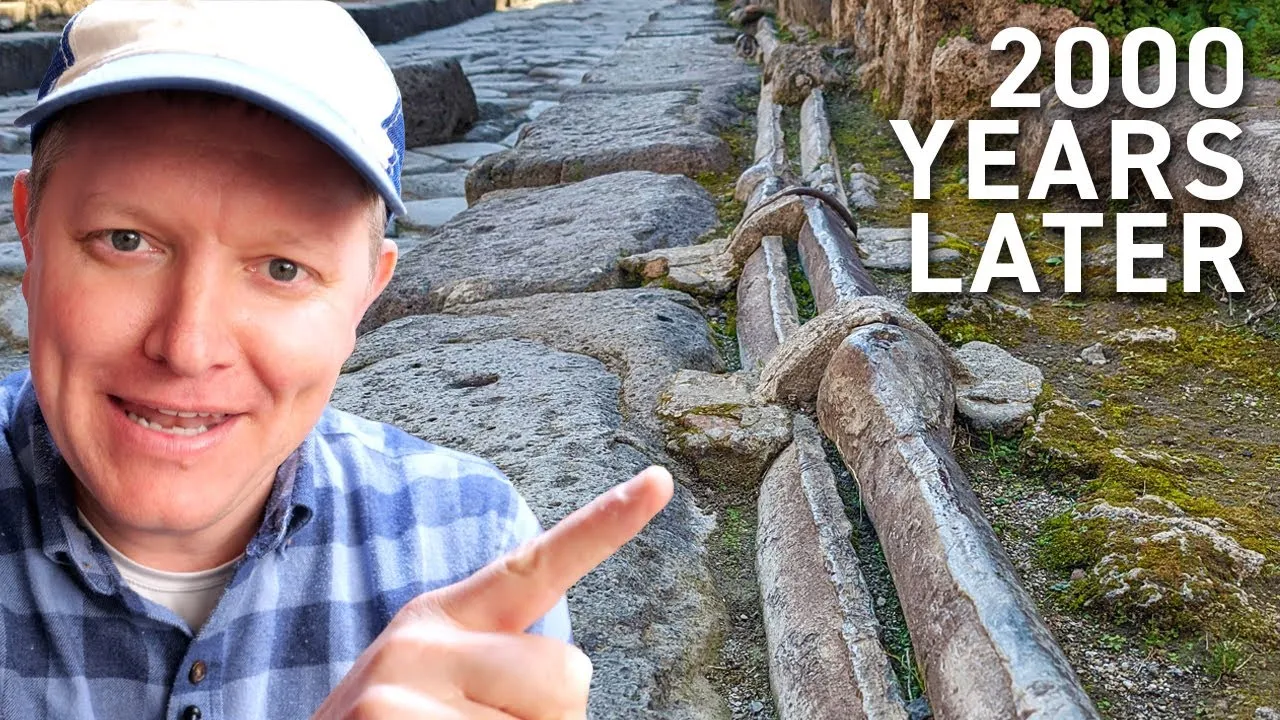
- Water Systems: Elaborate water systems included aqueducts that brought spring water from mountains miles away. Lead pipes, a Roman specialty (the word “plumbing” derives from the Latin “plumbum” for lead), carried water throughout the city. While functional, the lead pipes likely contributed to health issues, as Romans typically died young, around 40-45 years old. Fountains served not only as water sources but also as street cleaners, with water flowing out to wash the roads. They also featured decorative elements, sometimes with animal faces, to help inhabitants navigate the city before street names were common.
- Public Baths (Spas): These were complex facilities that included gymnasiums for pre-bath exercise. The architecture often featured intricate decorations, mosaic floors (chosen for beauty and non-slip properties), and original frescoes. The technique of fresco painting, applying pigments to wet plaster, allowed colors to be absorbed and preserved for millennia.
The Darker Side of Roman Society
Pompeii also reveals uncomfortable truths about Roman society, particularly the exploitation of individuals. Within the spa complexes, evidence of brothels was found. These establishments displayed erotic paintings, not as pornography by modern standards, but as a practical guide or “menu” to assist clients in communicating with sex workers, especially given language barriers.
The presence of these brothels highlights the exploitation of people, many of whom were slaves, for sexual pleasure and financial gain. This practice was not unique to the ancient world; the article notes that modern society likely sees more enslaved people than in the Roman Empire, with similar financial incentives driving sexual exploitation and trafficking.
The normalization of such exploitation in Roman society provides a stark contrast to the teachings of the early Christian church, which would have been perceived as radical and dangerous in that context.
Preservation and Insights
The volcanic ash preserved Pompeii exceptionally well. However, upon excavation, the vibrant colors and intricate details began to degrade due to pollution, weather, and later, the impact of World War II bombings. This fragility highlights the importance of slow, careful excavation and preservation efforts for future generations.
Visiting Pompeii offers a profound connection to the past, revealing not just the grand engineering feats of the Roman Empire but also the everyday realities, the social structures, and the human experiences that defined life over two thousand years ago. The city is a powerful reminder of both the ingenuity and the enduring struggles of human civilization.
Source: Pompeii Changed How I Think About The Roman Empire – Smarter Every Day 310 (YouTube)