How to Define Object Equality in Python with the `__eq__` Method
In Python, when you compare two objects using the equality operator (`==`), the default behavior is to check for object identity. This means Python considers two objects equal only if they refer to the exact same instance in memory. However, this default behavior isn’t always what you need, especially when working with custom objects that represent real-world concepts.
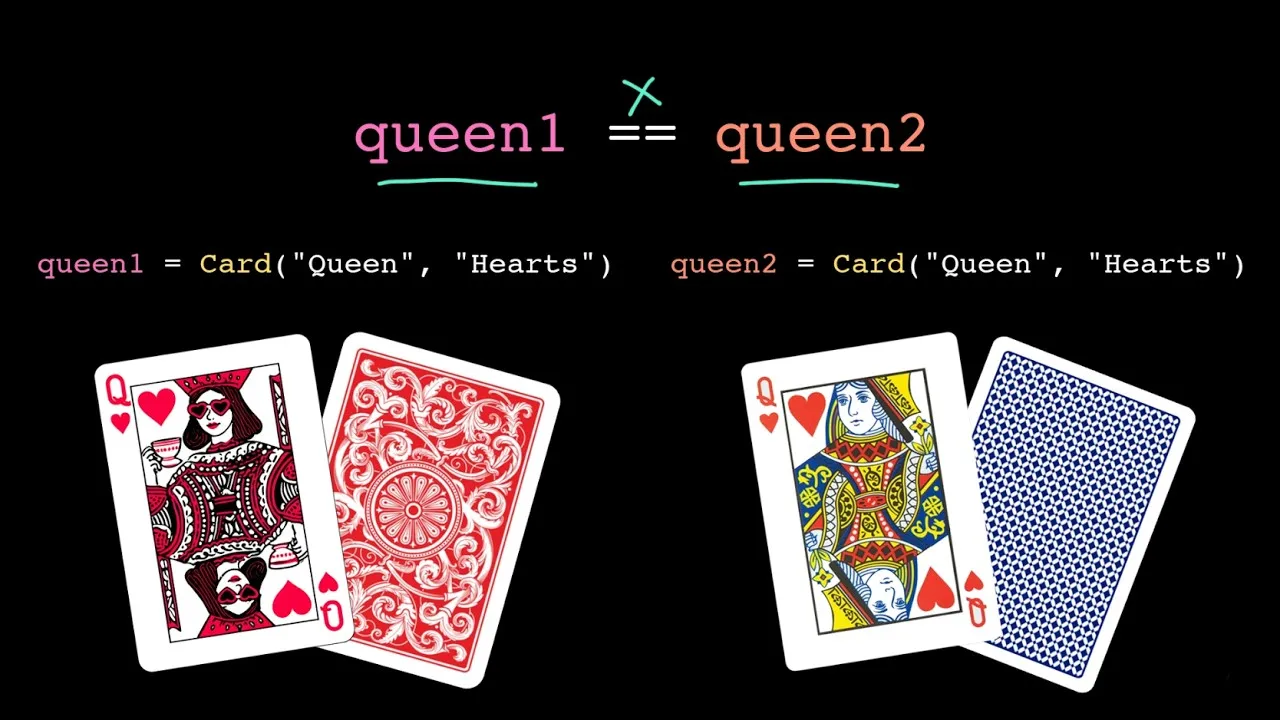
For instance, two `Card` objects representing a “Queen of Hearts” might be considered equal in a card game, even if they originate from different decks (different memory locations). This tutorial will guide you through overriding Python’s default identity comparison and defining custom equality logic for your objects using the special `__eq__` method.
Understanding Default Object Comparison
By default, Python compares objects based on their identity. This means that an object is only considered equal to itself. If you create two separate objects, even if they have identical attributes, Python will see them as distinct entities because they reside in different memory locations.
Consider a `Card` object with `rank` and `suit` attributes. If you create two `Card` objects, say `card1 = Card(‘Queen’, ‘Hearts’)` and `card2 = Card(‘Queen’, ‘Hearts’)`, using the default comparison:
card1 == card2
This will evaluate to `False` because `card1` and `card2` are different objects in memory, even though their attributes are the same.
Why Override Default Behavior?
The default identity comparison is useful in many scenarios, but it falls short when you want to define equality based on an object’s state or attributes. For example:
- Card Games: In a game, two ‘Ace of Spades’ cards are functionally identical, regardless of which deck they came from.
- Data Representation: When representing data like user profiles or product information, you might want two objects with the same ID or name to be considered equal, even if they were fetched from different sources or at different times.
Python provides a mechanism to define custom equality logic: the `__eq__` special method.
Overriding Equality with the `__eq__` Method
The `__eq__` method is a special method that you can define within your class. When you use the `==` operator between two instances of that class, Python will automatically look for and execute this `__eq__` method.
Steps to Implement `__eq__`
- Define the `__eq__` Method: Inside your class definition, create a method named `__eq__`. This method must accept two parameters: `self` (representing the object on the left side of the `==` operator) and `other` (representing the object on the right side).
class Card: def __init__(self, rank, suit): self.rank = rank self.suit = suit def __eq__(self, other): # Equality logic will go here pass - Return a Boolean Value: The `__eq__` method must return either `True` or `False`. `True` indicates that the objects are considered equal, and `False` indicates they are not.
- Implement Comparison Logic: Inside the `__eq__` method, you’ll write the code that determines if `self` and `other` should be considered equal. This typically involves comparing the relevant attributes of the two objects.
Example: Comparing only by rank:
class Card:
 def __init__(self, rank, suit):
 self.rank = rank
 self.suit = suit

 def __eq__(self, other):
 return self.rank == other.rank
With this implementation, two cards are equal if their ranks match, regardless of their suits.
Example: Comparing by both rank and suit:
class Card:
 def __init__(self, rank, suit):
 self.rank = rank
 self.suit = suit

 def __eq__(self, other):
 return self.rank == other.rank and self.suit == other.suit
This implementation considers two cards equal only if both their rank and suit attributes match.
- Handle Type Checking (Optional but Recommended): It’s good practice to ensure that you are comparing objects of compatible types. You can add a check at the beginning of your `__eq__` method to make sure `other` is an instance of the same class (or a compatible subclass).
class Card:
 def __init__(self, rank, suit):
 self.rank = rank
 self.suit = suit

 def __eq__(self, other):
 if not isinstance(other, Card):
 # Don't attempt to compare against unrelated types
 return NotImplemented
 return self.rank == other.rank and self.suit == other.suit
Returning `NotImplemented` allows Python to try the comparison in the reverse direction (i.e., `other.__eq__(self)` if `other` is a different type).
How Python Uses `__eq__`
When you write an expression like `card_a == card_b`, Python performs the following:
- It checks if `card_a` has an `__eq__` method defined.
- If it does, Python calls `card_a.__eq__(card_b)`. The return value of this call becomes the result of the `==` operation.
- If `card_a` does not have an `__eq__` method, Python checks if `card_b` has an `__eq__` method and calls `card_b.__eq__(card_a)`.
- If neither object has an `__eq__` method, Python falls back to comparing object identities (checking if `card_a` is the exact same object as `card_b` in memory).
Example Scenario
Let’s consider the `Card` class with the `__eq__` method implemented to compare both rank and suit:
class Card:
 def __init__(self, rank, suit):
 self.rank = rank
 self.suit = suit

 def __eq__(self, other):
 if not isinstance(other, Card):
 return NotImplemented
 return self.rank == other.rank and self.suit == other.suit

# Create two distinct Queen of Hearts cards
card1 = Card('Queen', 'Hearts')
card2 = Card('Queen', 'Hearts')

# Create a Queen of Spades card
card3 = Card('Queen', 'Spades')

# Compare them
print(f"card1 == card2: {card1 == card2}") # Output: card1 == card2: True
print(f"card1 == card3: {card1 == card3}") # Output: card1 == card3: False

# Compare with a different type
print(f"card1 == 'Queen of Hearts': {card1 == 'Queen of Hearts'}") # Output: card1 == 'Queen of Hearts': False
In this example, `card1` and `card2` are different objects in memory, but because their `rank` and `suit` attributes match, `card1 == card2` evaluates to `True` thanks to our custom `__eq__` method. `card1 == card3` is `False` because the suits differ.
Conclusion
By implementing the `__eq__` method, you gain fine-grained control over how your custom objects are compared for equality in Python. This allows you to define equality based on the logical state of your objects, making your code more intuitive and powerful, especially when dealing with complex data structures and applications.
Source: Object equality | Intro to CS – Python | Khan Academy (YouTube)