OpenAI’s Next-Gen AI Model Hints at Major Leap Forward
Whispers and early glimpses of OpenAI’s upcoming artificial intelligence model, potentially dubbed GPT-5.4, are generating significant buzz within the tech community. Leaked information, primarily from users with access to ChatGPT Pro accounts, suggests a substantial upgrade in both creative generation and complex coding capabilities, positioning it as a formidable advancement over current AI offerings.
GPT-5.3 Instant: Refining User Interaction
Before diving into the more advanced GPT-5.4, OpenAI has rolled out GPT-5.3 Instant within ChatGPT. This iteration focuses on immediate response times, aiming for a more natural and less ‘cringey’ user experience, particularly for everyday queries.
The previous version, 5.2, was noted for responses that could feel overly validating or preachy. GPT-5.3 Instant aims to strike a better balance.
Addressing ‘Cringe’ Responses
For instance, when asked about finding love in a city, GPT-5.2 might offer an overly empathetic, almost patronizing response. In contrast, GPT-5.3 Instant provides a more grounded answer, acknowledging the difficulties while avoiding excessive emotional validation. This refinement is also evident in its handling of user requests.
While older versions might preface analytical tasks with cautious disclaimers (e.g., “as long as we keep it purely analytical simulation and educational”), GPT-5.3 Instant offers a more direct approach, like “Great. Let’s calculate this.” This suggests a move towards less guarded and more task-oriented interactions for simpler use cases.
Reduced Refusals and Improved Accuracy
OpenAI has also reportedly worked on reducing the number of refusals GPT models issue, a common point of frustration for users, especially when compared to more permissive models like those from Anthropic or Google. Improvements in web search integration are expected to yield more accurate results, though the effectiveness of an ‘instant’ model for such tasks is still under evaluation by users.
GPT-5.4: A Glimpse of ‘The Beast’
The most significant revelations concern GPT-5.4, which appears to be undergoing live testing within select ChatGPT Pro accounts. The model’s capabilities, as demonstrated by early adopters, suggest a dramatic increase in complexity and output quality across various domains.
Advanced Creative Generation
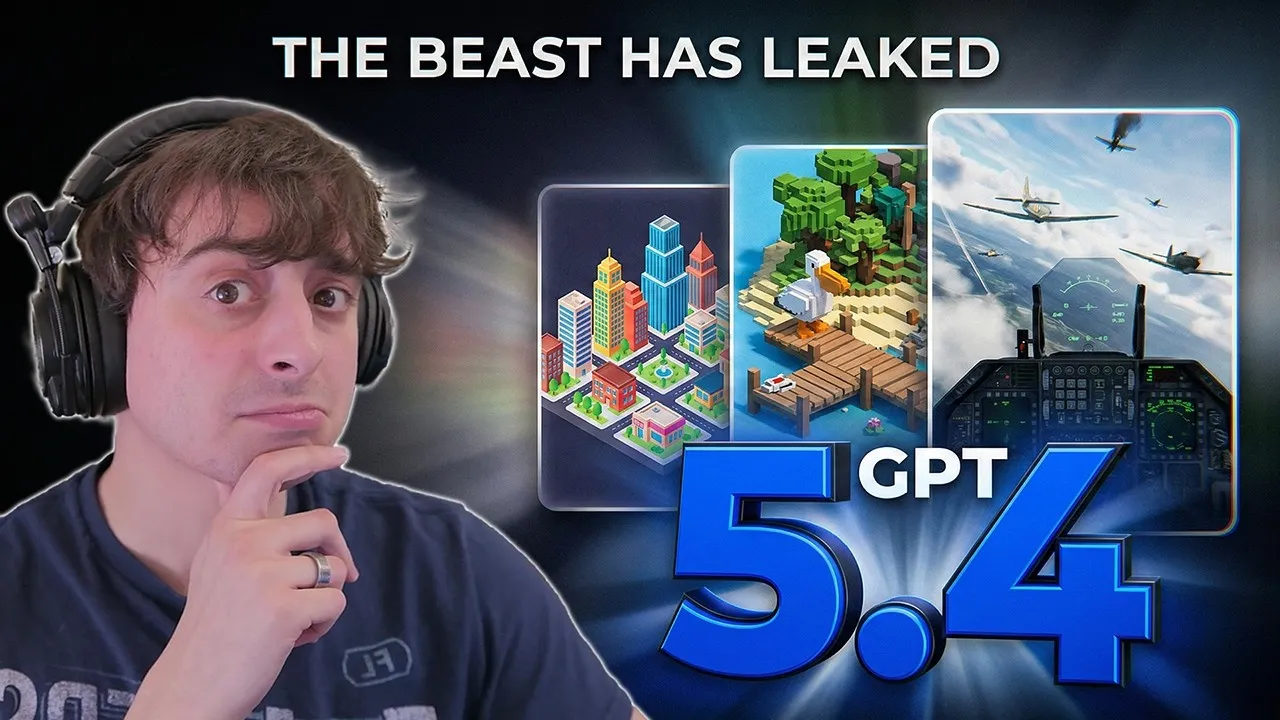
Early examples showcase GPT-5.4’s prowess in generating sophisticated visual content. This includes detailed 3D voxel art, such as a pelican on a bike with realistic lighting and environmental details, and a complex castle with moats and surrounding terrain that rivals detailed game assets.
The model has also demonstrated an impressive ability to generate SVG (Scalable Vector Graphics) files. One example shows a PlayStation 5 controller with accurate button placement and lighting, while another generates a highly detailed topological 3D globe, complete with atmospheric effects and a moon, exhibiting remarkable density and realism.
Coding and Simulation Prowess
Beyond creative visuals, GPT-5.4 is showing a significant leap in coding and simulation abilities. A flight combat simulator demo generated by the model reportedly ran for over 54 minutes, featuring interactive gameplay with NPC planes, damage modeling, and a functional reset system. This level of complexity in a simulated environment points to enhanced reasoning and execution capabilities.
Further demonstrations include the generation of intricate 2D vector graphics that simulate 3D perspectives, such as a detailed rendition of San Francisco with buildings, trees, and vehicles, even capturing the Golden Gate Bridge. While the perspective in some real-world scenes might still present challenges compared to perfectly understood virtual environments like Minecraft, the detail and coherence are a significant step up.
Performance and Access
It appears that GPT-5.4 may take longer to process complex prompts than previous models, with some simulations running for over an hour. This extended processing time is attributed to the model performing more extensive computations to deliver richer, more detailed results. Users can reportedly identify if they have access to the new model by looking for a specific thumbs-up/thumbs-down icon when running prompts in ChatGPT Pro.
Open-Source Alternative: Alibaba’s Qwen 3.5
While OpenAI pushes the boundaries of proprietary models, the open-source community continues to thrive. Alibaba recently released Qwen 3.5, an open-source model designed for local execution. This model is noted for its efficiency, outperforming models up to four times its size, and its capability for agentic tasks.
A particularly impressive aspect is a 2-billion parameter, 6-bit quantized version optimized for Apple Silicon, which reportedly delivers output superior to earlier versions of GPT-4. This indicates a rapid democratization of powerful AI capabilities, allowing users to run advanced models directly on personal devices.
Why This Matters
The apparent advancements in GPT-5.4 signal a new era for AI-driven content creation and complex problem-solving. Enhanced visual generation tools could democratize design and art, while improved coding and simulation capabilities might accelerate software development and scientific research. The trend towards more immediate, less restrictive AI interactions with models like GPT-5.3 Instant makes AI more accessible for casual users.
Simultaneously, powerful open-source alternatives like Qwen 3.5 ensure that cutting-edge AI research remains accessible to a broader audience, fostering innovation and competition. The ongoing development, whether proprietary or open-source, highlights AI’s accelerating trajectory and its increasing integration into daily workflows and creative processes.
Source: GPT 5.4 Is Leaking in Pro Accounts — And It's a BEAST! (YouTube)