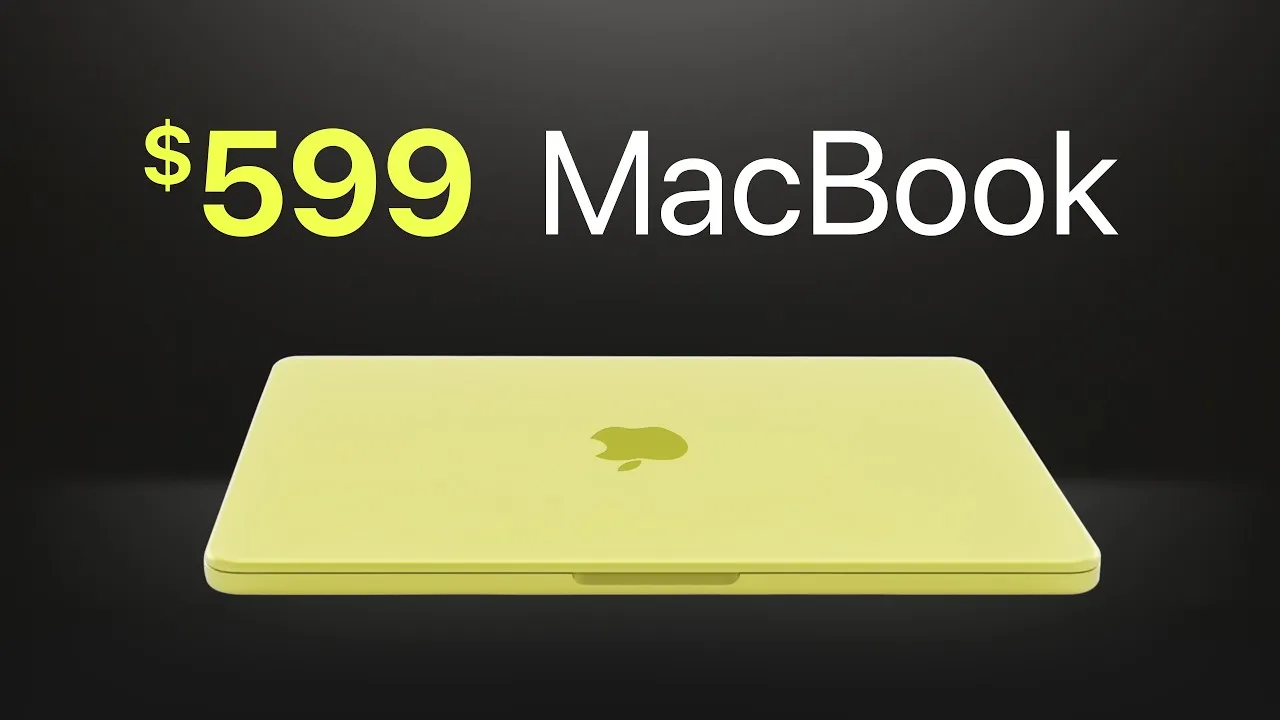
Apple Unleashes Budget MacBook Neo, Shaking Up Laptop Market
For months, whispers and speculation have circulated throughout the tech industry about Apple’s potential foray into the budget laptop segment. Competitors and chip manufacturers alike have reportedly been on edge, anxious about the disruptive potential of an inexpensive MacBook. Now, that speculation has materialized with the announcement of the MacBook Neo, a device poised to redefine entry-level computing and challenge the status quo in the laptop market.
A Premium Feel at an Unprecedented Price
The most striking aspect of the MacBook Neo is its build quality, especially considering its aggressive price point. Starting at a mere $599 USD for the base model (with an educational discount bringing it down to an astonishing $499), this machine boasts a full aluminum chassis. This is a significant departure from the plastic construction typically found in laptops at this price range.
The reviewer highlights the durability concerns with plastic Chromebooks that can easily crack, citing personal experience and anecdotal evidence from IT professionals. However, the aluminum unibody, while aesthetically pleasing and more premium to the touch, also presents a potential drawback: susceptibility to dents and scratches.
The reviewer recalls a disappointing experience with a 12-inch MacBook that sustained a permanent dent from a minor drop, a fate that might have been avoided with a plastic build. This raises questions about the long-term durability of the MacBook Neo in environments with heavy use, such as school settings.
Core Performance Driven by A18 Pro
Under the hood, the MacBook Neo is powered by the A18 Pro chip, the same silicon found in the iPhone 16 Pro. While not a direct competitor to Apple’s M-series chips for higher-end MacBooks, the A18 Pro offers impressive performance for everyday tasks. The reviewer notes that its multi-core performance is comparable to the original M1 chip, and its single-core performance is noticeably faster.
This bodes well for general productivity, web browsing, and typical student workloads. The device comes configured with 8GB of RAM and offers storage options ranging from 256GB to 512GB.
While 8GB of RAM is sufficient for many users, it is identified as a potential bottleneck for more demanding multitasking or future software advancements. The display is a 13-inch IPS panel with what Apple calls “Liquid Retina” technology, offering good brightness and resolution, though color accuracy will be a point of further testing.
Key Features and Omissions
In its effort to hit the target price, Apple has made several strategic feature cuts:
- Display: A 60Hz refresh rate IPS display. True Tone technology is absent due to the lack of an ambient light sensor.
- Ports: Two USB-C ports are included, but they do not support Thunderbolt speeds. However, one port can drive a 4K 60Hz external display.
- Charging: The MacBook Neo utilizes USB-C for charging, foregoing Apple’s MagSafe connector. This means one of the two USB-C ports will be occupied when charging, limiting peripheral connectivity. A 20W charger is included.
- Keyboard and Trackpad: It features the classic MacBook keyboard but lacks backlighting. The trackpad is a standard haptic trackpad, without the Force Touch capabilities found on higher-end models.
- AI Features: the launch press was remarkably light on AI marketing. Beyond basic Apple Intelligence features like photo editing and potential ChatGPT integration, there was minimal emphasis on AI capabilities, a stark contrast to many recent laptop releases.
Disruptive Potential and Target Audience
The MacBook Neo is clearly aimed at students and first-time Mac buyers looking for the most affordable entry into the Apple ecosystem. Its combination of premium build, capable performance, and an aggressive price point makes it a compelling option.
The reviewer posits that this device could be highly disruptive, potentially swaying younger users towards macOS early in their computing journey, leading to increased brand loyalty down the line. The $500 price difference between the Neo and the MacBook Air is significant, and Apple’s deliberate feature omissions are designed to create a clear value proposition for the Air, encouraging upgrades for those who desire features like keyboard backlighting, Force Touch trackpad, and potentially more robust performance.
Apple’s Unique Position
The article emphasizes that only Apple could have conceived and executed a product like the MacBook Neo. This is attributed to Apple’s tight integration of hardware and software.
By controlling both the A18 Pro chip design and macOS, Apple can optimize performance and efficiency to an extent unmatched by other manufacturers who rely on third-party operating systems. This vertical integration allows them to extract maximum utility from their silicon, delivering a capable and affordable machine that competitors would struggle to replicate.
Availability and Verdict
The MacBook Neo is available now, with the base model starting at $599 USD, and an educational discount bringing the price down to $499. While the long-term durability in rugged environments remains a question mark due to the aluminum build, and certain quality-of-life features are omitted, the MacBook Neo represents a significant move by Apple. It offers a powerful computing experience for the vast majority of users at an unprecedented price point, potentially reshaping the entry-level laptop market and forcing competitors to re-evaluate their strategies.
Source: MacBook Neo – Only Apple Could Do This (YouTube)