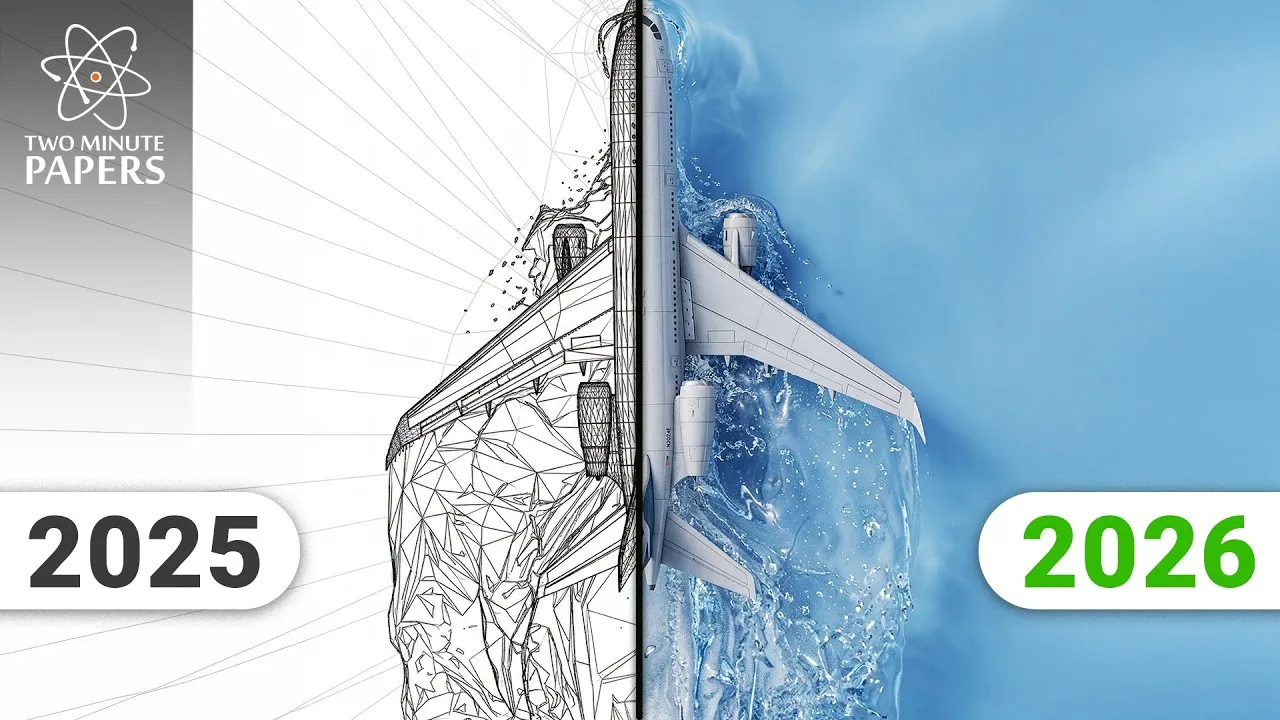
Physics Breakthrough Simulates Water With Stunning Realism
A groundbreaking new technique is revolutionizing how we simulate fluid dynamics, particularly the complex interaction between liquids and gases like water and air. This advancement, driven by pure physics and computational ingenuity rather than artificial intelligence, overcomes a long-standing challenge in computer graphics: the uncanny tendency for objects to ‘clip’ through water, leading to unrealistic simulations.
For years, researchers and game developers have grappled with the inherent difficulties of accurately modeling liquids. While existing methods can produce impressive visuals of water in motion, they often miss a crucial element, especially when dealing with vastly different densities, such as water and air. This oversight leads to visual glitches and physically implausible behavior.
The Problem: A “Mosh Pit” of Physics
The core issue lies in the dramatic density difference between water (heavy) and air (light). In simulation terms, this is a computational nightmare.
It’s akin to trying to choreograph a delicate dance between a sumo wrestler and a mouse without the wrestler accidentally crushing the smaller participant. Traditional approaches often resort to approximations or simplifications to maintain mathematical stability, but this comes at the cost of realism.
The transcript likens most current physics simulations to a chaotic “mosh pit” where different elements (solids and fluids) collide without regard for established rules, leading to unstable and unrealistic interactions. This is acceptable in some contexts, but for high-fidelity simulations, it falls short.
The Solution: A “Synchronized Ballet” of Particles
This new technique transforms that chaotic mosh pit into a precisely choreographed “synchronized ballet.” It offers a way to simulate 3D objects interacting with water with unprecedented accuracy and stability. The key innovation lies in its ability to achieve what experts call “two-way coupling.”
Two-way coupling means that not only does the water affect the object, but the object also influences the water’s flow in return. This creates a dynamic and realistic feedback loop. For example, when an object moves through water, the air around it is naturally displaced, forming bubbles and realistic wake patterns – effects that are often faked or omitted in less sophisticated simulations.
How It Works: Lattice Boltzmann Method and “Etiquette”
At the heart of this breakthrough is the Lattice Boltzmann Method (LBM). Unlike traditional methods that might broadcast instructions to a large group of particles (like a megaphone), LBM operates more like whispering individual instructions to each particle. This granular approach allows for finer control and more accurate simulation.
The LBM simulation operates in two distinct steps:
- Particle Movement: Particles move freely according to physical laws.
- Interaction: Particles then interact with each other and their environment.
This separation of movement and interaction is crucial. The transcript draws a parallel to human productivity: just as we need dedicated blocks of time for focused work and separate time for collaboration, these particles need distinct phases to move and then interact. This prevents the computational instability that arises when movement and collision are attempted simultaneously.
The technique employs a “hybrid moving bounce-back” method. This acts as an “etiquette guide” for the particles, dictating how they should react upon collision.
It ensures that when particles collide, they bounce back with the correct momentum, effectively transferring energy and information between the fluid and any immersed objects. This precise interaction is what enables the robust two-way coupling.
Beyond Realism: Speed and Capability
Remarkably, this advanced simulation doesn’t just look better; it’s also significantly faster than previous methods that attempted similar levels of detail. While some older techniques might take 10 times longer to achieve less accurate results, this new approach can be up to 4 times faster while delivering superior visual fidelity and physical accuracy.
The capabilities demonstrated are impressive:
- Realistic Turbulence: Simulating complex air-driven turbulence around objects like propellers.
- Object Interaction: Showing objects like airplanes ditching into water with splashes reaching ceilings.
- Stone Skipping: Accurately simulating the air layer between a skipping stone and water, allowing for multiple bounces – a feat many simulations struggle with due to the “stickiness” of water.
- Bubble Dynamics: Generating intricate bubbles and swirls in various liquids, even those of different densities (like raining cows or bunnies, albeit for visual effect).
- Controlled Landings: Simulating the precise moment a key breaches the water surface, creating a trailing pocket of air that behaves like a veil before collapsing into bubbles under water pressure.
Why This Matters
This breakthrough has profound implications across various fields:
- Visual Effects (VFX): Filmmakers and game developers can create far more believable and immersive water effects, from ocean waves to intricate liquid simulations, without the computational bottlenecks of older methods.
- Engineering and Design: Engineers can use these accurate simulations for designing everything from boat hulls and aircraft wings to more efficient water management systems, understanding fluid forces with greater precision.
- Scientific Research: Researchers studying fluid dynamics, weather patterns, or even biological processes involving fluid flow can benefit from more faithful computational models.
- Education: The technique provides a powerful tool for demonstrating complex physics principles in an accessible and visually engaging manner.
The researchers behind this work have not specified pricing or commercial availability, as it originates from a research paper. However, the underlying principles of the Lattice Boltzmann Method are well-established, and this advancement represents a significant leap in its application for complex fluid-air interactions.
The Beauty of Nature as a Guide
The video’s presenter emphasizes that this advanced simulation is, in essence, an attempt to replicate the elegance and efficiency of nature. Observing natural phenomena like mountain streams and how water flows around rocks provides the ultimate benchmark. Nature performs these complex fluid dynamics calculations constantly, perfectly, and at the speed of light, serving as the original inspiration for such computational endeavors.
Source: Most People Miss What Makes This Impossible (YouTube)