NVIDIA AI Cracks Self-Driving’s Toughest Challenge
The quest for fully autonomous vehicles has long been hampered by a critical limitation: AI’s inability to explain its decisions. While companies like Waymo are already offering hundreds of thousands of paid rides weekly, the underlying technology remains largely a black box. Now, a significant breakthrough from NVIDIA promises to change that, introducing the first truly open and reasoning-based AI system for self-driving, potentially revolutionizing the industry.
The ‘Teenager’ Problem in AI Driving
For years, the AI systems powering self-driving cars have operated much like a novice driver – they perform actions, but can’t articulate why. Imagine being in a car where the driver suddenly accelerates without explanation.
This is akin to current AI; it processes visual data from cameras and outputs steering commands, but the reasoning behind those commands is opaque. This lack of transparency is not just a philosophical issue; it directly impacts safety and the ability to improve the systems.
Introducing a Reasoning AI
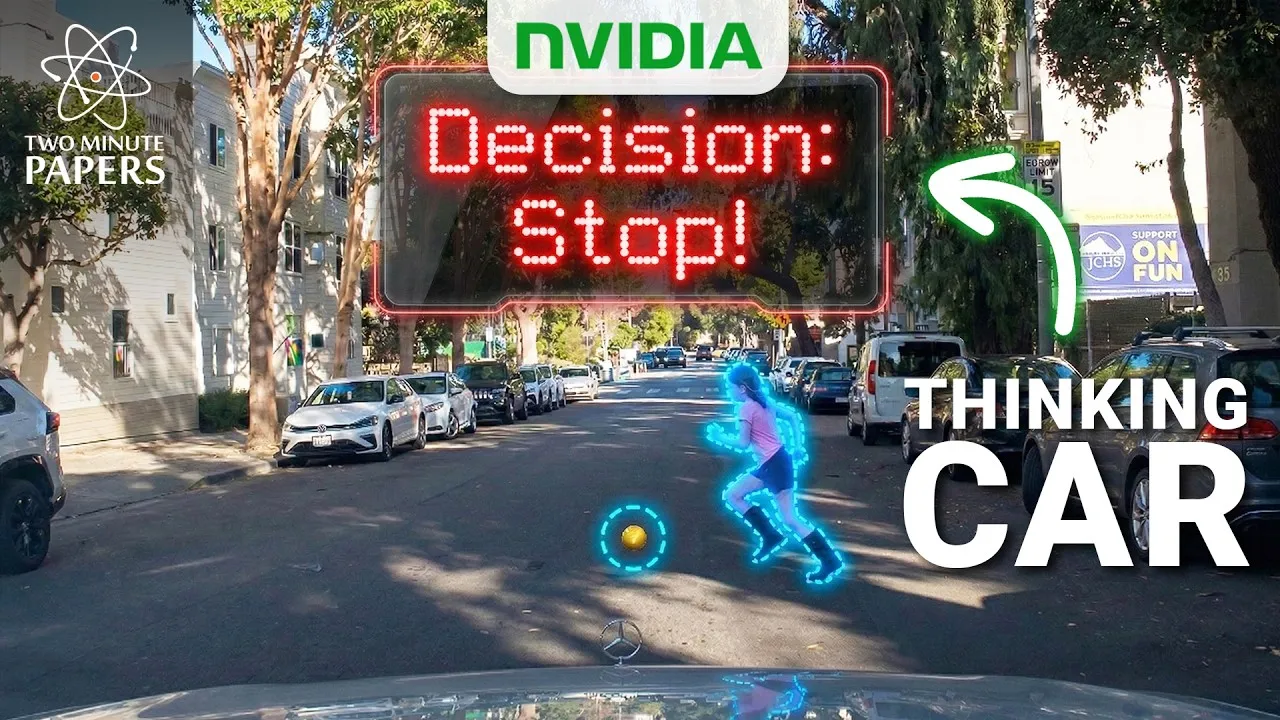
NVIDIA’s new system, detailed in a 42-page research paper, marks a departure from this paradigm. Unlike previous systems that merely react, this AI can articulate its intentions and the rationale behind them. For instance, it might state, “We are nudging to the left because there is a car stopped on the right,” or “We keep left to follow the temporary corridor.” This verbalization of intent offers unprecedented insight into the AI’s decision-making process.
Enhanced Safety and Problem Solving
The benefits of this reasoning capability are profound. By “thinking out loud,” the AI has reportedly reduced its close encounter rate by 25%. This is a remarkable improvement attributed solely to its ability to explain its actions.
When mistakes do occur, the explicit reasoning allows developers to pinpoint the exact cause and implement targeted fixes, accelerating the development cycle and improving system reliability. This is particularly crucial for addressing the “long tail” of driving scenarios – those rare, unpredictable events like unusual pedestrian behavior or complex construction zones that are difficult for AI to learn from limited data.
Open Access to a State-of-the-Art System
Perhaps one of the most exciting aspects of NVIDIA’s announcement is the decision to release key components of the system. They have made the model weights, inference code, and a subset of the training data publicly available. This open-access approach democratizes advanced AI research, allowing students and developers worldwide to experiment with, evaluate, and build upon a state-of-the-art self-driving AI without being dependent on proprietary, closed systems.
Ensuring Consistency: The ‘Lie Detector’
A significant challenge in developing reasoning AI is ensuring its statements align with its actions. NVIDIA addressed this by implementing a technique called reinforcement learning with a “consistency reward.” This acts as a ‘lie detector’ for the AI. If the AI states it will perform an action (e.g., stop at a red light) but then fails to do so, it receives a penalty.
This forces the AI to adhere to its declared intentions, preventing it from simply making things up. This mechanism ensures that its verbal reasoning is grounded in its actual driving behavior.
Advanced Training and Simulation
The training process for this AI is equally innovative. It involved analyzing 700,000 video clips, with the AI generating a detailed ‘diary entry’ for each, explaining the causal factors behind the car’s movements.
To handle the complexities and dangers of real-world driving, especially for rare events, NVIDIA developed a hyper-realistic simulation environment called Alpa Sim. This simulator, built using 3D Gaussian splatting for high fidelity, allows the AI to practice in a safe, virtual space, crashing and learning from mistakes until it demonstrates proficiency before being considered for real-world deployment.
Beyond Self-Driving: Life Lessons from AI
The implications of this AI extend beyond autonomous vehicles. The principle of articulating the cause before acting is presented as valuable life advice: instead of reacting impulsively, consciously identify the reason behind an emotion or action. Similarly, the AI’s adherence to its stated principles is a reminder to align one’s actions with their stated values, prompting introspection on whether one’s calendar truly reflects their priorities.
The Cost of Learning and Future Directions
While the reinforcement learning process is highly effective, it is also computationally expensive, akin to having a 24/7 private tutor for the AI. Researchers at DeepSeek, in a separate paper, explored methods to mitigate this cost by enabling the AI to generate and evaluate multiple plans internally, potentially offering a path for future optimizations of NVIDIA’s system.
Accessibility and the Future
The release of NVIDIA’s reasoning AI model and code marks a key moment. It empowers a broader community to contribute to the advancement of self-driving technology. For those looking to experiment with large AI models, services like Lambda GPU Cloud offer powerful NVIDIA GPUs, enabling reliable and fast execution of complex AI experiments, including models with billions of parameters.
Why This Matters
This breakthrough addresses the fundamental challenge of trust and transparency in AI. By enabling self-driving systems to explain their actions, NVIDIA is not only improving safety and accelerating development but also making autonomous vehicles more understandable and acceptable to the public.
The open-source nature of the release fosters collaboration and innovation, potentially speeding up the widespread adoption of safer, more reliable self-driving technology. The underlying principles of reasoning and consistency have broad applications, offering valuable insights for developing more responsible and predictable AI systems across various domains.
Source: NVIDIA’s New AI Just Cracked The Hardest Part Of Self Driving (YouTube)