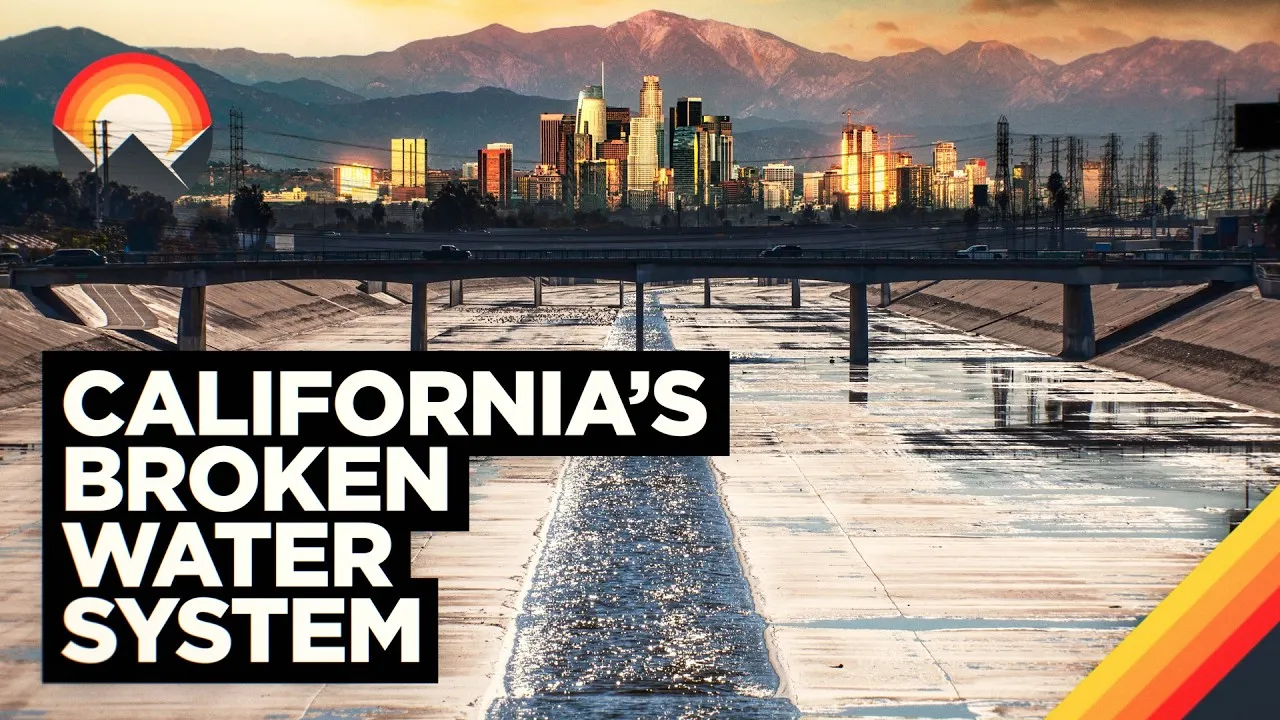
Understand California’s Water Crisis: Aqueducts and Rights
California, a state renowned for its economic power and desirable climate, faces a significant and persistent challenge: its water supply. This article digs into the complex water system of California, explaining how the state’s population centers were developed in areas with limited local water resources and the ingenious, yet problematic, engineering solutions implemented to bring water to them. We will explore the history and mechanics of major aqueduct systems, the legal framework of water rights, and the resulting conflicts between urban and agricultural users.
The Disconnect: People Where the Water Isn’t
A fundamental issue in California is the geographical distribution of its population versus its water resources. Major population centers, particularly in Southern California (Los Angeles and San Diego), are home to roughly half the state’s population within just 10% of its land area. This region, despite its Mediterranean climate and ample sunshine, receives significantly less rainfall compared to other major cities like New York City or London.
Los Angeles receives about 12-15 inches of rain annually, while San Diego receives around 10 inches. This scarcity is exacerbated by the fact that much of the precipitation in the surrounding mountains, which could supplement local water supplies, is quickly absorbed by dry soil or channeled to the Pacific Ocean for flood control.
Engineering Solutions: The Great Aqueduct Systems
To overcome this natural deficit, California has developed extensive water infrastructure. Southern California’s growth is intrinsically linked to three major water systems:
The Los Angeles Aqueduct
Completed over a century ago, this gravity-fed system was one of the earliest and most ambitious projects. It spans 230 miles and was instrumental in the development of Los Angeles. However, its construction led to the complete drying up of Owens Lake, devastating the local Owens Valley community and creating a lasting divide between urban and rural California.
The Colorado River Aqueduct
Established in the late 1920s and built during the Great Depression, this aqueduct was a monumental feat of engineering. It was designed by the Metropolitan Water District of Southern California to transport water from the Colorado River. The system is characterized by a series of massive pumping stations required to lift water over mountainous desert terrain, earning it recognition as an engineering marvel.
The State Water Project
Initiated in the 1960s, this is the most recent and complex system. It begins with Lake Oroville in Northern California, which regulates the flow of the Sacramento River by supplementing it with Sierra Nevada snowmelt. Water then travels south through the 444-mile California Aqueduct, the longest single waterway in the state, supplying water to agricultural areas, smaller communities, and eventually Southern California.
These aqueducts are critical, with Los Angeles relying on them for about 88% of its water and San Diego for around 80%. Technically, these systems have the capacity to meet current demand and accommodate population growth.
The Root of the Problem: Water Rights and Prior Appropriation
Despite the impressive engineering, California faces a perpetual water crisis. The core issue lies not in the plumbing but in the accounting and legal framework governing water allocation. In the American West, water rights are primarily governed by the doctrine of prior appropriation, often summarized as “first in time, first in right.”
Under this system:
- Water rights are granted based on the earliest date of claim.
- Senior rights holders have priority to water over junior rights holders.
- In times of scarcity, junior rights holders are the first to be cut off.
This system presents a significant challenge for urban areas, which generally developed later than agricultural settlements and thus hold more junior water rights. These cities are often the ones with the largest and fastest-growing populations, creating a fundamental conflict.
The Allocation Deficit: More Rights Than Water
Compounding the issue is a structural deficit in water allocation. Studies have found that California allocates rights to approximately 370 million acre-feet of water annually, while even a good precipitation year typically produces only about 70 million acre-feet.
This means the state has legally allocated rights to nearly five times more water than it naturally produces. While cities have largely been spared direct cutoffs in practice, the margins are continually narrowing, leading to increased scrutiny and conflict.
The Agricultural Dominance and the “Wonderful Company” Example
Agriculture accounts for about 80% of California’s water use, yet contributes only about 2.5% to the state’s economy. The Central Valley, in particular, is an agricultural powerhouse, producing a vast amount of the nation’s fruits, nuts, and vegetables. While it’s easy to romanticize the plight of small farmers, much of this agriculture is dominated by large, industrial operations.
A prominent example is The Wonderful Company, owned by the Resnik family. This company controls significant agricultural operations and has accumulated substantial water resources, including a 57% share of the Kern County Water Bank, a massive underground storage facility.
This access was largely secured through the 1994 Monterey Amendments, a deal that transferred ownership of parts of the water bank from the state to private entities in exchange for retiring junior water rights. This deal also removed an “urban preference” rule that prioritized urban areas during droughts, leading to accusations of impropriety and a shift of public water resources for private profit.
This situation highlights how well-resourced agricultural businesses can leverage their financial power, lobby for favorable policies, and invest in infrastructure to secure water, often at the expense of urban needs and public trust principles.
The Broader Conflict: Heritage vs. Efficiency
The conflict extends beyond specific companies. It represents a clash between the historical development of water rights, rooted in agricultural needs and settlement patterns, and the demands of a modern, growing population.
The “use it or lose it” mentality inherent in prior appropriation encourages water users to claim and utilize their allocated water, even for water-intensive crops, rather than conserving it. This system, coupled with natural variability and climate change, creates a precarious situation for a state that relies heavily on imported water and faces an ever-increasing demand.
Looking Ahead: A Reckoning for California’s Water Future
As California faces drier summers, reduced snowpack, and more intense droughts, the existing water management system is under increasing strain. The fundamental questions remain: Should water serve people or plants?
Should the state rely on outdated water rights systems or forge new rules for a changing climate? The current approach, characterized by complex engineering, legal battles over water rights, and a significant allocation deficit, points towards an inevitable reckoning for California’s water future.
Source: California's Water Problem (YouTube)