OpenAI Stumbles as Rivals Dominate AI Race
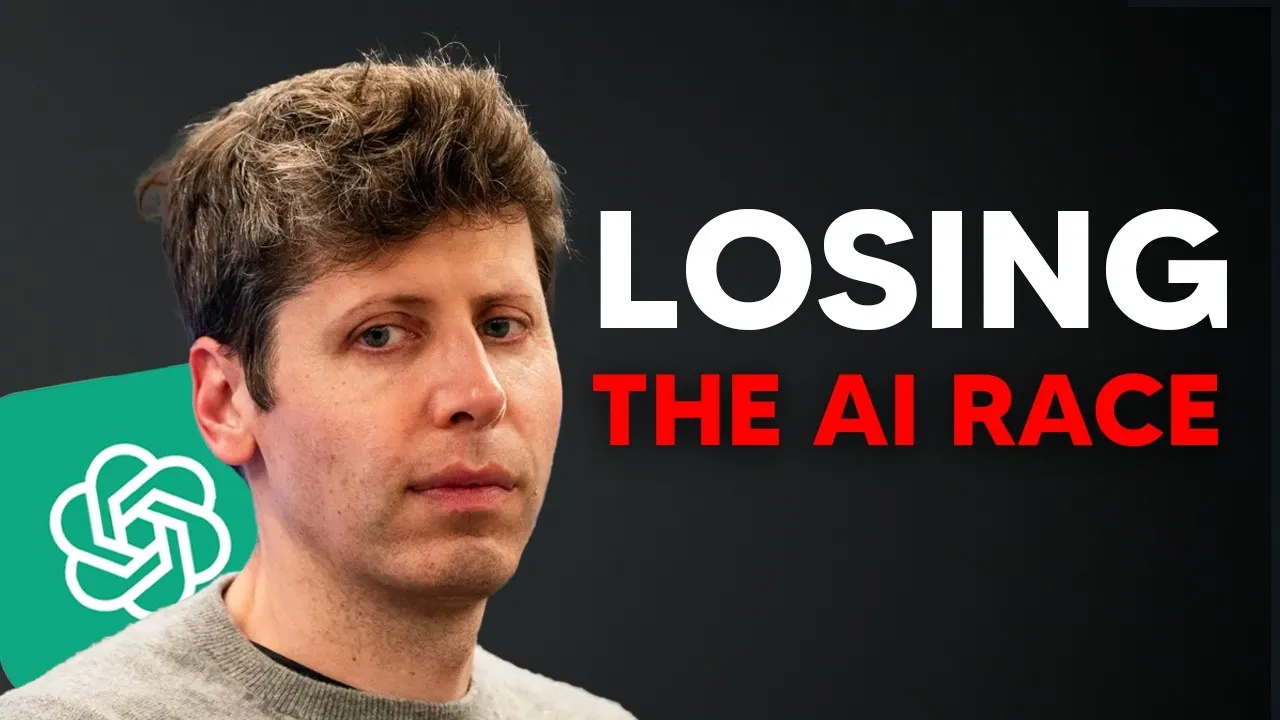
OpenAI, the company that sparked the current AI revolution with ChatGPT, is facing serious challenges. Once the undisputed leader, OpenAI is now scrambling to keep pace with competitors like Anthropic and Google. A leaked internal memo from CEO Sam Altman in late 2025, marked “code red,” revealed the company was in emergency mode, prioritizing the survival of ChatGPT over other projects like advertising tools and a personal assistant.
Just three years ago, OpenAI and ChatGPT were synonymous with AI. The tool didn’t just lead the market; it *was* the market. Now, the company that initiated this massive technological shift is watching its lead disappear. So, what happened to OpenAI, the company with the biggest head start, widespread recognition, and a valuation of half a trillion dollars?
Rivals Chart New Paths
The answer lies in how rivals like Anthropic and Google approached the AI landscape differently. Anthropic, creator of the Claude AI, focused on paying customers: developers and businesses. Google, on the other hand, made a bold bet on multimodal AI. This means creating AI that can understand and process not just text, but also images, audio, video, and code, all within a single system. While they were building these focused products, OpenAI was trying to be everything to everyone, a strategy that proved costly.
The core difference is stark: OpenAI built the best demo. Anthropic built the best product for work. Google built the best platform. This gap between a compelling demonstration, a useful product, and a foundational platform tells the whole story.
OpenAI’s Shrinking Market Share and Rising Costs
OpenAI’s market dominance is clearly waning. ChatGPT’s share of the app market dropped from 69% in January 2025 to 45% a year later. On the web, it fell from nearly 87% to about 65%, a significant 22-point decline in just 12 months. While OpenAI still boasts around 800 million weekly users, only about 5% of them are paying customers. Every free query costs the company money.
The financial strain is immense. OpenAI’s video generation tool, Sora, was estimated by Forbes to be burning roughly $15 million daily. The head of Sora himself called its economics “completely unsustainable.” The company is projected to lose $14 billion in 2026 alone. Cumulative losses through 2028 are expected to reach $44 billion, with no profits anticipated until 2029.
Talent Drain and Product Missteps
Adding to its woes, OpenAI is experiencing a talent exodus. In 2025, Meta recruited at least seven top researchers for its own AI lab. Key figures like the CTO, Chief Research Officer, and VP of Research departed. Sam Altman is now one of only two original founding members remaining. More senior staff left in early 2026, reportedly frustrated that OpenAI was sacrificing long-term research for a desperate push to make ChatGPT competitive again.
A former employee told The Irish Times that while OpenAI is still progressing, it’s in a tough race with Google and Anthropic, who have “stronger models.” This means OpenAI has less room to slow down. The company’s structural problem is trying to be a consumer app, an API provider, a video platform, a search engine, and a research lab all at once. It’s spread too thin and dominates nowhere.
The “Sam Altman Problem” and Reputation Damage
OpenAI’s reputation has also taken a hit, largely linked to CEO Sam Altman. In February 2026, Altman drew criticism after comparing the energy cost of training an AI model to raising a human child. Though he later clarified his remarks, the clip went viral out of context, leading to accusations that he was dismissive of AI’s environmental impact and dehumanizing childhood. This wasn’t the first time his public statements caused controversy.
Allegations from former OpenAI board member Helen Toner also surfaced, claiming Altman withheld information, failed to disclose his ownership of an OpenAI startup fund, and provided inaccurate safety process details. For a company seeking global trust with powerful technology, these headlines matter.
Recent product launches have also faltered. Altman himself admitted the GPT-5 launch was “totally screwed up.” Users described the model as colder and harsher, with some reporting negative impacts on social interactions. GPT-5.2 faced issues with writing quality, a flatter tone, worse translations, and inconsistent behavior. When a CEO calls two consecutive flagship launches failures, it’s a poor look, especially when competitors are releasing models that developers praise.
The Pentagon Deal Backlash
In late February 2026, OpenAI signed a contract to deploy its models on a classified Department of Defense network. The backlash was immediate, leading to a 295% spike in ChatGPT uninstalls in a single day and a surge in negative app store reviews. Over 2.5 million people joined a boycott campaign, and an estimated 1.5 million users canceled subscriptions.
Meanwhile, Anthropic, which had refused a similar deal, saw Claude climb to the top of the U.S. app store, possibly surpassing ChatGPT in paid subscribers for the first time. OpenAI’s head of robotics resigned over the Pentagon deal, citing concerns about surveillance and autonomous weapons. The New York Times summarized the public sentiment: OpenAI and the Pentagon asked for trust, and the public refused. OpenAI is losing not just market share and money, but also trust.
Anthropic’s Focused Growth
While OpenAI was dealing with crises, Anthropic pursued a focused strategy, concentrating on enterprise clients and coding. Their growth has been extraordinary. Anthropic’s annual revenue soared from $1 billion at the end of 2024 to $9 billion by the end of 2025, reaching nearly $20 billion by early March 2026 – a roughly tenfold increase year-over-year. No enterprise tech company has ever grown this fast at this scale.
Their “Claude” coding agent generated $2.5 billion in annual billings in about nine months. Business subscriptions quadrupled in the six weeks after January 1, 2026. Developers are building entire workflows around Claude, not just experimenting with it. On the SBench benchmark, which tests real GitHub issues, Claude Opus leads with about 81% accuracy, being the first model to surpass 80%.
Beyond benchmarks, developers favor Claude for its million-token context window, allowing it to process entire code repositories. This capability is crucial for complex enterprise engineering tasks. Anthropic’s relentless focus on enterprise and trust has led to widespread adoption, with eight of the top ten Fortune 100 companies now using Claude. Over 500 companies spend more than $1 million annually on Anthropic products, giving them an estimated 29% share of the AI assistant market for enterprises.
In February 2026, Anthropic secured a $30 billion Series G funding round at a $380 billion valuation. Analysis from Epoch AI suggests that if current growth rates continue, Anthropic could overtake OpenAI in total revenue by mid-2026, or by 2027 under more conservative projections. This trajectory is a major concern for OpenAI.
Google’s Multimodal Powerhouse
Google’s approach is different from Anthropic’s depth; it’s about breadth. Their vision is that the future of AI isn’t just a chatbot, but a system that can see, hear, read, watch, and understand everything simultaneously – multimodal AI. Google has aggressively pursued this, more than anyone else.
The launch of Gemini 3 Pro in late 2025 marked a turning point. Google called it their most capable multimodal model ever, and benchmarks supported this, setting new records in visual reasoning tasks. Gemini 3 Pro can process high-frame-rate video, understand spatial relationships, and crucially, convert long-form video into structured code. Imagine showing a three-hour video and having Gemini extract knowledge, generate summaries, and even build an application based on its content. No other company is achieving this level of capability.
In March 2026, Google released Gemini Embeddings 2, its first natively multimodal embedding model. This model maps text, images, video, audio, and documents into a single, unified space, allowing one model to understand all media types together. This is infrastructure-level AI that reshapes industries, even if it doesn’t always make headlines.
User numbers reflect Google’s success. Gemini grew from 350 million monthly active users in early 2025 to over 750 million by year’s end. Its app market share more than doubled from about 15% to 25%, and web traffic surpassed two billion monthly visits for the first time in January 2026.
A significant potential boost comes from an upcoming partnership to embed Gemini into Apple’s Siri. With 2.5 billion active Apple devices, even a small fraction of users would dwarf OpenAI’s or Anthropic’s reach through their own apps. Unlike OpenAI, Google can afford a long-term strategy. Alphabet generates over $400 billion annually, meaning AI doesn’t need to be profitable for Google right now; it just needs to keep users within its ecosystem.
Meanwhile, Google has quietly expanded its work with the Pentagon, signing deals for AI-powered content indexing and building the multimodal infrastructure essential for future AI applications. While OpenAI and Anthropic publicly debated defense contracts, Google advanced significantly under the radar.
Why This Matters: The Stakes for OpenAI and the Industry
OpenAI is planning an IPO, needing to justify its massive valuation by showing investors a path to $200 billion in annual revenue by 2030. This requires a fifteenfold increase from its current standing, all while its market share is falling, costs are soaring, and its two main competitors are growing faster.
If OpenAI falters, the consequences will ripple outwards. Microsoft, which has invested billions in OpenAI as its AI backbone, would need to change course. The startup ecosystem built on OpenAI’s API would face uncertainty. The narrative that a single startup can outperform trillion-dollar incumbents would be seriously challenged.
This situation echoes historical tech patterns. In the 1990s, Netscape built the browser and ignited the internet revolution, but Google ultimately owned the web. OpenAI ignited the AI revolution with chatbots. The question is whether it will be remembered as the company that changed everything or the one that got there first but couldn’t hold on.
OpenAI created the spark, but sparks don’t win races; engines do. Anthropic built an engine for the enterprise, focused, trusted, and growing at an unprecedented pace. Google built an engine for the platform, multimodal and everywhere, backed by the deepest pockets in tech. OpenAI, meanwhile, is still running on the spark, a spark that is costing it $14 billion a year. The AI race is not about who started first, but about who builds the right thing for the right customer. Right now, OpenAI appears to be the only one still figuring that out.
Source: Why OpenAI Is Losing The AI Race (YouTube)