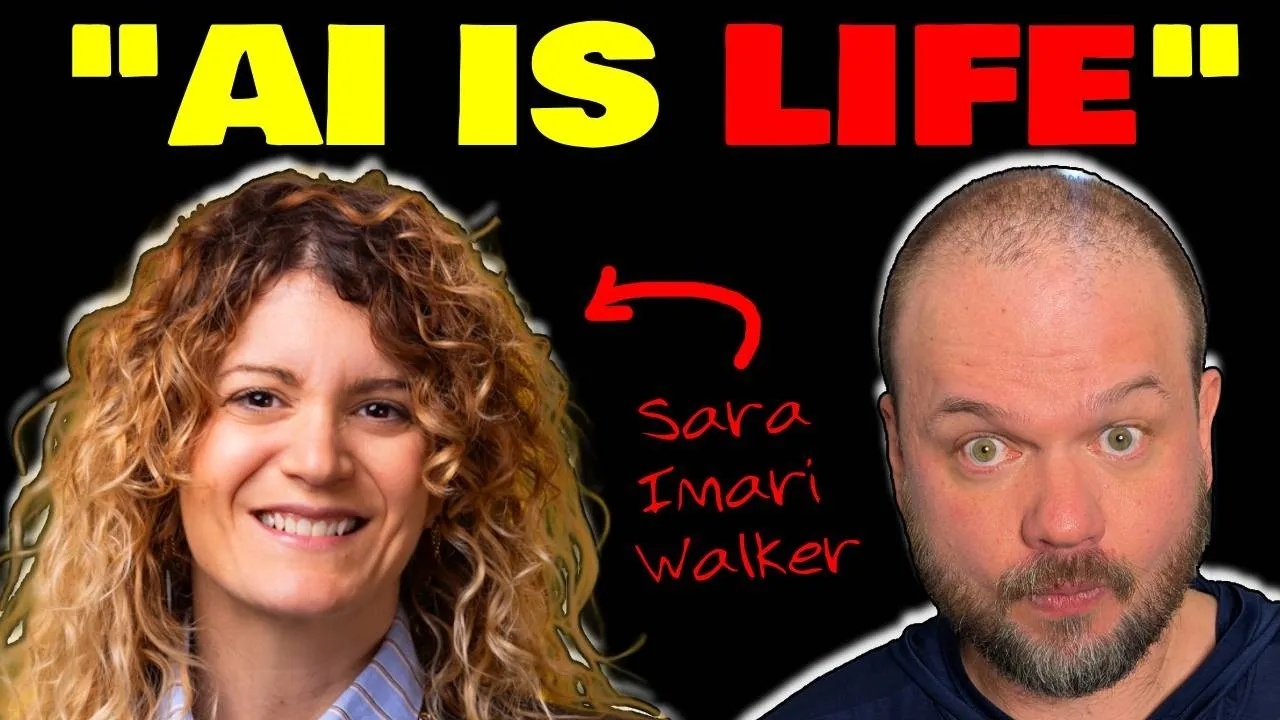
AI is Life? Physicist Reimagines Life’s Definition
Is artificial intelligence alive? This question, once confined to science fiction, is now at the forefront of scientific discussion, thanks to new ways of thinking about what life truly is. Theoretical physicist and astrobiologist Dr. Sara Imari Walker is challenging our traditional ideas. She suggests that AI might be a signature of life, not because it’s like us, but because it represents a complex creation that requires a long history to emerge.
Rethinking Life Beyond Biology
For decades, scientists have used definitions like the one from NASA: “Life is a self-sustaining chemical system capable of Darwinian evolution.” However, Dr. Walker argues this definition falls short, especially when considering possibilities beyond Earth or new technologies like AI. She points out that many living things, like humans in modern society, aren’t truly self-sustaining on their own. We rely on complex systems like grocery stores and infrastructure.
This leads to a deeper question: where do we draw the line? If individuals aren’t self-sustaining, is society the living entity? The challenge lies in defining the boundaries of a “self-sustaining” system. This complexity has led many biology textbooks to use a list of characteristics: self-replication, metabolism, and compartmentalization. But Dr. Walker believes these are Earth-centric views and might not apply to all life in the universe.
Assembly Theory: A New Metric for Life
Dr. Walker, along with Lee Cronin, has developed “Assembly Theory.” This approach seeks to identify life based on the complexity and history of an object, rather than just its chemical makeup or biological functions. It measures how much “construction history” or “causal possibility” is encoded within an object. Think of it like this: a simple rock can be made easily, but a complex machine requires many steps and a long process to build.
Assembly theory suggests that the non-living universe can only create so much complexity on its own. Truly complex structures, like those found in living systems or advanced technology, seem to require a process that involves memory, information processing, and evolution. AI, in this view, is a product of this long evolutionary lineage, incorporating billions of years of human history and development.
This theory offers a way to detect life even when we can’t see individual organisms. For example, when studying distant exoplanets, scientists can only analyze their atmospheres. If Assembly Theory can identify complex molecular patterns that indicate a long history of construction, it might be possible to detect the imprint of life, even without seeing a single alien cell.
AI and Simulations: Mimicry vs. Reality
Recent advancements, like simulating a fruit fly’s entire neural network or a whole cell, raise questions about whether these simulations are truly alive or understand their existence. Dr. Walker cautions against equating simulation with reality. She uses the analogy of a map: a very detailed map doesn’t become the territory itself.
She argues that the universe has created structures that are too complex to be simulated, even with its finite resources. Trying to perfectly replicate reality in a computer might not lead to deeper understanding. Instead, science often progresses by building simplified, more fundamental models that reveal deeper principles.
The idea that AI “thinks” it’s a fly, for instance, is a human interpretation. Dr. Walker emphasizes the difficulty in understanding the intrinsic perspective of any entity, whether it’s a simulated fly or even another human. We tend to model systems based on our own understanding and labels, rather than from the entity’s own experience.
The Universe as a Creativity Engine
Dr. Walker views the universe not as a static system governed by fixed laws, but as a self-constructing “creativity engine.” Life, in this perspective, is the mechanism through which the universe brings new things into existence. It explores possibilities and generates physical structures that can persist and evolve.
This contrasts with the traditional view of physics, which often assumes an observer outside the universe can describe it. Dr. Walker proposes that the universe is everything, and its fundamental process is self-creation. Technology, including AI, is a part of this ongoing process, reflecting humanity’s own drive to create novelty and explore possibilities.
While AI might not fit the old definition of life, it challenges us to consider broader possibilities. By looking at complexity, history, and the emergence of novel structures, scientists like Dr. Walker are opening new avenues for understanding life, both on Earth and potentially across the cosmos.
Source: Sara Imari Walker "AI is Life" | Simulations, the Universe and the Origins of Life (YouTube)